
Discover SAP Portfolio Management course modules, key topics and learning objectives, including project planning, budgeting, risk management and portfolio monitoring.
Selecting a course on SAP is not simply a matter of looking at the course duration or type of training program that is offered. There must be clear knowledge on what subject areas will be covered and the practical skills that can be developed. In the case of SAP Portfolio Management, it is crucial that the professionals be aware of how project investments and other financial considerations work.
A good SAP Portfolio Management Training Syllabus should discuss not only the fundamentals but also business-related subjects. It should provide insights into how businesses consider projects, manage portfolios and monitor business initiatives.
An SAP Portfolio Management training program must educate students about the methods and tools employed for managing projects in an organization. Instead of concentrating on how individual projects can be executed, the program must educate the students on how organizations make decisions to choose, prioritize, and monitor projects based on their strategic needs.
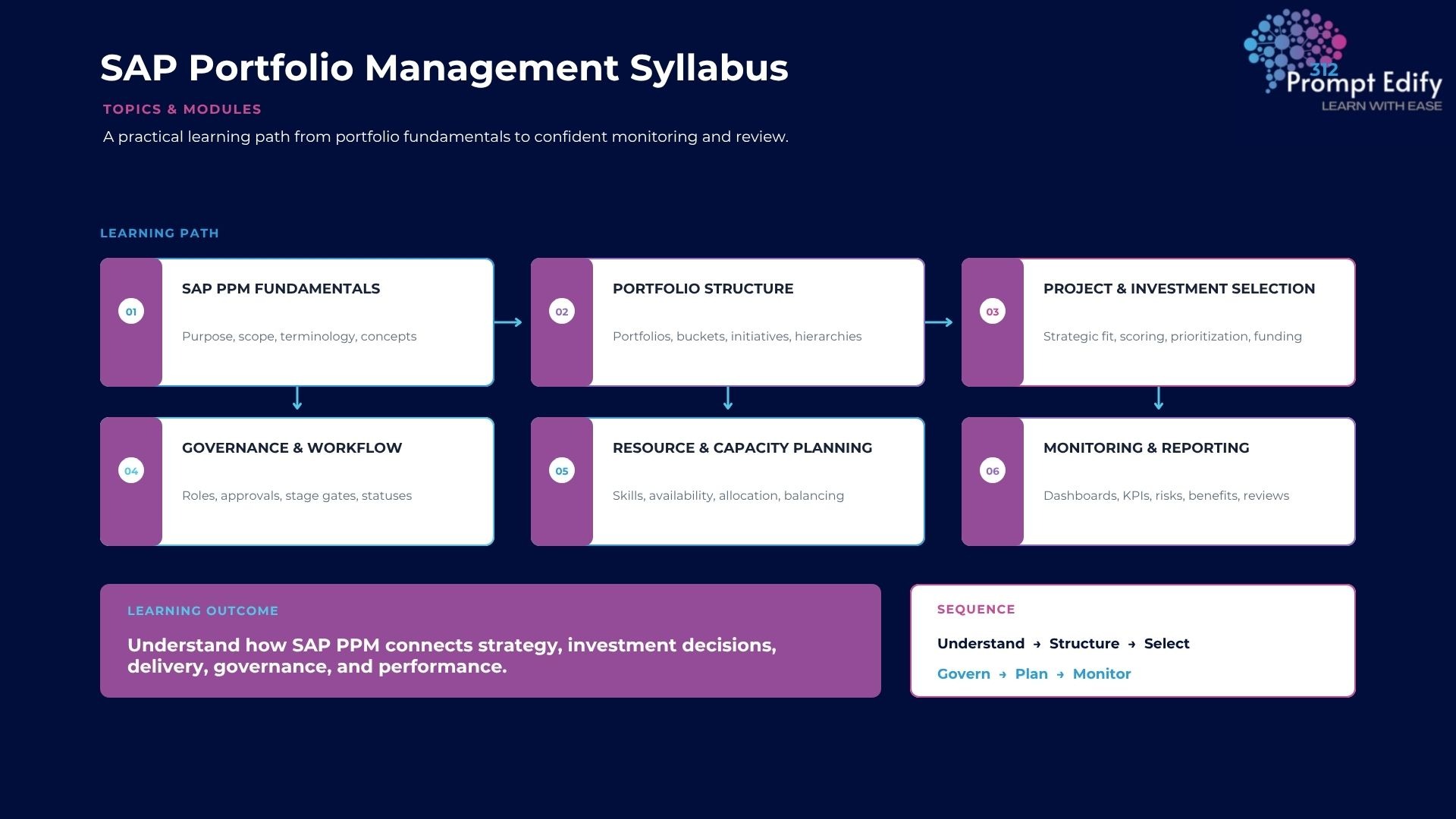
Some of the topics covered by an SAP Portfolio Management training program are portfolio planning, project evaluation, resource management, financial planning, risk analysis, and performance monitoring.
The first unit of the SAP PPM course must contain information about the fundamental concepts of portfolio management and the importance of portfolio management for an enterprise.
Students must study:
Such information will help newcomers comprehend how an organization deals with various initiatives and invests in them.
The Enterprise Portfolio and Project Management Training should provide information on how companies link their strategic plans to project implementation.
This section should cover portfolio structure, project links and project management processes. The learners should learn how each project helps the organization achieve its objectives and how management keeps track of various business operations.
This will serve as a base for learning enterprise project management systems.
Project prioritization is an important component of portfolio management because of limited resources in organizations.
There are some issues that should be considered by the syllabus with regards to the way companies evaluate their project proposals for investment.
These include:
Resource management is not easy in the case of multiple projects, especially when the same human resources, financial resources, and technical knowledge base is used.
The SAP Portfolio Management modules of this course should include resource planning and resource allocation concepts. The students must be informed about resource requirements, availability, capacity planning, and resource conflicts.
Examples might help in illustrating the concept of resource allocation in organizations.
Financial planning enables organizations to determine the financials and investments required by their projects.
Some topics that must be included in the SAP PPM training course include:
Every project undertaken by an organization faces some uncertainties which could possibly impact costs, schedule or the benefits expected from it.
It is important for learners to know about how organizations deal with identifying, evaluating and managing risks involved in a project. This training module will introduce learners to the concepts of risk management, mitigation strategies, project interdependencies, and changing business needs.
Portfolio monitoring enables managers to determine if the approved projects are performing as expected.
This section should address issues such as the monitoring of projects' progress, milestones, portfolio measures and management reporting.
Students must be made aware of how dashboards are used for this purpose.
For students who are keen to learn about consulting or implementing SAP, it is equally essential to understand the technical and functional configuration.
According to the SAP solution under study, the subject might include topics related to configuration of the system, portfolio, workflows, authorisations and integrations into the associated management processes.
The module needs to specify the SAP product version and the deployment environment since different features and methods of configuration apply to specific solutions.
It is important for learners to get beyond the course names and find out whether there are learning opportunities available.
Following criteria must be considered while evaluating the same:
A good programme is one in which there is both theoretical and practical learning.
The SAP Portfolio Management Training Syllabus will be of great benefit to learners to help them understand how organizations plan, assess, prioritize and track different projects. Each one of the listed topics plays an important role in helping learners get a full understanding of enterprise portfolio management from fundamental aspects of portfolio management, resource management, financial management and risk management to reporting.
At Prompt Edify, professionals can benefit from SAP training that aims at acquiring functional and practical knowledge on the subject. You can learn more about our SAP Portfolio Management Course Syllabus. You may also benefit from our SAP Project Management Training and SAP Portfolio Management Hands-On Training.
By Team Prompt Edify
Have any enquiry? Call us
+(27) 740294414
(+91) 99932-86938
wecare@promptedify.com


Prompt Edify Africa (PTY) Limited
2nd Floor, Rivonia VillageCnr Mutual Road and Rivonia Boulevard Rivonia Village, 2191
Johannesburg , South Africa
Contact : +27740294414
Prompt Edify East Africa Limited
KN 78 ST, Kagarama, Kigali, Kigali, Nyarugenge, Umujyi wa Kigali, Rwanda
Contact : +250 727 845 771
Prompt Edify Private Limited
4th Floor #15, City Vista Tower, Fountain Road,
Kharadi, Pune(MH), India.
PIN- 411014
Contact : (+91) 99932 86938



Contact Us Today!
+27740294414 | (+91) 99932 86938 | +250 727 845 771
contact@promptedify.com | wecare@promptedify.com
🌐 https://promptedify.co.za/