
Learn how SAP Production Planning and Control connects engineering data, material requirements, production orders, and scheduling to streamline manufacturing operations.
The manufacturing industry has to consider all aspects related to proper planning, resource management, and efficient production process in order to meet customers' needs. SAP Production Planning & Control helps organizations perform these activities by combining all production requirements, engineering data, materials and production processes in one single platform.
By using SAP S/4HANA Production Planning, manufacturing companies can organize their production activities, plan their material needs and production orders. It is very important to have knowledge about the processes and master data of the system in order to organize production planning and control.
SAP Production Planning and Control (PP) is one of the crucial aspects of SAP that helps in production planning and control of the manufacturers. The PP module contains different modules like demand management, material requirements planning (MRP), capacity planning and production.
The primary objective of the SAP Production planning and control system is to ensure that all the materials, resources and production capacities are available for the process.
The important features of SAP production planning include:
The above functions help the companies to improve the process of manufacturing.
SAP PP has a sequential process which starts from the production requirements and ends with production execution.
It all begins with determining the need of what needs to be produced and the date on which that need is to be met. The requirement may be generated through sales orders, demand forecasts, or even independent requirements.
It is Demand Management which translates those requirements into quantities and dates to plan. Those requirements are the basis of the SAP MRP process.
The Material Requirements Planning (MRP) calculates the material requirements, in terms of quantities, and availability date.
SAP MRP takes into account issues including:
From the above mentioned information, MRP develops procurement recommendations, which include planned orders for internal manufacture and purchase requisitions for external procurement.
This will help to eliminate material shortages and unnecessary buildup of inventories by the manufacturing companies.
Planned orders consist of suggested manufacturing operations developed from MRP or developed manually.
This contains the material details, quantity, and dates on which it should be produced. Nonetheless, these planned orders are not released yet for execution on the shop floor.
In the planning process, the company analyzes the available capacity, work center, and operation timing. The schedule will determine if the production process can be done on time.
After finalizing the plan, then it becomes possible to release the planned order into a production order.
Production orders in SAP are key documents that control the manufacturing process.
The production order includes important data such as:
The production order lifecycle, in general terms, includes creation, scheduling, availability check, release, production, confirmation, receipt of goods, and order settlement.
As a part of the production process, operation confirmations and material consumption are recorded in the production process. The receipt of goods takes place after the completion of the production process.
It facilitates visibility through the entire production process.
Master data acts as the foundation of production planning. Any mistake in the master data may lead to MRP calculation errors.
Master data includes:
1. Material Master: It includes details about the raw materials, semi-finished goods, and finished goods.
2. Bill of Materials (BOM): Specifies the components along with the number of them that must be used to manufacture the product. BOM data is used by MRP to determine dependent requirements of materials.
3. Routing: Provides information about manufacturing operations that are necessary to make a material including their description and process times.
4. Work Centers: Symbolize production capacities, such as machines, production lines or personnel. They provide information about capacities and schedules.
5. Production Version: Links together a certain BOM and a routing specifying the way the material should be produced.
In combination, the above mentioned master data allows SAP to create material requirements, schedules operations and create production orders.
The production engineering data and production planning and control play different yet interrelated roles.
While production engineering revolves around the determination of how products would be produced, production planning and control involves using the engineering data to plan what needs to be produced, when to produce it and what resources/materials are required.
For instance, the engineering process will specify the component parts and production sequence for a product. In SAP PP, the approved BOM and routings are used to generate material requirements, production timing and production order.
In SAP S/4HANA Production Planning, the inclusion of engineering data into the planning process allows for keeping engineering specification consistent with production processes.
This ensures that engineering specification does not conflict with the production process.
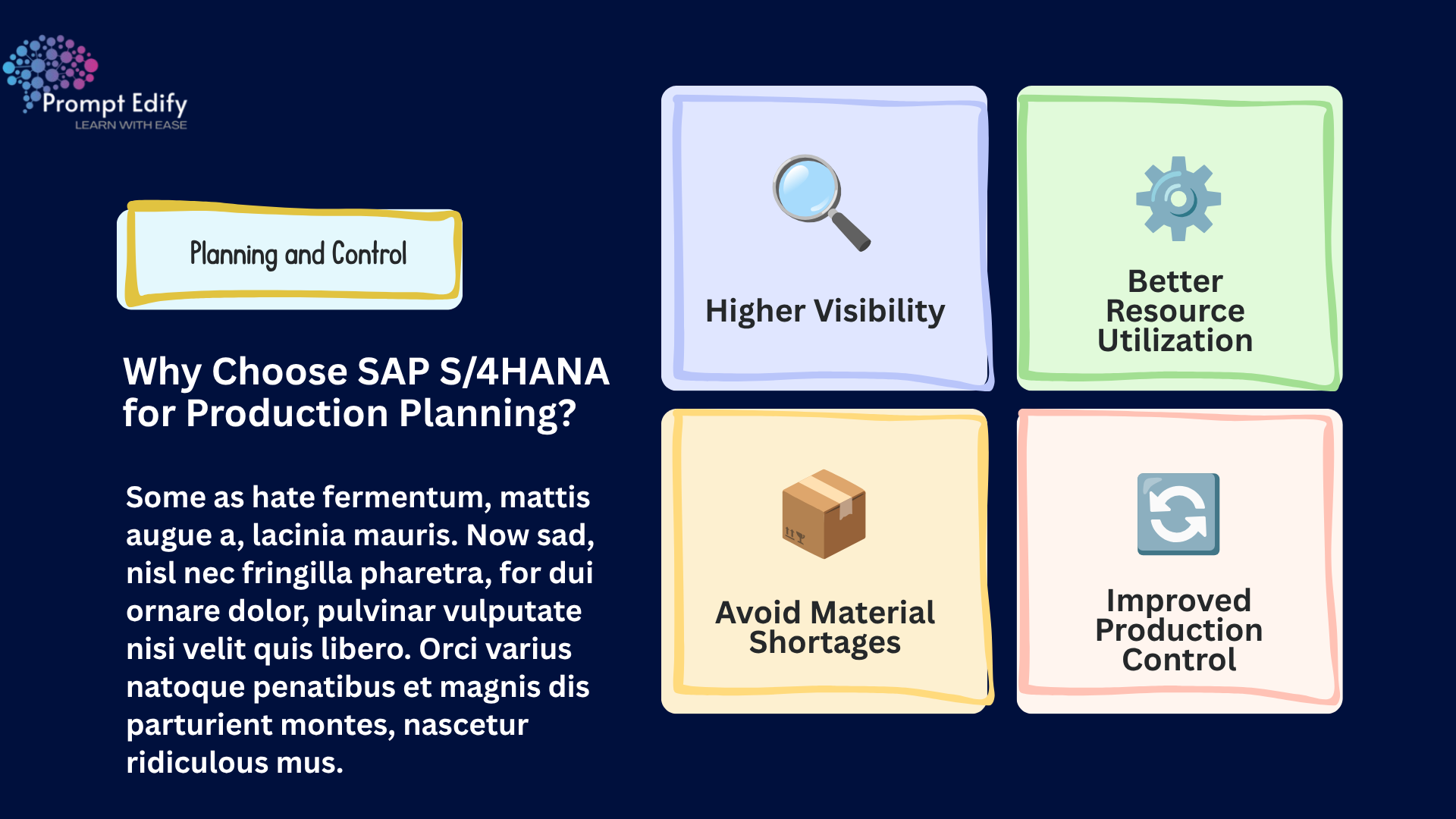
Advantages of using SAP Production Planning are:
Production Planning and Control (SAP) is an integrated process involving demand management, master data, MRP, production scheduling and production execution. By effectively managing engineering data and integrating it with the production planning process, manufacturing companies can manage their material availability and resource utilization.
Need to implement or enhance SAP manufacturing process? Feel free to contact us at Prompt Edify for further information regarding SAP solutions for production planning and control process.
By Team Prompt Edify
Have any enquiry? Call us
+(27) 740294414
(+91) 99932-86938
wecare@promptedify.com


Prompt Edify Africa (PTY) Limited
2nd Floor, Rivonia VillageCnr Mutual Road and Rivonia Boulevard Rivonia Village, 2191
Johannesburg , South Africa
Contact : +27740294414
Prompt Edify East Africa Limited
KN 78 ST, Kagarama, Kigali, Kigali, Nyarugenge, Umujyi wa Kigali, Rwanda
Contact : +250 727 845 771
Prompt Edify Private Limited
4th Floor #15, City Vista Tower, Fountain Road,
Kharadi, Pune(MH), India.
PIN- 411014
Contact : (+91) 99932 86938



Contact Us Today!
+27740294414 | (+91) 99932 86938 | +250 727 845 771
contact@promptedify.com | wecare@promptedify.com
🌐 https://promptedify.co.za/