
Discover SAP PS course topics covering WBS, networks, activity planning, project scheduling, budgeting and cost control, with practical exercises and outcomes.

Project management goes beyond task scheduling and deadline setting. Businesses need to learn how to create project structures, how to schedule project activities, how to control costs and how to allocate resources throughout the project life cycle. This is where SAP Project System (PS) can help enterprises carry out all these operations on a single enterprise platform.
For those who would like to learn more about SAP PS, the first step to take is to review the SAP PS course syllabus. This course syllabus should include project structuring, Work Breakdown Structure (WBS), networks, project planning, budgeting and cost management among others.
The SAP Project System syllabus must cover the fundamentals of how organizations plan and control their projects through SAP. The training must not only cover various transactions but must also explain the linkages between various project processes and business processes.
While analyzing the SAP PS syllabus for training, a learner must find out whether the course syllabus covers:
The syllabus must also include the application of the above concepts in investment, construction, engineering, and manufacturing projects.
WBS is one of the key subjects in SAP Project System. It is used to subdivide complex projects into more manageable components.
In a good SAP WBS training course, participants will learn how to develop a project structure hierarchy and how to determine individual WBS components depending on project requirements.
Participants should be able to:
For instance, in a construction project there may be separate WBS components for foundation works, structural construction, electric works and finishing. Practical exercises should assist participants in developing such structures using SAP.
Networks and activities play a significant role in determining the order of tasks performed during a project. Where WBS determines the hierarchical order, networks determine the order of tasks performed in the project and their connections.
The SAP PS course outline should contain information on how networks are formed and how each activity is managed.
Key areas of study may include the creation of activities, relations among activities, milestones, task dependencies and scheduling. Students should also be familiar with how activities may include internal and external sources.
An ideal practical assignment could be to develop a network for a project involving the installation of equipment.
Project planning aids in making a practical timeline for projects. This part of SAP PS training curriculum must cover how to plan project dates, milestones, activity durations, and scheduling needs.
The learner will learn how a project is scheduled, how dependencies affect the timeline and how planned dates can be compared to actual progress made.
Hands-on learning will include making a project schedule, managing activity dates, and analyzing the results of scheduling.
Another key aspect to consider when choosing SAP Project System Training is financial planning.
Every project entails costs associated with labour, material, machinery and services from outside sources.
These costs need to be estimated and managed effectively by any organisation.
The following key aspects need to be covered:
Students need to get acquainted with the importance of cost information for business decision making and ways to avoid budget overrunning. Practical exercises related to the difference between planned and actual expenditures will also contribute to understanding this topic.
Further knowledge about project cost management in SAP can be acquired in order to learn about financial planning and project controlling.
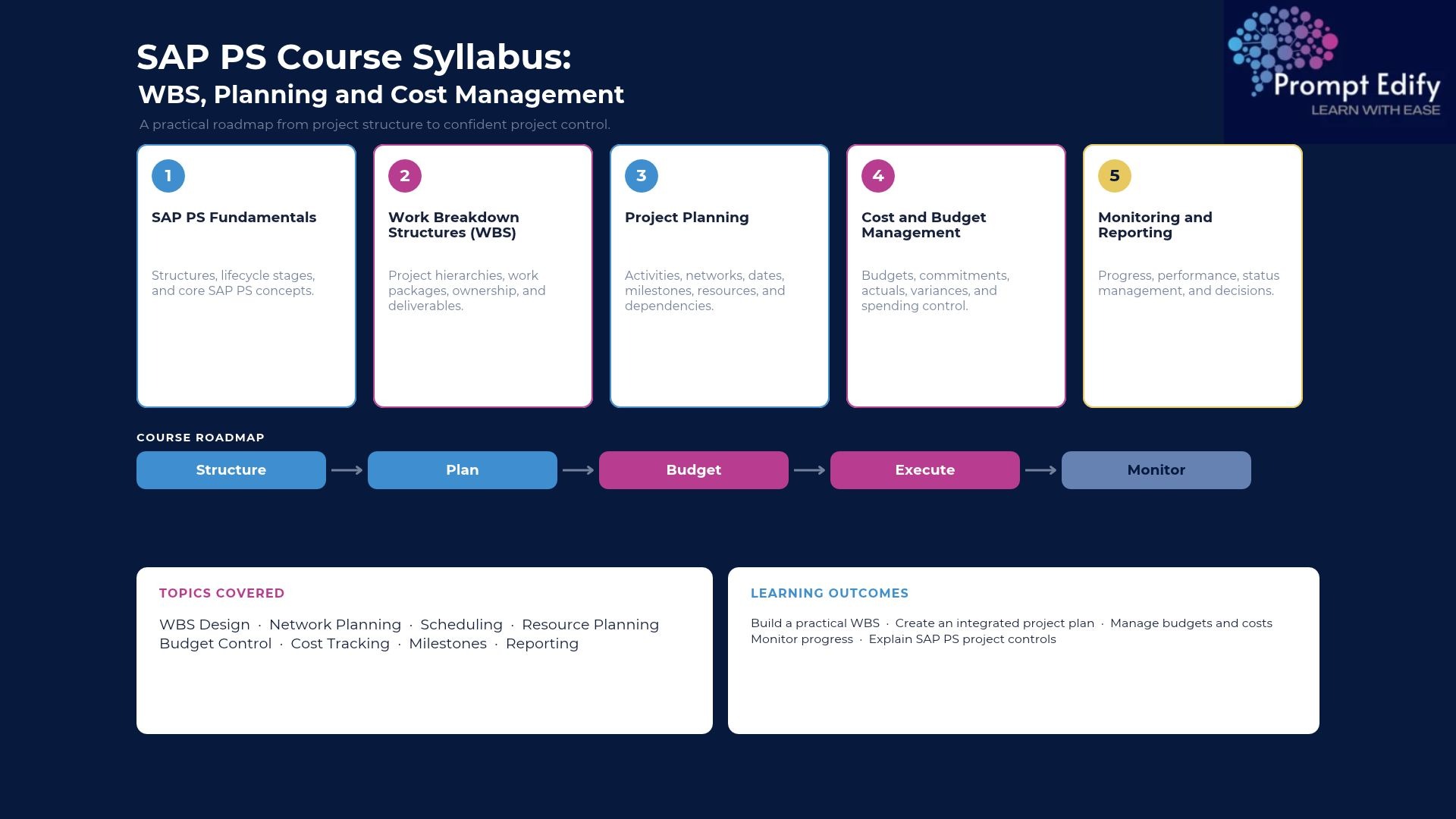
A good SAP PS training program must have both theoretical and practical system components. Prior to joining the training program, one should look into whether the training program has any practical exercises relating to project creation, WBS generation, networking, activity and cost planning.
After completing practical exercises, learners will be able to:
It may be worthwhile to look into the experience of the trainer as well as availability of practice systems and learning materials.
Selection of a proper SAP PS syllabus could assist you to learn well about the process of enterprise project planning and controlling. Prior to choosing any program, make sure that you examine the subjects being taught under the program and other learning outcomes.
Prompt Edify offers industry-oriented SAP training programs aimed at facilitating learners to acquire useful functional knowledge.
Check out the SAP Project System syllabus offered by Prompt Edify for a detailed list of training subjects and learning prospects.
Contact Prompt Edify now and get one step closer to learning SAP Project System.
By Team Prompt Edify
Have any enquiry? Call us
+(27) 740294414
(+91) 99932-86938
wecare@promptedify.com


Prompt Edify Africa (PTY) Limited
2nd Floor, Rivonia VillageCnr Mutual Road and Rivonia Boulevard Rivonia Village, 2191
Johannesburg , South Africa
Contact : +27740294414
Prompt Edify East Africa Limited
KN 78 ST, Kagarama, Kigali, Kigali, Nyarugenge, Umujyi wa Kigali, Rwanda
Contact : +250 727 845 771
Prompt Edify Private Limited
4th Floor #15, City Vista Tower, Fountain Road,
Kharadi, Pune(MH), India.
PIN- 411014
Contact : (+91) 99932 86938



Contact Us Today!
+27740294414 | (+91) 99932 86938 | +250 727 845 771
contact@promptedify.com | wecare@promptedify.com
🌐 https://promptedify.co.za/