
Explore the SAP S/4HANA Finance syllabus, covering SAP FI, SAP CO, SAP FICO, financial accounting, controlling, reporting and integration for aspiring professionals.

To understand how financial management works in today’s organizations, one needs to learn about integrated ERP solutions and digital finance systems.
SAP S/4HANA Finance is a system that organizations can use for the management of their financial reports, accounting and controlling, and business operations.
For those wishing to pursue a career in SAP Finance, it is important to learn the syllabus of the SAP S/4HANA Finance course as a starting point.
This syllabus contains information about the main financial principles, configuration methods, and reporting possibilities of SAP Finance.
Whether you are interested in SAP FICO, SAP FI, or SAP CO modules, knowing these systems will help you create a solid basis for mastering SAP financial management.
The SAP S/4HANA Finance module represents the financial management part of SAP S/4HANA, which is used for real-time processing, reporting, controlling and accounting of finances. The module is based on the SAP HANA system and a unified data model, which simplifies access to financial information.
SAP S/4HAN Finance module includes the most important finance processes, such as general ledger accounting, accounts receivable, accounts payable, asset accounting and management accounting.
For learners, the SAP S/4HANA Finance module offers the possibility to learn how financial operations get recorded, monitored and analyzed in business processes.
A structured SAP S/4HANA Finance training programme introduces learners to the core concepts of financial accounting and management accounting. The following modules outline the important topics generally covered in an SAP Finance learning programme.
General Ledger Accounting is a core component of SAP FI. It helps organisations maintain financial records and manage accounting transactions.
Topics include:
This module explains how organisations manage financial transactions related to suppliers.
Accounts Receivable focuses on customer-related accounting and payment processes.
Asset Accounting supports managing an organisation's fixed assets throughout their lifecycle.
This module introduces the financial processes used to manage organisational banking activities.
SAP CO supports internal cost monitoring, planning and profitability analysis. It helps organisations understand operational costs and financial performance.
Key topics include:
Financial reporting helps organisations evaluate financial performance and support business decisions.
SAP S/4HANA Finance works with other business functions to maintain consistent financial information across the organisation.
These terms are closely related but represent different areas of SAP financial management.
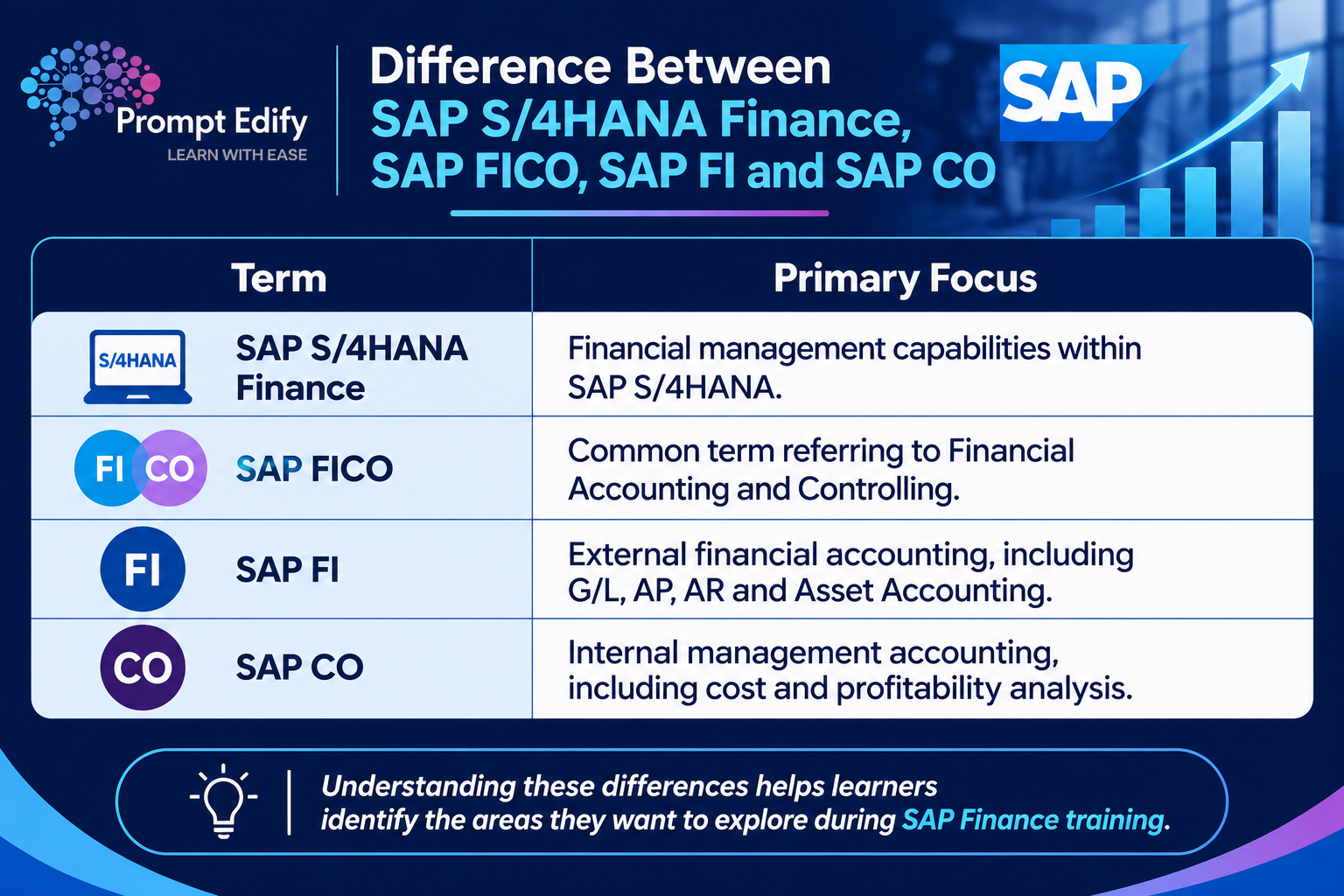
SAP S/4HANA Finance will be helpful to those who want to become familiar with the corporate finance system.
The course may be suitable for:
Knowledge of accounting and finance is advantageous, though it is possible for beginners to join with the help of basic knowledge.
The service provided by Prompt Edify consists of SAP training and consulting services aimed at helping individuals and companies grasp SAP solutions and business processes within the enterprise.
The SAP S/4HANA Finance course offers knowledge on key issues in financial accounting, controlling, reporting, and integration. With the help of qualified SAP instructors, students can study topics related to SAP FI and SAP CO through a designed course outline.
Starting from a zero level in the field of SAP or having some knowledge in finance, knowing the SAP S/4HANA Finance programme helps determine the next class to be taken.
By Team Prompt Edify
Have any enquiry? Call us
+(27) 740294414
(+91) 99932-86938
wecare@promptedify.com


Prompt Edify Africa (PTY) Limited
2nd Floor, Rivonia VillageCnr Mutual Road and Rivonia Boulevard Rivonia Village, 2191
Johannesburg , South Africa
Contact : +27740294414
Prompt Edify East Africa Limited
KN 78 ST, Kagarama, Kigali, Kigali, Nyarugenge, Umujyi wa Kigali, Rwanda
Contact : +250 727 845 771
Prompt Edify Private Limited
4th Floor #15, City Vista Tower, Fountain Road,
Kharadi, Pune(MH), India.
PIN- 411014
Contact : (+91) 99932 86938



Contact Us Today!
+27740294414 | (+91) 99932 86938 | +250 727 845 771
contact@promptedify.com | wecare@promptedify.com
🌐 https://promptedify.co.za/