
Explore how SAP Service Cloud streamlines customer support with AI, case management and automation to boost agent productivity and improve customer experiences.
It has become very necessary for companies to offer good customer service in the current competitive market environment in order to develop customer trust and maintain long term relationships. For managing customer inquiries, complaints and providing personalized services to customers through various channels, companies require an effective tool. In this case, SAP Service Cloud becomes an essential part.
What is SAP Service Cloud? SAP Service Cloud is a CRM cloud based software solution offered by SAP that assists in managing customer service operations and improving customer experience. It helps service teams to handle customer inquiries, service requests and resolve their problems effectively.
The use of AI, automation and customer data make the task easier for the service representatives through SAP Service Cloud.
Some of the features of SAP Service Cloud that assist the company in enhancing its customer service operations are as follows:
The process that is entailed in SAP Service Cloud involves the integration of customer engagement, service request, and support in one platform.
Below is the general description of the process of customer service:
This kind of process makes it easier for organizations to manage their customer interactions and support services.
The adoption of SAP Service Cloud can bring many benefits to companies willing to enhance their customer service processes.
Below are five main benefits that SAP Service Cloud can offer:
The above-stated SAP Service Cloud benefits allow for building better customer relationships.
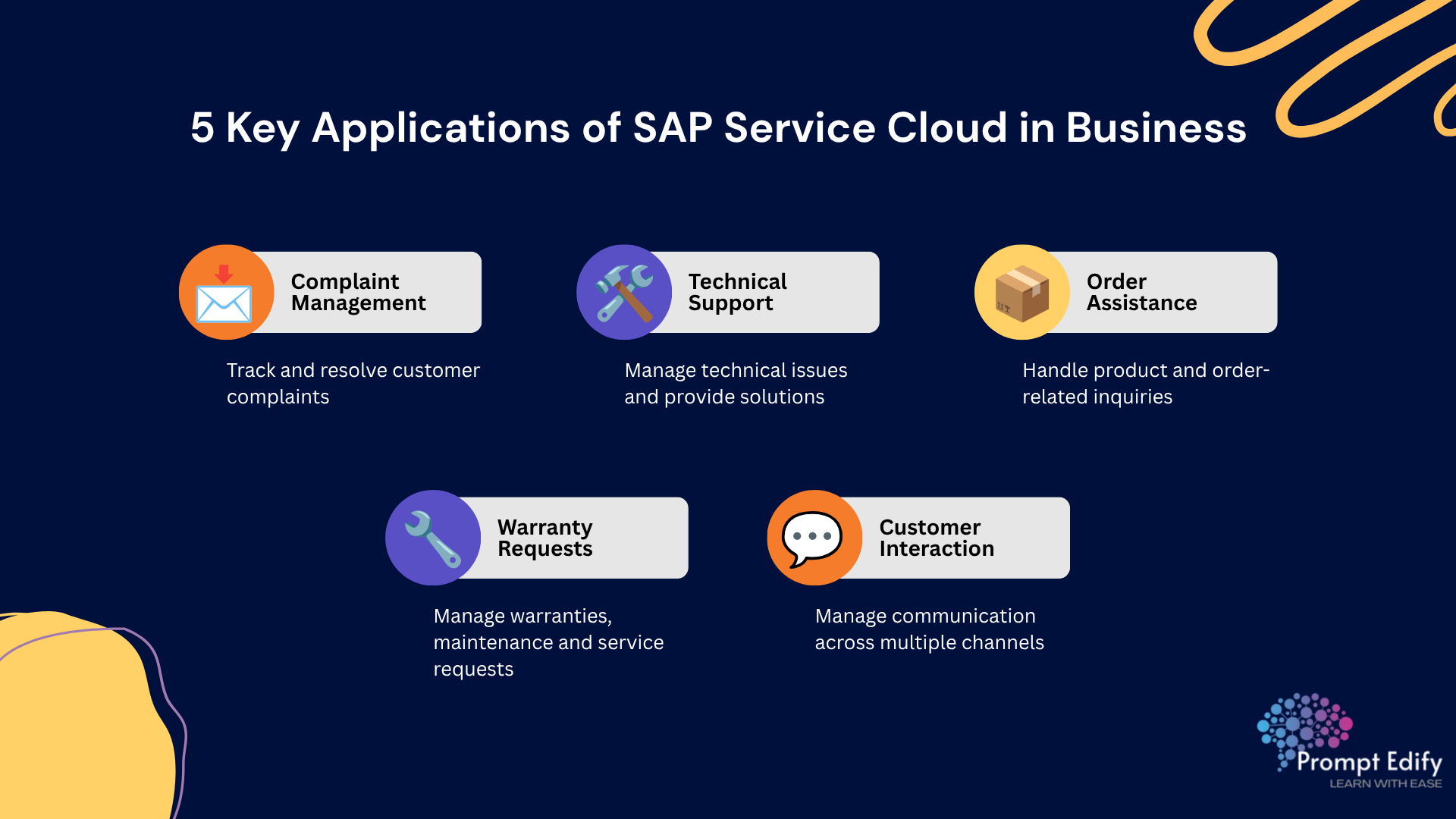
SAP Service Cloud can cater to customer service needs of various industries. The organizations can adopt the solution for several different uses.
The typical use cases of SAP Service Cloud include the following:
For example, the manufacturing firm can use SAP Service Cloud to manage customer complaints about its products, manage service requests and coordinate with different departments for resolving the problems of the customers.
On the other hand, the utility firms can make use of this solution to manage customer inquiries and service requests.
SAP Service Cloud plays a crucial role in the SAP Customer Experience (SAP CX) product line. SAP CX is all about managing customer relations at various stages of their journey.
The main purpose of SAP Service Cloud is customer service and support, whereas other SAP CX solutions are useful for conducting other business operations.
Some of the SAP CX solutions that are similar to SAP Service Cloud include:
With the integration of these solutions, organizations will be able to build a more connected customer experience. Sales teams will get the required customer information and service teams will have information of prior interactions and can serve customers better.
SAP Service Cloud can also be integrated with SAP S/4HANA and other enterprise systems.
The traditional CRM software is designed in a way that can help in managing the customer information, sales activity, and customer relations. This software is capable of helping the organizations in storing the customer information, monitoring their activities, and communicating with the customers. However, the traditional CRM system might require further tools to perform the more advanced customer service activities.
On the other hand, the SAP Service Cloud is capable of performing advanced customer service activities by supporting the business in managing customer inquiry, customer service request, and customer service cases. The features that it offers include omni-channel communications, AI automation, case management, knowledge management, and service analytics.
Therefore, while the traditional CRM software is mainly about customer relation management, the SAP Service Cloud is more about providing an automated, connected, and streamlined customer service experience.
SAP Service Cloud may be used to perform customer service in different sectors.
They include:
SAP Service Cloud enables business organizations to increase their efficiency in the customer service department by integrating automation, AI, case management, and omni-channel communication.
The information related to how SAP Service Cloud works and where it is actually used can prove quite useful for people who are in search of job prospects in SAP CRM.
SAP Service Cloud training can be a good choice for someone who wants to learn about SAP applications and make a name in the SAP field.
Looking to train in SAP Service Cloud and carve out a career in SAP? Contact Prompt Edify now!
By Team Prompt Edify
Have any enquiry? Call us
+(27) 740294414
(+91) 99932-86938
wecare@promptedify.com


Prompt Edify Africa (PTY) Limited
2nd Floor, Rivonia VillageCnr Mutual Road and Rivonia Boulevard Rivonia Village, 2191
Johannesburg , South Africa
Contact : +27740294414
Prompt Edify East Africa Limited
KN 78 ST, Kagarama, Kigali, Kigali, Nyarugenge, Umujyi wa Kigali, Rwanda
Contact : +250 727 845 771
Prompt Edify Private Limited
4th Floor #15, City Vista Tower, Fountain Road,
Kharadi, Pune(MH), India.
PIN- 411014
Contact : (+91) 99932 86938



Contact Us Today!
+27740294414 | (+91) 99932 86938 | +250 727 845 771
contact@promptedify.com | wecare@promptedify.com
🌐 https://promptedify.co.za/