
Understand SAP Service Cloud implementation, including setup, configuration, testing, integrations and best practices for a reliable service launch in practice.
A good customer service solution needs proper planning and implementation in order to run business operations smoothly. Businesses must have a good platform for managing customer interactions and service-related tasks. With the help of SAP Service Cloud implementation, businesses can automate their customer service operations and improve efficiency of their service teams.
SAP Service Cloud includes many features such as case management, customer information management, communication options and service automation among others. Nevertheless, there are some steps that businesses must consider in implementing their SAP Service Cloud systems properly.
In this article, we will go through the SAP Service Cloud implementation process which involves configuration, testing, integration and some other important considerations.
The term SAP Service Cloud implementation is used to describe the process whereby SAP Service Cloud software is deployed and configured based on the customer service needs of the organization. This process includes preparation of the system, configuring the users, service workflow definition and system validation.
This process enables organizations to set up a customer service environment whereby employees can handle customer inquiries, follow up and solve problems from a central platform.
A good implementation will ensure that customer data is available to relevant employees and that services are linked with business processes.
However, there are still some steps which should be taken into account when it comes to the SAP Service Cloud implementation.
The main actions to be taken when implementing SAP Service Cloud are:
This will allow organizing the implementation process.
SAP Service Cloud configuration involves modification in the system settings and functionalities depending upon the requirement of the business. Proper configuration will help to make effective use of the platform by the employees in managing their customer service activities.
Some of the important configurations are:
For SAP Service Cloud 2 some of the additional configurations are:
The test execution is one of the major parts of the implementation phase because the purpose is to find out configuration problems, integration problems and workflow problems before go-live.
The following types of testing must be conducted in order to check whether the system functions as it is expected to do.
They are:
Integration of SAP Service Cloud means the integration of customer service systems with other SAP solutions and third-party applications. Through integration, organizations get the capability to share information between different systems and maintain customer data consistency.
Below are few integration scenarios:
In the case of SAP Service Cloud Version 2, communication systems and configurations support the establishment of connection with external applications. Configurations of communication help in configuring inbound and outbound communications along with data mapping and integration scenarios.
Replication of data between SAP Service Cloud and SAP S/4HANA is also supported with SAP Cloud Integration.
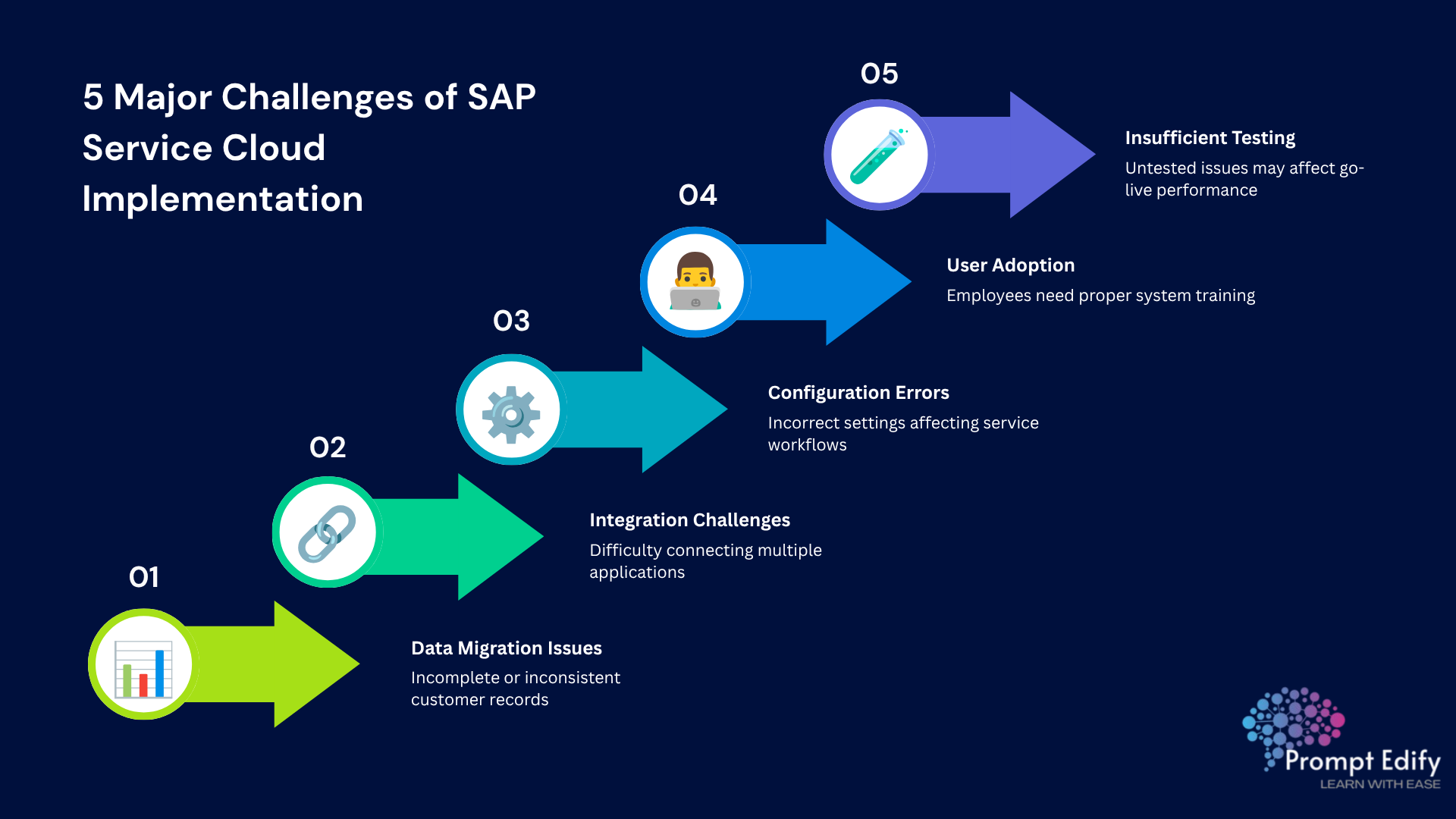
Despite the fact that implementation is a process with lots of benefits for the business, there are some challenges that the company may face when implementing.
Challenges to consider are:
Such challenges can be addressed properly with appropriate planning and training.
SAP Service Cloud consulting training allows gaining knowledge about the way the product is being implemented from both technical and functional perspectives including system configuration, service processes, integration, and testing.
During the process of SAP Service Cloud consulting training, students will have an opportunity to learn about the following topics:
Practical training can allow understanding implementation practices in SAP customer experience projects.
The process of implementing SAP Service Cloud is associated with many crucial activities, such as requirement analysis, system configuration, data migration, testing, and integration. The above mentioned stages have a significant impact on the success of implementing the desired solution.
Learning how to set up SAP Service Cloud and obtaining necessary configuration and integration skills can help one to be prepared for implementing the software solution.
If you are planning to implement SAP Customer Experience and get practical skills in the implementation process, the SAP Service Cloud can become the first step towards successful career development.
Are you interested in obtaining practical SAP Service Cloud implementation skills? Reach us at Prompt Edify today and start learning SAP training.
By Team Prompt Edify
Have any enquiry? Call us
+(27) 740294414
(+91) 99932-86938
wecare@promptedify.com


Prompt Edify Africa (PTY) Limited
2nd Floor, Rivonia VillageCnr Mutual Road and Rivonia Boulevard Rivonia Village, 2191
Johannesburg , South Africa
Contact : +27740294414
Prompt Edify East Africa Limited
KN 78 ST, Kagarama, Kigali, Kigali, Nyarugenge, Umujyi wa Kigali, Rwanda
Contact : +250 727 845 771
Prompt Edify Private Limited
4th Floor #15, City Vista Tower, Fountain Road,
Kharadi, Pune(MH), India.
PIN- 411014
Contact : (+91) 99932 86938



Contact Us Today!
+27740294414 | (+91) 99932 86938 | +250 727 845 771
contact@promptedify.com | wecare@promptedify.com
🌐 https://promptedify.co.za/