
Learn how SAP Service Contract Management connects service agreements, service orders, coverage, pricing, and SAP Service Billing in one practical workflow.

It may be difficult to manage service agreements, service commitment, and billing activities when organizations have several service contracts. It requires an organization to adopt a systematic way of tracking the validity of the service contract, coverage of services, service request management, and billing.
Here is where SAP Service Contract Management and SAP Service Billing come into play. Both solutions help businesses link the service agreement with service fulfillment and billing.
In SAP S/4HANA, service contracts provide the commercial base for customer services, while service orders facilitate the delivery of such services. Finally, the billing process transforms valid service transactions to customer invoices.
In this blog post, we are going to discuss SAP service contracts, service contract lifecycle, service billing principles, and how both processes are linked to each other via an example.
SAP Service Contract Management is a capability within a business which helps organizations in creating and managing their service agreements with the customers.
Service agreements are the agreements which specify conditions such as duration of service contract, scope of service, pricing and billing.
Using the SAP S/4HANA service contracts, organizations will be able to monitor customer commitments throughout the process as well as understand their commitment in terms of agreements.
Capabilities of SAP S/4HANA service contracts are:
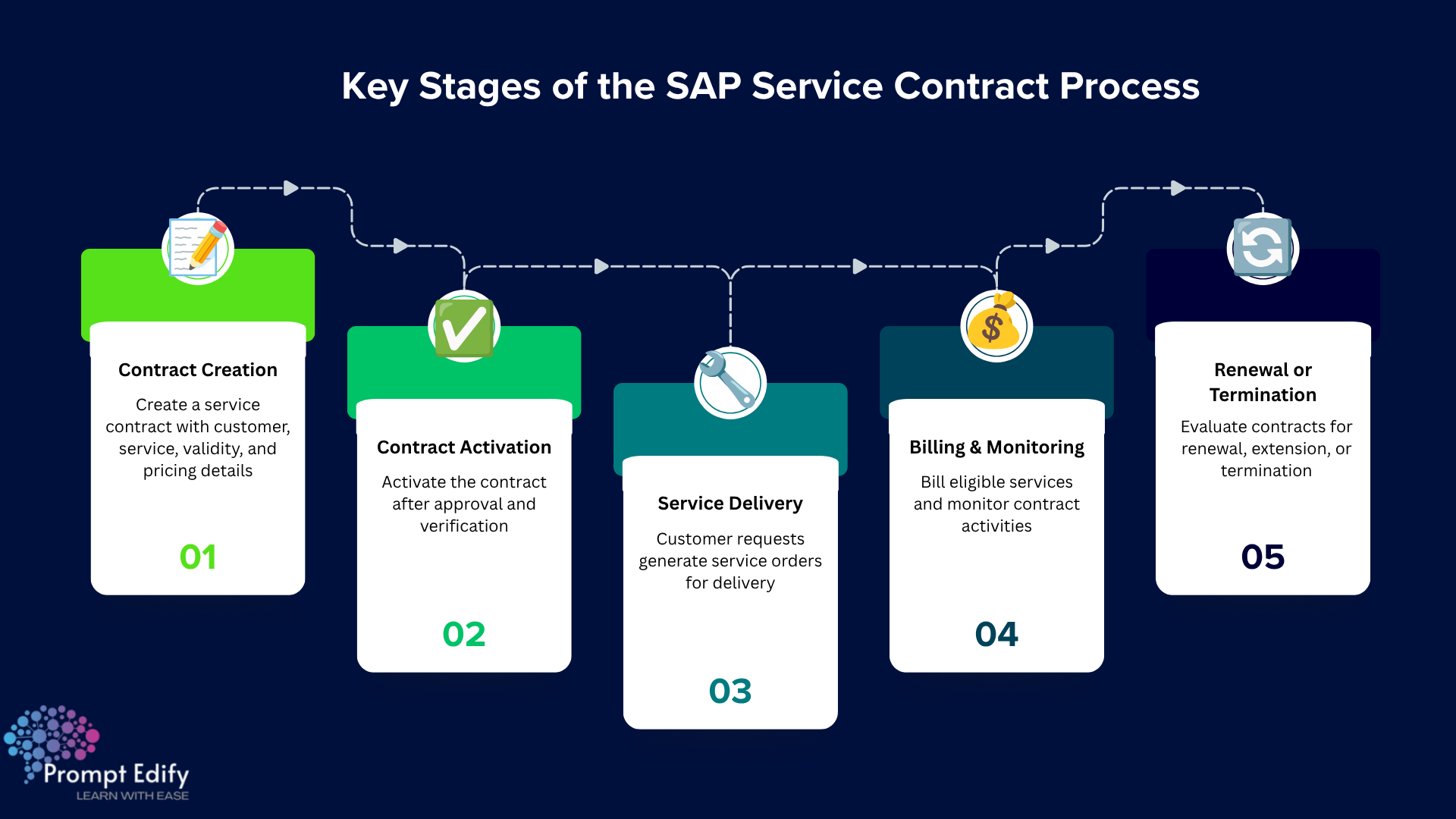
SAP contract for services usually adheres to a lifecycle model beginning with contract creation all the way to the end of the service.
The different stages are:
1. Contract Creation: A service contract is created based on customer information, service information, valid from/to, and price information.
2. Contract Activation: The contract is activated after getting approval once all the information has been put in place.
3. Service Delivery: The customers generate service requests which result in creating service order.
4. Billing and Monitoring: Eligible services and contracts are billed using the billing workflow.
5. Renewal or Termination: The contracts are evaluated either for renewal, extension, or termination.
This kind of lifecycle is important in ensuring that business controls everything related to the customer agreements and services.
There are three key aspects that play a role in service contract operation in SAP S/4HANA.
Contract Validity
The validity of the contract indicates the term within which the contract is valid. Companies use start and end dates to check if the customer is entitled to receive services through the contract.
Service Coverage
Service coverage determines the services that are covered by the contract. For instance, a maintenance contract may include preventative maintenance, inspection of machines, and some repairs.
It may also include limitations and service exclusions.
Concepts of Pricing
Pricing can be explained as the way clients will pay for services contracted. The pricing will include the following, depending on the contract signed:
A clear understanding of the above concepts reduces billing problems and ensures that clients are billed as per the contract.
There is a link between service contracts and service orders in service management processes.
While service contracts state the services that the organization has contracted out to the client, service orders provide a description of the work to be done in delivering the services to the client.
In case a client raises any problem with the equipment used under a particular contract, the service provider will consider the contract to create a service order.
Details about the service order includes the following:
This linkage enhances the linkage between contractual obligations and service performance.
SAP Service Billing is the method where service transactions that are eligible are converted into billing documents.
It is important that all the completed services, contractual charges, and any additional charges are taken into consideration as per the commercial terms agreed upon.
SAP Service Billing is a way for the companies to handle their billing processes while linking service performance with financial transactions.
Billing could be done for recurring charges, service transactions, and other charges.
Service Billing Process in SAP is usually accomplished through the following steps:
1. Service Confirmation: Perform service actions and confirm performed work.
2. Evaluation of the billing: Evaluate completed service transactions and identify billable items based on the coverage and pricing agreements.
3. Billing: Create billing requests and invoices for the customers according to the data for billing.
4. Posting to the accounting: Billing posting to the accounting and subsequent sending invoices to the customers for the payment.
The billing documents and billing requests may have different document flows and processing depending on SAP S/4HANA version and configuration.
This is a systematic way of ensuring the transparency of the billing process.
The service order billing is an intermediate step between services provided using service orders and their cost for the client.
Having performed the service actions, it becomes possible to evaluate all necessary information concerning labor, spare parts, costs and services themselves.
But not all the service order items may be billable. It all depends on the contract scope, pricing, agreements with the customer, and billing rules.
It becomes especially relevant where businesses offer some services in the contract scope and additional services that are to be paid for.
Suppose a business provides annual maintenance services for industrial equipment.
The customer signs a one-year service contract including inspection and certain maintenance operations.
The process is as follows:
SAP Service Integration provides the link that allows service management processes to be connected with the business process or financial process.
The linkage between the service contract, service order, billing document, and accounting provides better information flow between various departments.
For instance, the service department records the work performed, the billing department reviews the valid charges, and the finance department posts the invoices.
The two SAP systems Service Contract Management and SAP Service Billing are quite significant for organizations offering their customers continuous services.
Whereas a service contract indicates the business agreement, service order is an indication of the work being done, and billing process ensures the creation of invoice.
By understanding the connection between SAP S/4HANA service contracts, service execution, and billing documents, organizations will be able to enhance contract transparency, manage service costs and keep the proper records of the finance.
Want to get more about the SAP service contract and billing process? Reach out to Prompt Edify for more information on SAP services.
By Team Prompt Edify
Have any enquiry? Call us
+(27) 740294414
(+91) 99932-86938
wecare@promptedify.com


Prompt Edify Africa (PTY) Limited
2nd Floor, Rivonia VillageCnr Mutual Road and Rivonia Boulevard Rivonia Village, 2191
Johannesburg , South Africa
Contact : +27740294414
Prompt Edify East Africa Limited
KN 78 ST, Kagarama, Kigali, Kigali, Nyarugenge, Umujyi wa Kigali, Rwanda
Contact : +250 727 845 771
Prompt Edify Private Limited
4th Floor #15, City Vista Tower, Fountain Road,
Kharadi, Pune(MH), India.
PIN- 411014
Contact : (+91) 99932 86938



Contact Us Today!
+27740294414 | (+91) 99932 86938 | +250 727 845 771
contact@promptedify.com | wecare@promptedify.com
🌐 https://promptedify.co.za/