
Understand SAP Service Management, compare SAP Service Cloud and Field Service Management, and discover how each solution supports business service needs today.
The expectations of customers are changing. A business should act quickly, act effectively, and provide reliable support at any customer touchpoints. At the same time, dealing with all those processes through scattered systems might lead to delays, failed communication, and bad customer experience.
It is the place where SAP Service Management can help. SAP provides products that will help companies manage customer services, operations in service, and field operations. Among the main SAP products we can find SAP Service Cloud, SAP Field Service Management, and SAP S/4HANA Cloud for Service.
While all these products deal with similar processes, each of them has its own purpose. It may be helpful to know what distinguishes the three of them.
Service Management in SAP can be defined as the various offerings in SAP and the processes within them that facilitate effective management of services and customer services. The idea is to link customer inquiries to all the necessary resources and processes to handle these queries.
This is meant to help organizations organize and run their services more efficiently. Businesses can be able to manage customer inquiries, service cases, service orders, field technician scheduling, repair activities, and many other aspects of their operations using integrated systems.
As a service management software system, SAP can help organizations in many ways such as managing customer inquiries and complaints, tracking service cases and the progress of resolving them, service contract management, service order management, scheduling of field technicians, repair and maintenance activities, and connecting service activities with business processes.
SAP offers various service management solutions that can be combined for handling the whole process of the customer service cycle from beginning to end. SAP’s service management solutions offer an overall view of these capabilities.
SAP Service Cloud targets customer-oriented services. This product enables service teams to handle customer interactions, support requests, and problem resolution with the use of a connected agent workspace.
For instance, if a customer approaches a company via an email or some other supported channel, the service team will be able to register the request, examine customer data, and handle the issue as a customer service case.
Main features of SAP Service Cloud include:
Use case example: A client calls a manufacturer of electronic goods because the item recently purchased does not function properly. The service representative enters the problem into SAP Service Cloud, gathers available data about the client and the product and proceeds with further actions. In case of a need for a repair, the process may transition to the field service management procedure.
To sum up, SAP Service Cloud could be especially helpful for those companies that seek improvement in customer interaction and support case management.
SAP Field Service Management (often abbreviated SAP FSM) is aimed at planning, coordinating and performing work carried out by technicians away from the office or on site.
It enables managing field workers, job assignments, schedules and data collection from completed services. In addition, the name of the product used in SAP documentation is now called SAP Field Service and Asset Management.
Functionalities of critical importance include:
An illustrative scenario: A firm that deals with the installation and maintenance of industrial equipment is asked to repair some equipment. The service department creates the service work order itself or is given it; next, a dispatcher assigns a technician. The technician comes to the customer’s location, inspects the equipment, captures performed work and updates the work order.
Therefore, SAP Field Service Management is especially crucial for manufacturers, utilities, equipment suppliers, and companies with mobile service forces.
While both SAP Service Cloud and SAP Field Service Management help in servicing, there exist differences between these two services. SAP Service Cloud mainly addresses customer support while SAP Field Service Management mainly deals with on-site service management.
SAP Service Cloud is mainly employed by customer service agents in dealing with customer inquiries, complaints, and other service cases. The service helps firms in managing customer interactions, dealing with service requests, and resolving issues. The primary aim of the service is providing improved customer support.
On the other hand, SAP Field Service Management is mainly used by dispatchers, field technicians, and service staff dealing with on-site activities. Some of the activities that the service manages include scheduling of technicians, assignment of jobs, dispatches, repairs, installations, and maintenance. The main aim of the service is to ensure efficient field service management by assigning technicians to appropriate tasks.
One can easily identify the difference between the two based on the following observation that the former takes care of processing the request made by the customer while the latter takes care of managing the process and the people required to do the job.
There shouldn’t really be any competition between the two since both these services can be used at the same time without interfering with each other in a continuous service process flow.
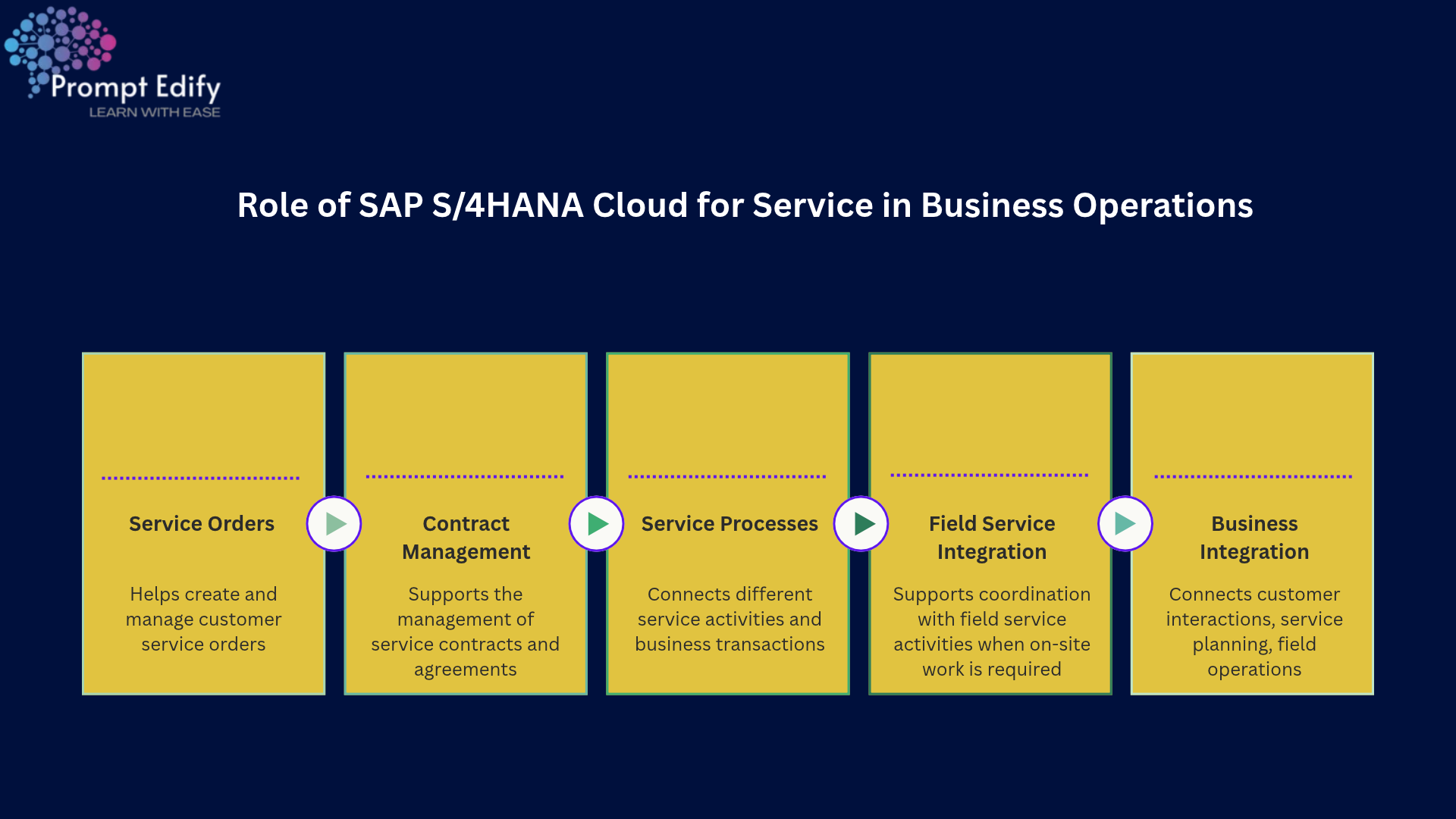
SAP S/4HANA Cloud for Service aids in service management from a broader organizational perspective. The solution helps the organization manage service orders, contracts, processes of service, and other types of business transactions.
For example, when the customer requests maintenance of equipment, the service order and other information about business can be managed through SAP S/4HANA Cloud for Service. When there are processes related to service orders that require physical presence, then integration of field service can be done.
The solution helps connect customer interactions, planning of services, field services, and back office activities. Everything depends on SAP solutions of the organization.
The correct choice of service depends on the services that your company offers.
In case you need to manage your customers' inquiries, service cases, and any other kinds of support, you can use SAP Service Cloud.
If your company works with technicians that carry out some kind of maintenance and inspections on-site, then you need to choose SAP Field Service Management.
You may want to go for SAP S/4HANA Cloud for Service in case you need to manage service orders and other enterprise processes.
The SAP Service Management is a set of tools that enables you to make your service operations better and more interconnected. SAP Service Cloud is about helping your customers; SAP Field Service Management is about managing technicians and implementing tasks on-site; SAP S/4HANA Cloud for Service allows you to manage the most important service processes.
Knowing what distinguishes these tools is the first thing you should consider when trying to choose the right service management strategy.
Do you plan to enhance your service operations with the help of SAP? Contact Prompt Edify to consult on your SAP service management needs, discover the most appropriate tools for you, and learn how SAP processes may be connected within your company.
By Team Prompt Edify
Have any enquiry? Call us
+(27) 740294414
(+91) 99932-86938
wecare@promptedify.com


Prompt Edify Africa (PTY) Limited
2nd Floor, Rivonia VillageCnr Mutual Road and Rivonia Boulevard Rivonia Village, 2191
Johannesburg , South Africa
Contact : +27740294414
Prompt Edify East Africa Limited
KN 78 ST, Kagarama, Kigali, Kigali, Nyarugenge, Umujyi wa Kigali, Rwanda
Contact : +250 727 845 771
Prompt Edify Private Limited
4th Floor #15, City Vista Tower, Fountain Road,
Kharadi, Pune(MH), India.
PIN- 411014
Contact : (+91) 99932 86938



Contact Us Today!
+27740294414 | (+91) 99932 86938 | +250 727 845 771
contact@promptedify.com | wecare@promptedify.com
🌐 https://promptedify.co.za/