
Learn SAP Service Order Management, covering order creation, planning, execution, confirmations and billing with practical business examples and workflows.

Customer service request management entails adequate planning, execution, and billing for successful business operations. There should be adequate ways of handling and managing service requests in the organization; businesses should have mechanisms to plan service activities, track the activities, and manage billing processes. SAP Service Order Management allows companies to handle these activities in an organized manner.
The SAP S/4HANA software enables businesses to handle the service order process by connecting service requests, planning of resources, execution of services, confirming of activities, and finally billing.
This guide provides information on what SAP Service Order Management is, how service orders are processed, difference between service orders and confirmations, and how service activities are progressed from creation to billing.
SAP Service Order Management is a business process that is utilized for planning, managing, and controlling activities relating to the customer service process. The business process assists an organization in creating service orders, allocating resources, recording the completion of work, and generating billing for customers.
In SAP S/4HANA, service orders are created in order to control planned activities like repairs, maintenance, inspection, and others related to the customers.
SAP service order management assists in managing significant information such as:
Service Order and Service Confirmation are two key components of the SAP Service Process. Even though the two are related, each one has a different function.
The Service Order is developed in order to plan and coordinate the work to be done for the customer. It includes information such as service activities, material requirements, resource planning and cost schedules.
The SAP Service Confirmation on the other hand documents the work performed during the service process. It includes information about completed service activities, labor time spent, materials used, and execution details.
In case for instance a customer needs an air conditioner repaired, the service order will document planned activities, the labor and spare parts to be used. Once the work is done, the technician will enter information about the work done using the service confirmation.
In conclusion, the service order is for planning the work while the service confirmation is for documentation.
The steps of the service order process by SAP include the various steps beginning from the requirements of the customer up to the generation of the bill. Every step ensures efficient and organized management of service orders as well as maintenance of transaction records.
Process flow includes:
1. Service Request Creation
Document the requirements of the customer or any issue he/she reports.
2. Service Order Creation
Create service orders including services/materials/resources needed.
3. Planning and Release
Plan activities, resource assignment and release of the order.
4. Service Execution
Execution of planned activities at customer’s premises by technicians.
5. Service Confirmation
Actual working hours, materials used and expenses are documented.
6. Billing Document Creation
Billable documents are released; Billing document requests are generated.
7. Creation of invoices to the customers.
Service request/quotation is an optional step depending on business scenario. The key process involves service order creation, confirmation and billing.
Planning and execution form key stages in the SAP S/4HANA service order process. Planning involves identifying what is to be done and ensuring that the required resources are at hand for its completion.
The planning activities involve the following:
After planning, the service order shall be scheduled for execution whereby the technicians can undertake the activity and consume the required resources.
For example, where there is a need to carry out the repair of machinery for a firm operating in the manufacturing industry, the service manager assigns the technicians and gets the spare parts and then releases the service order.
The SAP service confirmation procedure involves documenting the work done against the service order to allow companies to compare their planning with actual results and measure resource consumption.
Confirmations may contain:
Transaction overview allows managers to check service orders, confirmations and documentation related to them. It gives an insight into the current status of orders, their completion and further actions.
Also, SAP enables creating subsequent transactions, including timesheets, material documents and cost postings, depending on the process setup.
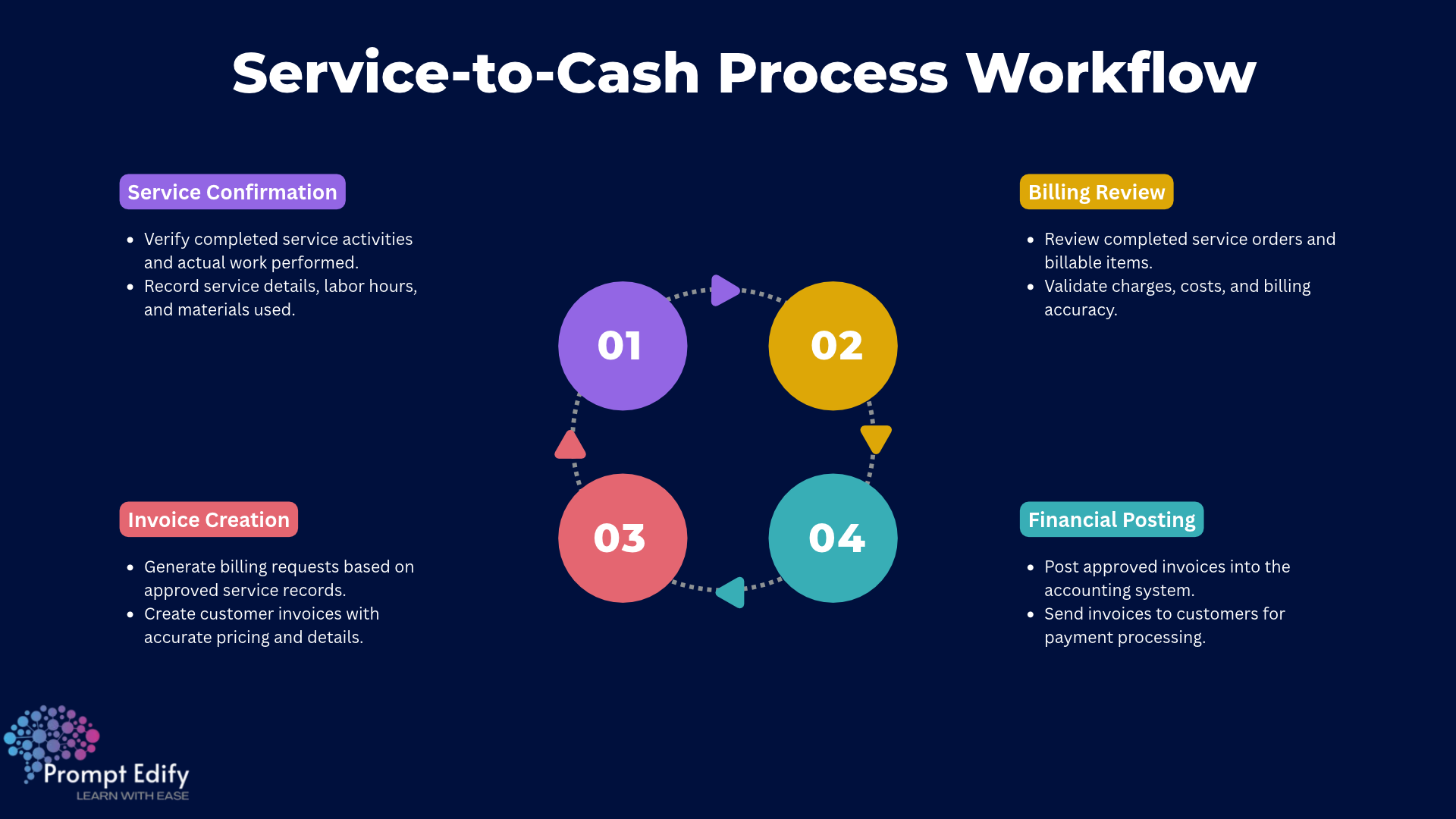
SAP billing process involves converting service activities that are both performed and billable to customer invoices.
When the appropriate service order and the corresponding confirmation items are eligible for billing, they are then released for billing. SAP creates a Billing Document Request (BDR) which is used as a model for the actual billing document.
Some of the key billing processes include:
There are different methods of billing, depending on the type of the service order and the item category. Time and Material services may be charged as per the resources confirmed while fixed price services are billed based on the agreed price.
Such processes will enable the organization to control its billing process and link its service activities to the financial processes.
Suppose there is a manufacturing company that provides maintenance and repair services for their customers’ equipment. The customer contacts stating that his machine is damaged, and he needs to receive assistance.
Using SAP Service Order Management, the company does the following steps:
In this case study, we can see how the process of service planning, execution, confirmation, and billing is integrated by SAP.
The SAP Service Order Management helps in managing the service orders from their inception until completion and final billing of the orders.
With the integration of service order creation, planning, execution, confirmation, and billing, the SAP S/4HANA platform can help in gaining greater visibility of the service process.
Through the learning of the life cycle of SAP service orders and SAP Service Processing, one can get practical understanding of the service management process.
Those individuals who wish to pursue their careers in SAP S/4HANA and have practical knowledge about the process of service order processing will find this information extremely valuable.
Want to learn more about the SAP S/4HANA Service Management through industry focused practical training? Contact Prompt Edify today to find out more about SAP training programs.
By Team Prompt Edify
Have any enquiry? Call us
+(27) 740294414
(+91) 99932-86938
wecare@promptedify.com


Prompt Edify Africa (PTY) Limited
2nd Floor, Rivonia VillageCnr Mutual Road and Rivonia Boulevard Rivonia Village, 2191
Johannesburg , South Africa
Contact : +27740294414
Prompt Edify East Africa Limited
KN 78 ST, Kagarama, Kigali, Kigali, Nyarugenge, Umujyi wa Kigali, Rwanda
Contact : +250 727 845 771
Prompt Edify Private Limited
4th Floor #15, City Vista Tower, Fountain Road,
Kharadi, Pune(MH), India.
PIN- 411014
Contact : (+91) 99932 86938



Contact Us Today!
+27740294414 | (+91) 99932 86938 | +250 727 845 771
contact@promptedify.com | wecare@promptedify.com
🌐 https://promptedify.co.za/