
Discover SAP Supplier Management, its key components, supplier registration, qualification, performance monitoring and role in improving procurement processes.
Any company relies on its suppliers to get goods, supplies and services that help run the business. But when you have several suppliers, a lot of things need to be done including getting information about the suppliers, their capabilities evaluation, registration management, compliance verification and business relationship management. These things become really challenging without some proper planning.
That is when SAP Supplier Management comes into play. This solution enables companies to organize all information related to suppliers and improve the process of working with external business partners. This concept is important for those who want to learn SAP procurement solutions.
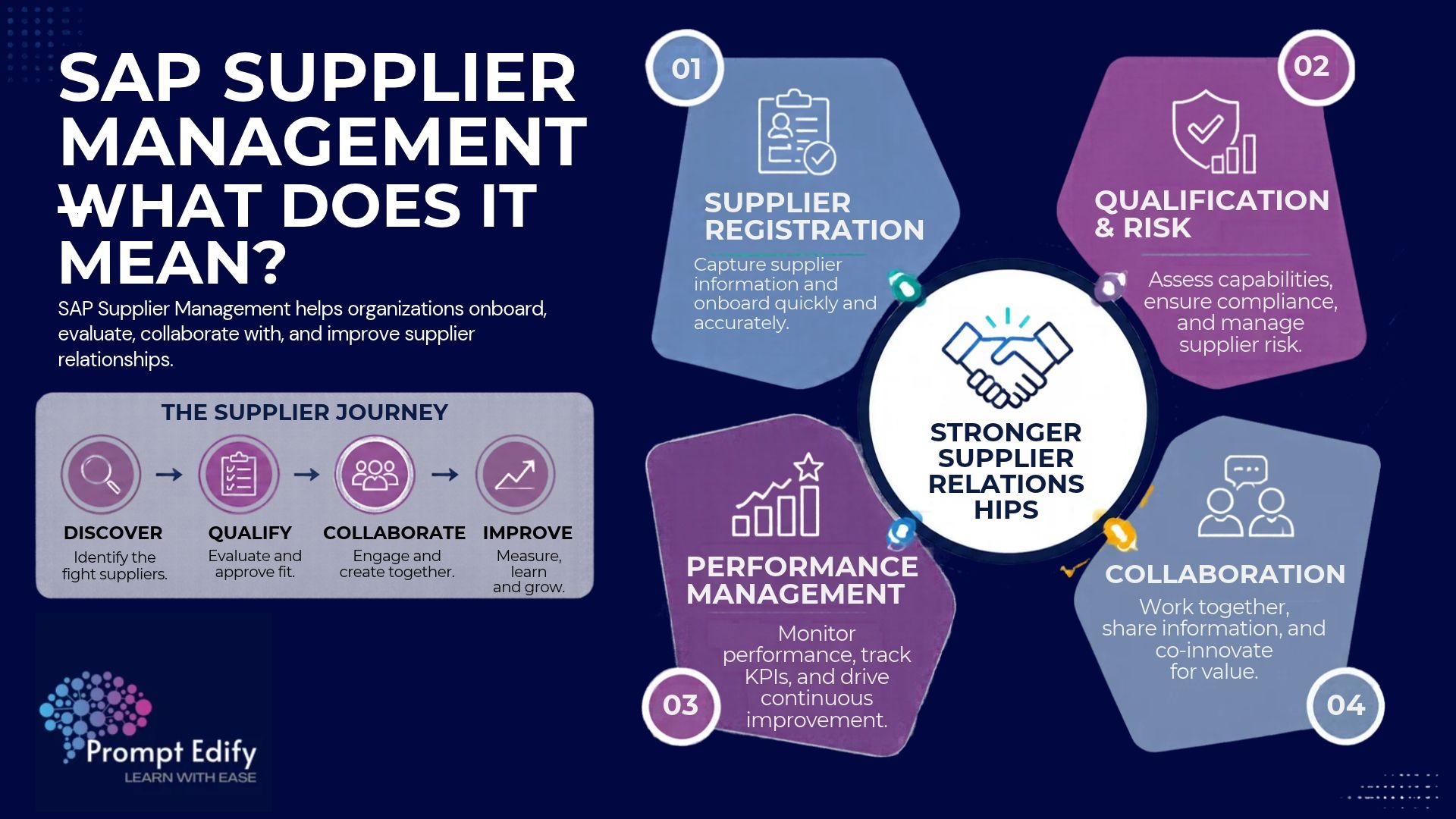
What Is SAP Supplier Management? This is the processes and SAP enabled capability used to handle supplier data, onboarding, qualifying, evaluation, and managing the relationship with the supplier.
Supplier management involves having proper supplier data, knowing about the capabilities of the supplier and making sure that the suppliers are able to meet the needs of the organisation even when carrying out business.
There are various capabilities that SAP offers to enable the management of the supplier management process. Examples of such capabilities include SAP Business Network and SAP Ariba where they have collaboration and supplier lifecycle management.
This will depend on what SAP solutions the organisation uses.
Supplier management is not only about managing a list of suppliers but understanding whom the organisation works with and whether the suppliers can meet their business needs.
The supplier management process ensures that businesses achieve a number of business goals:
This becomes very significant for businesses operating with many suppliers in different locations.
Supplier management entails some activities in the entire supplier management life cycle. These components include:
Supplier information is very important in procurement activities. In general, organizations keep information such as supplier names, addresses, contact details, tax information, banking information, categories of business among other documents.
The use of SAP to manage supplier activities helps in keeping supplier information and its use in various business activities. The availability of supplier information will depend on the software used.
Onboarding of suppliers is a process whereby a supplier is registered with all the information needed to form a business relationship.
These activities may include registration forms, company information, tax information, banking information among others.
Using SAP supplier management activities makes it possible to automate the registration of suppliers.
Not all suppliers qualify in meeting all the business requirements. In supplier qualification, the organizations are able to determine whether the supplier qualifies in meeting certain requirements.
The criteria used might include the following;
Based on the results of the assessment, the organizations will be able to determine whether the supplier qualifies based on organizational qualifications.
The evaluation of the suppliers enables organizations to measure the performance of the suppliers in meeting the set expectations. The organizations can measure their performance based on delivery, quality, pricing, and regulations.
The performance information is very useful for procurement professionals in making good procurement decisions.
It is necessary to note that communication between organizations and suppliers helps in conducting efficient procurement processes. It includes sharing information, responding and processing business documents and conducting the procurement process.
The SAP solutions provide digital collaboration capabilities for procurement professionals to work with suppliers efficiently.
There are several SAP solutions which help the organizations in managing the supplier management process.
Some of these solutions are SAP Ariba Supplier Lifecycle and Performance which helps in managing the process of supplier registration, supplier qualification, supplier segmentation, and supplier performance management.
SAP Business Network is another product which facilitates collaboration between the buyers and suppliers as well as the exchange of procurement documents.
SAP S/4HANA is the product that helps in managing the supplier master data in order to manage the supplier information which is used in procurement and billing processes, among others.
These SAP solutions may be integrated according to the specific SAP landscape of the organization. But not all processes of supplier management can be managed through any SAP solution.
Organizations may encounter many obstacles in managing their suppliers by using disconnected systems or through manual systems.
By following a systematic process using SAP, organizations can overcome these problems.
SAP Supplier Management Knowledge is important for those associated with procurement and supply chain and other SAP experts and novices who wish to learn supplier management techniques.
Prompt Edify provides training programs for SAP that will assist the learners in getting knowledge of SAP solutions, procurement process and business process. Check out the available SAP training courses to increase your knowledge of supplier management and procurement process.
By Team Prompt Edify
Have any enquiry? Call us
+(27) 740294414
(+91) 99932-86938
wecare@promptedify.com


Prompt Edify Africa (PTY) Limited
2nd Floor, Rivonia VillageCnr Mutual Road and Rivonia Boulevard Rivonia Village, 2191
Johannesburg , South Africa
Contact : +27740294414
Prompt Edify East Africa Limited
KN 78 ST, Kagarama, Kigali, Kigali, Nyarugenge, Umujyi wa Kigali, Rwanda
Contact : +250 727 845 771
Prompt Edify Private Limited
4th Floor #15, City Vista Tower, Fountain Road,
Kharadi, Pune(MH), India.
PIN- 411014
Contact : (+91) 99932 86938



Contact Us Today!
+27740294414 | (+91) 99932 86938 | +250 727 845 771
contact@promptedify.com | wecare@promptedify.com
🌐 https://promptedify.co.za/