
Discover SAP Business Network Supply Chain Collaboration, its key features, supplier workflows and benefits for visibility, planning and resilient operations.

The modern supply chain comprises many companies, suppliers, manufacturers, distributors, and logistics providers. Communicating and exchanging information among all of them may be difficult if every company has its own system and process.
To solve this problem, companies are implementing digital collaboration solutions that will unite suppliers and customers through one single platform. SAP Business Network Supply Chain Collaboration is one of these solutions.
This solution helps companies enhance communication with suppliers, exchange business data, check material availability, and perform other supply chain-related activities.
Knowing What is Supply Chain Collaboration is vital for those who want to know how modern technologies affect the performance of the supply chain.
This beginner's guide will help you understand SAP Business Network Supply Chain Collaboration, its major features, processes of supplier collaboration, business benefits, and importance of supply chain visibility.
SAP Business Network Supply Chain Collaboration is a cloud-based application which enables buyers and suppliers to collaborate using a common digital platform.
It allows businesses to share information, manage procurement processes, forecast, keep track of their inventories and coordinate all activities related to quality management with their business partners.
Until now, businesses were communicating with their suppliers using email communications, spreadsheets, phone calls and even other business applications which might lead to communication and information gap issues.
SAP Supply Chain Collaboration can help eliminate these problems by connecting business partners and exchanging digital information between them.
The main goals are:
It is one of the solutions offered in SAP Business Network.
Supply Chain Collaboration is the process of communicating information, coordinating activities and collaborating with various business partners to attain common supply chain goals.
This includes collaboration between buyers, suppliers, manufacturers, logistics providers and various other stakeholders.
For instance, when a manufacturer is required to get the raw materials, he has to collaborate with the suppliers to confirm whether the material is available, what is the delivery schedule, quantity and quality of material required.
Lack of collaboration may result in communication delays among other issues which will lead to production and delivery delays.
Digital Supply Chain Collaboration makes the whole process more convenient through provision of a common platform for exchange of information and coordination of business activities.
This enables the organization to:
There are some features that SAP Business Network Supply Chain Collaboration provides to organisations in order to support the relationship management between an organisation and its suppliers/trading partners.
Forecast collaboration is used by the buyer to collaborate on their demand forecast with suppliers. The suppliers get the forecast for checking, giving their feedback and discussing their capability of fulfilling future requirements.
This assists organisations in knowing about the shortage of materials and capacity issues ahead of time.
Procurement collaboration is used to conduct purchasing activities between buyers and suppliers electronically.
Inventory collaboration helps companies see what their supplier’s inventories look like and whether materials are available or not.
It allows companies to keep track of their inventories, align their replenishment requirements and maintain adequate inventories.
Quality collaboration enables companies to share quality information and collaborate on solving the quality problems.
It helps organisations detect quality problems and cooperate with their suppliers for solving quality problems faster.
Manufacturing collaboration enables companies to align and coordinate activities of manufacturers, suppliers and contract manufacturers.
It helps companies to get visibility of their suppliers’ inventories and materials availability to foresee production disruptions.
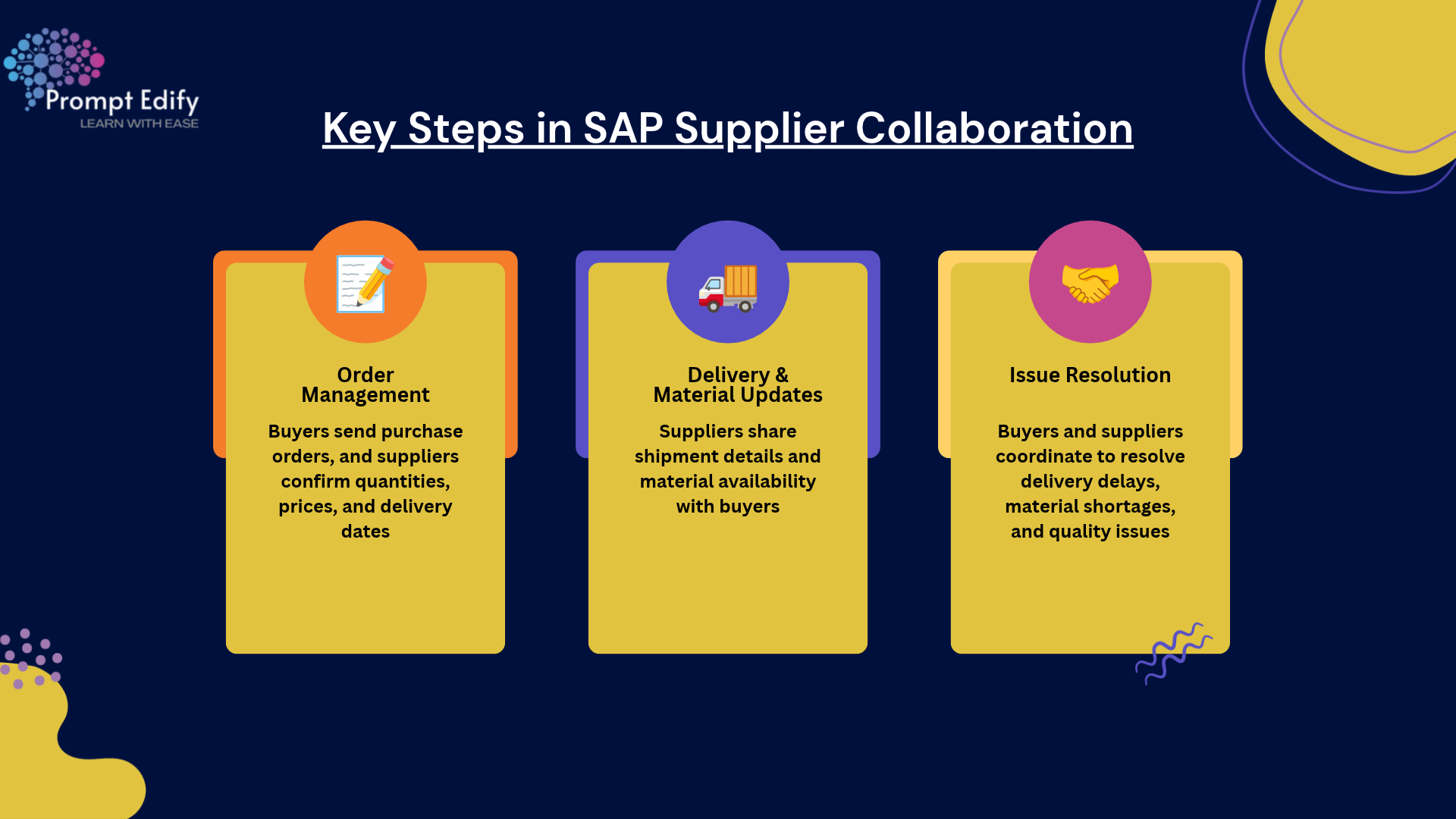
Supplier collaboration is one of the most important aspects of SAP Business Network Supply Chain Collaboration. This makes it possible for linking the buyer and the supplier to allow the exchange of information and business process coordination.
This process is usually characterized by the following;
For example, when the supplier fails to supply the required quantity of the goods by the agreed time, the buyers will be notified of that before it causes any problem during the production process.
The use of SAP Business Network Supply Chain Collaboration may bring a lot of benefits to companies.
1. Better Buyer-Supplier Relationship: Helps in the effective communication between buyer and supplier.
2. Automated Processes: Makes the whole process of information exchange automated and reduces reliance on emails and spreadsheets.
3. Supply Planning: Makes it possible for companies to recognize that there is lack of supplies and make plans for material requirements.
4. Increased Efficiency: Provides the opportunity to conduct procurement and inventory tasks more efficiently.
5. Reduced Supply Chain Risks: Helps in detecting supply chain risks at an early stage.
6. Increased Visibility: Increases visibility of supplier commitments, inventories and deliveries.
All of these benefits will help companies improve performance and efficiency of their supply chains.
The SAP Business Network Supply Chain Collaboration will be useful for the professionals working in procurement, supply management, manufacturing, and supply chain domains.
The different users of this technology include the following:
These professionals make use of digital collaboration to improve communication and manage the needs of the supply chain.
SAP Business Network Supply Chain Collaboration helps organisations connect buyers, suppliers, and other trading partners through a shared digital platform. It supports forecast collaboration, procurement, inventory management, manufacturing coordination, and quality processes.
By improving communication, supply chain visibility, and information sharing, businesses can reduce operational challenges and build more resilient supply chains.
As organisations continue adopting digital technologies, understanding SAP Business Network solutions can be valuable for professionals interested in procurement and supply chain management.
Want to learn more about SAP solutions and supply chain management? Contact Prompt Edify to explore professional SAP training programmes and develop the skills needed to grow your career in the evolving supply chain industry.
By Team Prompt Edify
Have any enquiry? Call us
+(27) 740294414
(+91) 99932-86938
wecare@promptedify.com


Prompt Edify Africa (PTY) Limited
2nd Floor, Rivonia VillageCnr Mutual Road and Rivonia Boulevard Rivonia Village, 2191
Johannesburg , South Africa
Contact : +27740294414
Prompt Edify East Africa Limited
KN 78 ST, Kagarama, Kigali, Kigali, Nyarugenge, Umujyi wa Kigali, Rwanda
Contact : +250 727 845 771
Prompt Edify Private Limited
4th Floor #15, City Vista Tower, Fountain Road,
Kharadi, Pune(MH), India.
PIN- 411014
Contact : (+91) 99932 86938



Contact Us Today!
+27740294414 | (+91) 99932 86938 | +250 727 845 771
contact@promptedify.com | wecare@promptedify.com
🌐 https://promptedify.co.za/