
Discover how SAP Supply Chain Management connects procurement, inventory, production, warehousing, and logistics while improving visibility, efficiency, and planning.
A contemporary company requires an effective way to manage its purchasing, inventory, manufacturing, warehousing and delivering of products. In case these processes are organized by separate systems, a business can face difficulties such as lack of stocks, late orders, increased expenses and poor transparency within the supply chain. The SAP Supply Chain Management enables companies to link the mentioned processes and base decision-making on accurate operational information.
People who want to learn these processes should pay attention to SAP Supply Chain Training.
SAP Supply Chain Management implies the use of SAP solutions in order to plan, orchestrate, track, and optimize the activities related to the transfer of materials and products from suppliers to customers. SAP supply chain management links key business processes such as procurement, production planning, inventory management, warehousing, logistics, and demand planning.
SAP supply chain management solutions can be provided via SAP S/4HANA, SAP Integrated Business Planning (SAP IBP), SAP Extended Warehouse Management (SAP EWM), among others.
For instance, when a manufacturer gets an order from a customer, it needs to consider the availability of materials, plan production, organize procurement activities, manage warehousing, and deliver the product. Integration of SAP processes will allow people to get access to necessary information and coordinate their actions more efficiently.
SAP SCM involves several interconnected processes, and it is crucial to understand the process flow for any business organization and those working with SAP solutions.
Demand planning and forecasting help organizations plan and estimate their future demand using sales data, market research, and business forecasting. The process of proper demand planning helps organizations anticipate changes in the demand and minimize their stock.
SAP IBP helps in demand and supply planning using scenarios and coordination of business plans.
Procurement entails such processes as sourcing for the materials, selecting the suppliers, preparing purchase orders, and overseeing the deliveries from the suppliers. Procurement The procurement process in SAP assists organizations in managing the procurement process and monitoring their material needs.
The integration of procurement processes with inventory and production planning processes assists organizations in detecting shortages beforehand.
Inventory management consists of management of inventory levels, inventory movements, goods receiving, goods issuing, and inventory transferring. The functionalities of SAP inventory management can help in knowing what is in stock and where it is located.
Effective inventory management will ensure no unnecessary stock holdings, improve material availability, and also make planning efforts easy.
Manufacturing companies need materials, production capabilities, scheduling, and demand to be coordinated. The functionalities of SAP production planning will help in planning and coordinating production orders and also managing manufacturing processes.
Coordination of production and procurement activities will reduce the delay caused by lack of material availability and resource management.
Warehouse management involves goods receiving, putaway, picking, packing, and shipping. SAP Extended Warehouse Management allows companies to have functionalities for managing complicated warehouse processes.
Transportation management includes transportation planning, carrier coordination, and transport process monitoring.
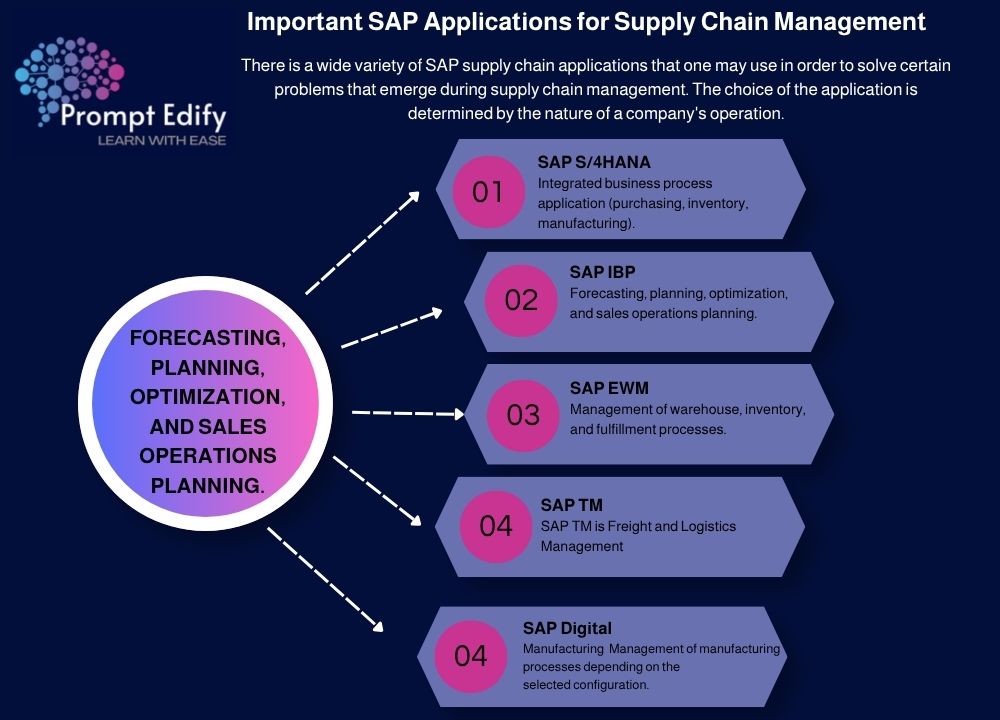
There is a wide variety of SAP supply chain applications that one may use in order to solve certain problems that emerge during supply chain management. The choice of the application is determined by the nature of a company’s operation.
They can all be put together in a single process to establish a link between the supply chain processes.
The right SAP solution for the supply chain can definitely bring some advantages to your company.
However, the success is based on the quality of the implementation process and solutions selected.
With companies shifting towards digitisation, individuals who know how to work with supply chain processes and enterprise systems will be able to develop their valuable skills. Individuals involved in procurement, inventory, warehouses, production planning, logistics, and individuals that are SAP consultants-in-training will benefit from SAP training.
The SAP Supply Chain Training will enable learners to gain knowledge about integrated business processes, use the appropriate SAP applications, and get acquainted with procurement, inventory, production, and logistics processes. Practical tasks with the application of theoretical knowledge in real-life scenarios can be helpful for this purpose.
The SAP Supply Chain Management tool will allow enterprises to integrate various processes that are involved in demand planning and procurement, manufacturing, warehousing, and logistics. Using the right SAP software and its integration into business processes, companies will be able to increase visibility and optimize their supply chains.
Prompt Edify helps professionals and companies with SAP training to develop knowledge and skills in SAP.Get more information about SAP Supply Chain Training.
Contact: +27 740 294 414 | +91 99932 86938
Email: contact@promptedify.com
Website: https://promptedify.co.za/
By Team Prompt Edify
Have any enquiry? Call us
+(27) 740294414
(+91) 99932-86938
wecare@promptedify.com


Prompt Edify Africa (PTY) Limited
2nd Floor, Rivonia VillageCnr Mutual Road and Rivonia Boulevard Rivonia Village, 2191
Johannesburg , South Africa
Contact : +27740294414
Prompt Edify East Africa Limited
KN 78 ST, Kagarama, Kigali, Kigali, Nyarugenge, Umujyi wa Kigali, Rwanda
Contact : +250 727 845 771
Prompt Edify Private Limited
4th Floor #15, City Vista Tower, Fountain Road,
Kharadi, Pune(MH), India.
PIN- 411014
Contact : (+91) 99932 86938



Contact Us Today!
+27740294414 | (+91) 99932 86938 | +250 727 845 771
contact@promptedify.com | wecare@promptedify.com
🌐 https://promptedify.co.za/