
Learn how SAP Sustainability Control Tower enables businesses to track ESG performance, manage sustainability data, monitor targets, and simplify reporting.
It goes without saying that today’s market requires businesses to be aware of their environmental impact, improve sustainability performance, and create clear reports. These days, sustainability is not just about corporate social responsibility activities. This concept is an inherent part of planning, risk management, and sustainable development.
To accomplish these objectives, companies need reliable data, performance indicators, and greater transparency in terms of sustainability initiatives. Hence, SAP Sustainability Control Tower helps organizations to gather their sustainability data, track performance, and take informed actions.
This guide will help you understand how you can approach your sustainability reporting and implement environmental sustainability into your business.
SAP Sustainability Control Tower is a sustainability management and reporting solution designed to help organisations manage the collection, organisation, analysis, and reporting of their ESG data. It provides a single platform for tracking performance, setting goals, tracking progress and sustainability reporting.
Instead of managing their sustainability data through spreadsheets and multiple reporting platforms, companies can leverage the software to bring together their relevant sustainability data from both SAP and non-SAP sources.
This will ensure uniformity in handling data among the sustainability teams, financial experts, operational managers, and other business executives.
There is usually a challenge faced by many companies with the collection of sustainability data from various departments, branches, suppliers, and business systems. The data regarding the use of energy, carbon footprints, people-related indicators, waste, and resource management could be available in various forms.
The process can lead to a slow process of sustainability reporting, and there are chances of having inconsistent data.
The software is helpful in solving the problem as it enables the management of sustainability data effectively. Companies are able to monitor sustainability indicators, find performance gaps, track historical results, and see whether the sustainability activities have provided the desired results.
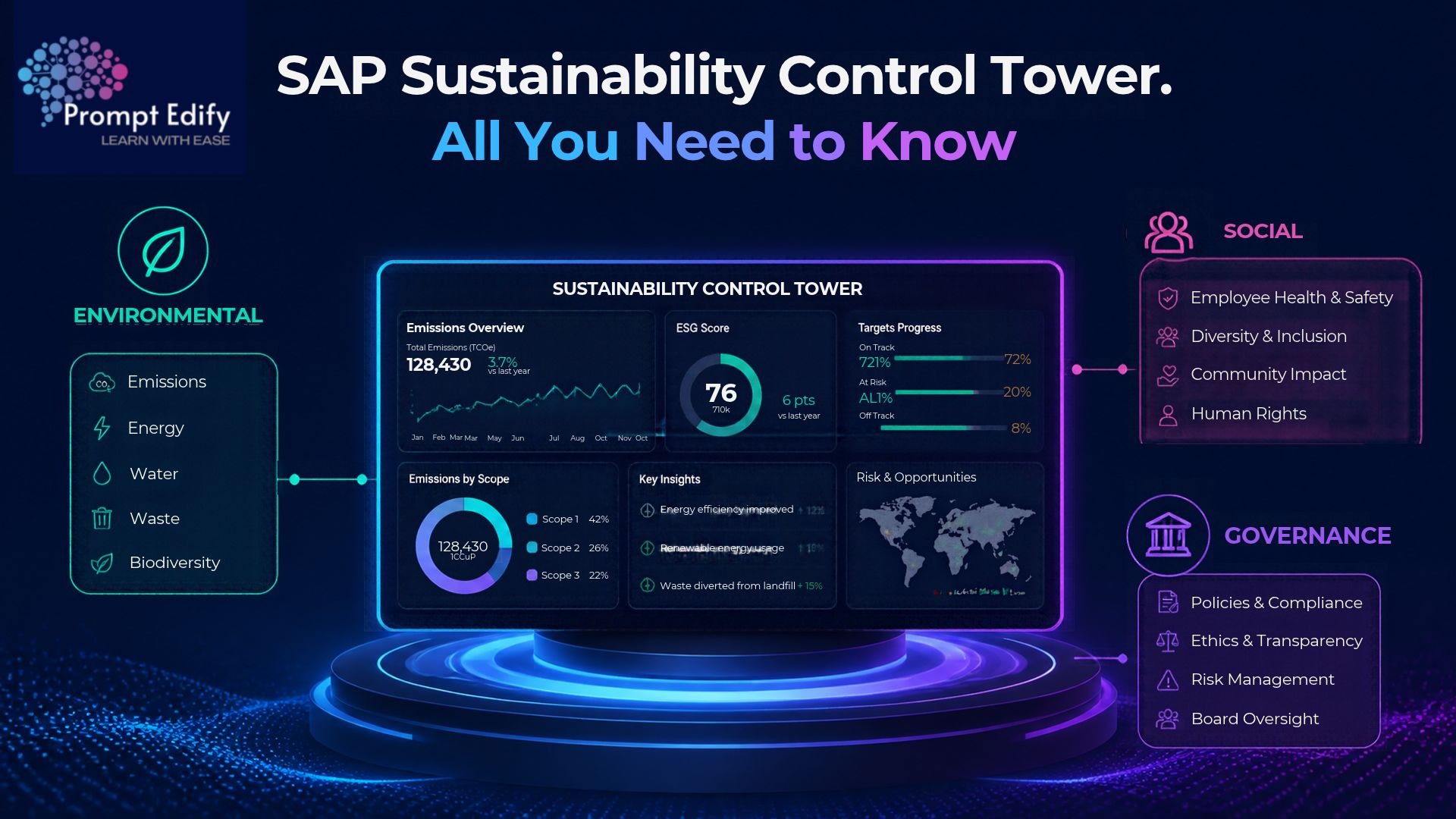
The key feature is that it provides the opportunity to collect information on sustainability from different sources. The integration of information from SAP applications and other sources is possible so that all the information on sustainability can be collected.
There is a data collection, reporting scope, workflow, and data management. The responsibility of collecting and reviewing the data can be configured depending on the reporting period.
The feature allows managing the pre-defined metrics on sustainability as well as creating new ones according to business needs.
Metrics can include different types of performance, including environmental, social, governance, and economic performance of the company. The metrics configuration, tracking of actual figures, and performance evaluation according to reporting periods are possible.
For example, carbon emission, water usage, waste creation, employees' performance, and other metrics can be collected by companies.
Using the interactive dashboards allows for receiving sustainability performance insights in the form of visual representations. The insights help analyze sustainability metrics in terms of business units, geography, time periods and other aspects.
The insights will be useful in identifying patterns and making management decisions which will be based on these insights. As a result of combining sustainability metrics and financial/operational data, businesses will see how sustainability performance correlates with business performance.
The possibility exists for businesses to set sustainability ambitions, identify sustainability targets and assess their progress in achieving the established targets.
For example, an industrial enterprise may develop plans concerning reducing greenhouse gas emissions, increasing energy efficiency or minimizing the amount of produced waste within a certain period of time. This approach will allow monitoring the sustainability performance in terms of set targets.
Reporting is yet another key capability of SAP Sustainability Control Tower. It allows organizations to carry out the sustainability reporting process using templates, metrics, and AI-assisted reports creation.
Organizations are able to create reports, evaluate data, improve disclosures and strive for reporting frameworks such as European Sustainability Reporting Standards (ESRS) or others depending on the reporting scope and configuration.
The indicators that are measured vary depending on the industry the company operates in, the sustainability targets it has set, and the measurement needs. For instance:
It is possible for businesses to measure predefined indicators while customizing some to suit their sustainability approaches.
Organisations can use SAP Sustainability Control Tower across several sustainability reporting and management activities.
For example, a manufacturing business can monitor emissions across production facilities, compare energy consumption between plants, and evaluate progress towards carbon reduction targets.
A retail company may use sustainability information to monitor waste, resource consumption, and selected supplier-related indicators. Similarly, a multinational organisation can consolidate sustainability information from different locations to improve reporting visibility and coordination.
These use cases demonstrate how sustainability data can support both regulatory reporting and internal business decisions.
As sustainability reporting becomes more important for the operation of businesses, professionals with expertise in SAP sustainability solutions can find themselves in demand in terms of sustainability reporting, ESG data management, SAP consulting, business transformation, and enterprise technology.
Having the information about SAP Sustainability Control Tower – including the metrics, reports, data collection process, dashboards, and performance management – might allow professionals to understand how companies use SAP technology for sustainable purposes.
Gain an understanding of SAP Sustainability Control Tower Training to develop your SAP sustainability solutions skills.
Prompt Edify provides SAP training, consulting, and professional education to those looking to develop their SAP expertise. Prompt Edify is powered by expert SAP consultants and trainers offering industry-oriented education programs.
By Team Prompt Edify
Have any enquiry? Call us
+(27) 740294414
(+91) 99932-86938
wecare@promptedify.com


Prompt Edify Africa (PTY) Limited
2nd Floor, Rivonia VillageCnr Mutual Road and Rivonia Boulevard Rivonia Village, 2191
Johannesburg , South Africa
Contact : +27740294414
Prompt Edify East Africa Limited
KN 78 ST, Kagarama, Kigali, Kigali, Nyarugenge, Umujyi wa Kigali, Rwanda
Contact : +250 727 845 771
Prompt Edify Private Limited
4th Floor #15, City Vista Tower, Fountain Road,
Kharadi, Pune(MH), India.
PIN- 411014
Contact : (+91) 99932 86938



Contact Us Today!
+27740294414 | (+91) 99932 86938 | +250 727 845 771
contact@promptedify.com | wecare@promptedify.com
🌐 https://promptedify.co.za/