
Learn about SAP Sustainability Data Exchange, its key capabilities, PCF data exchange process, business partner collaboration, and industry applications.

In the context of growing concern for companies’ impact on the environment, knowing the amount of carbon emissions has become very important. Nevertheless, knowing the emissions of the company itself is just one step towards sustainability. A lot of data concerning environmental impact should be gathered from the partners of the business in order to estimate the impact of purchased and manufactured products.
In such a context, SAP Sustainability Data Exchange plays its important role. The tool allows companies to gather the carbon footprint information of the products from their supply chain partners.
SAP Sustainability Data Exchange is a cloud-based application which allows businesses to exchange sustainability data including the Product Carbon Footprint (PCF) data with their business partners.
Earlier, organizations used to collect supplier emission data via email, spreadsheets, and manual processes. All these were time-consuming and created inconsistent data and challenges related to record maintenance.
SAP Sustainability Data Exchange makes this task easy with its request and response method. While buyers request PCF data of the products, suppliers get the chance to submit the requested data.
SAP Sustainability Data Exchange follows various industry frameworks like WBCSD PACT (Partnership for Carbon Transparency) and Catena-X. It can operate independently or even together with other SAP sustainability solutions.
The approach creates a structured communication workflow between buyers and suppliers. Both sides have an opportunity to engage in exchanges of carbon footprint data about products.
The workflow usually consists of the following actions:
1. Connecting with Business Partners
Companies make connections with their suppliers and customers in the network. Both sides will be able to communicate and exchange sustainability data.
2. Requesting Sustainability Data
A buyer chooses the products for which there is a need for carbon footprint information and asks for that information from the related supplier. Requests can also be made to multiple suppliers.
3. Processing Requests for Sustainability Data
Suppliers receive requests for carbon footprint data from their customers and analyze the needed product data. They can select the proper products and get carbon footprint data ready.
4. Sending Product Carbon Footprint Data
Suppliers send their PCF data through the platform. They may also do it proactively without any new requests from their customers.
5. Handling and Utilizing the Information
Buyers get the sent information and keep their product footprints.
The SAP Sustainability Data Exchange has a variety of features which can help businesses manage sustainability data in a much better manner.
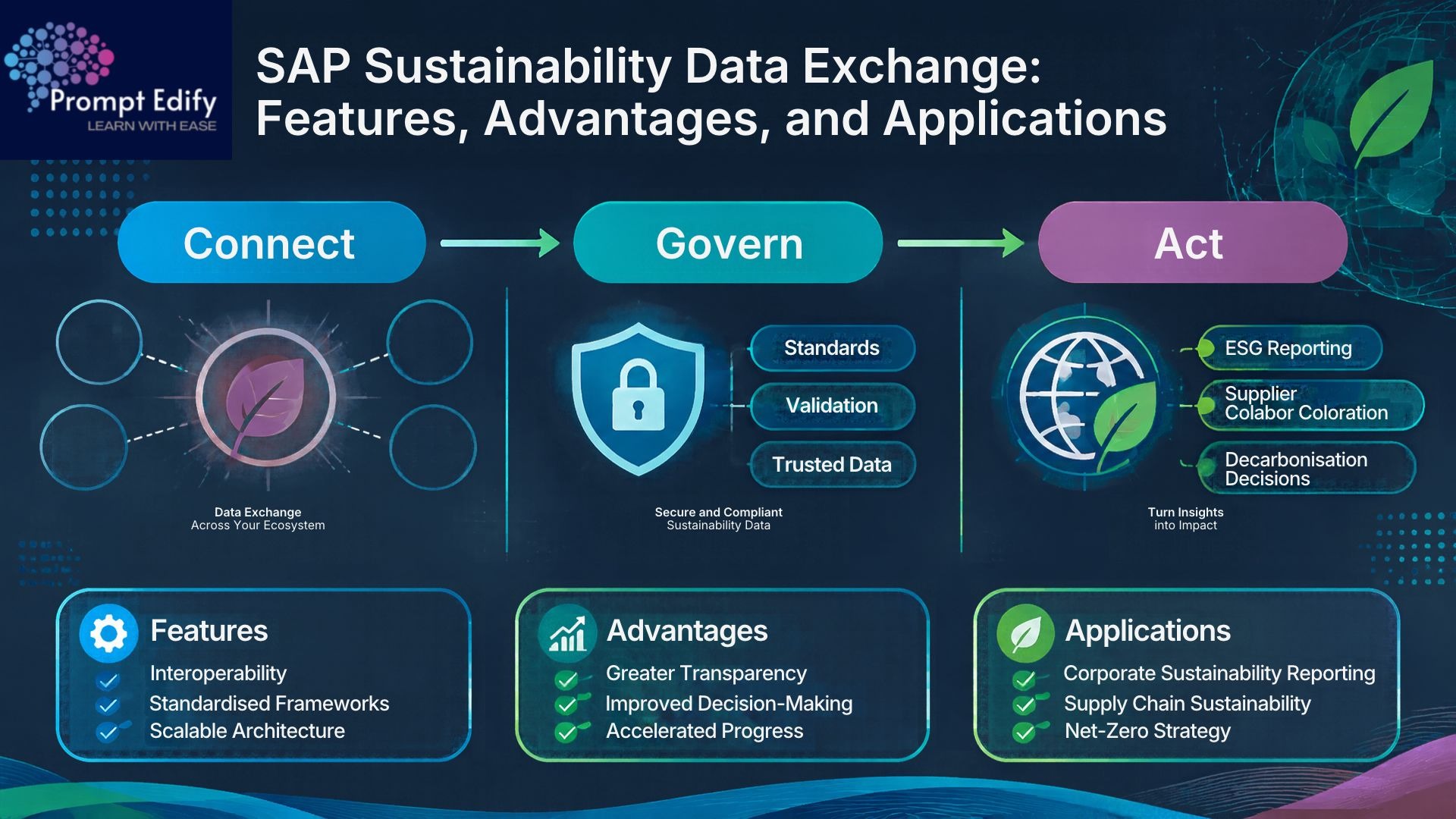
There are some advantages of using SAP Sustainability Data Exchange which can help to enhance the sustainability process of any organization.
SAP Sustainability Data Exchange can cater to a variety of industries and supply chain processes.
With sustainability becoming a significant aspect of business management, professionals require learning about how organizations gather, manage and exchange environmental data in their supply chains.
Prompt Edify equips professionals and organizations with practical skills in using SAP solutions through learning programs and training for industry professionals. Explore SAP Sustainability Data Exchange Training to learn more about the features, processes and practical application of this SAP solution.
At Prompt Edify, we have worked on more than 10 ERP implementation projects, have more than 15 SAP consultants and trainers and more than 5,000 professionals have been trained in SAP Solutions.
By Team Prompt Edify
Have any enquiry? Call us
+(27) 740294414
(+91) 99932-86938
wecare@promptedify.com


Prompt Edify Africa (PTY) Limited
2nd Floor, Rivonia VillageCnr Mutual Road and Rivonia Boulevard Rivonia Village, 2191
Johannesburg , South Africa
Contact : +27740294414
Prompt Edify East Africa Limited
KN 78 ST, Kagarama, Kigali, Kigali, Nyarugenge, Umujyi wa Kigali, Rwanda
Contact : +250 727 845 771
Prompt Edify Private Limited
4th Floor #15, City Vista Tower, Fountain Road,
Kharadi, Pune(MH), India.
PIN- 411014
Contact : (+91) 99932 86938



Contact Us Today!
+27740294414 | (+91) 99932 86938 | +250 727 845 771
contact@promptedify.com | wecare@promptedify.com
🌐 https://promptedify.co.za/