
Learn how SAP Sustainability Footprint Management calculates product and corporate carbon footprints, integrates ERP data, and helps identify emission hotspots.
As the firms strive to reduce their ecological footprint, carbon emission analysis has emerged as one of the critical aspects of operations and strategy. Apart from the fact that the firms require the information about the total amount of carbon emitted, it is essential for them to be aware of those products, processes, suppliers, and other factors that account for carbon emissions.
Here comes the significance of SAP Sustainability Footprint Management. This solution provides the firms with a way in which they can calculate, analyze, and manage the product and corporate carbon footprints based on the operational and enterprise data.
SAP Sustainability Footprint Management is a cloud-based solution that aims at computing corporate and product carbon footprints. The solution utilizes enterprise data, material flows, production, energy use, transportation data, and supplier data to compute the carbon footprints.
Instead of computing the carbon footprint manually or through spreadsheets, companies are able to adopt the ERP approach for carbon footprints calculations. The solution helps to link sustainability data with business processes so as to enable companies to analyze their impacts in relation to business processes.
The solution not only computes carbon footprints but also computes the environmental impact for other areas depending on the configuration.
Despite the usefulness for organizations, both concepts have different purposes.
The product carbon footprint (PCF) is a measurement of greenhouse gases emissions of the specific product along the whole life cycle or the chosen stages of it.
Such kind of information may be useful for businesses for comparison of different materials, evaluation of supplier contributions, and emission hotspots as well as for product design.
For instance, manufacturers can find out the carbon footprint of a certain product through considering its raw materials, energy usage in the production process, and transportation.
The corporate carbon footprint (CCF) measures the greenhouse gas emissions of the organization within a specific period of time. The greenhouse gas emissions are measured across the corporate activities and value chain categories, namely Scope 1, Scope 2, and Scope 3 according to Greenhouse Gas Protocol.
Calculations of corporate footprint allow understanding of the company's total emissions, identification of important sources, setting reduction targets, and assessment of sustainability progress.
Sustainability Footprint Management by SAP allows carrying out calculations of corporate and product footprints based on a connected data foundation.
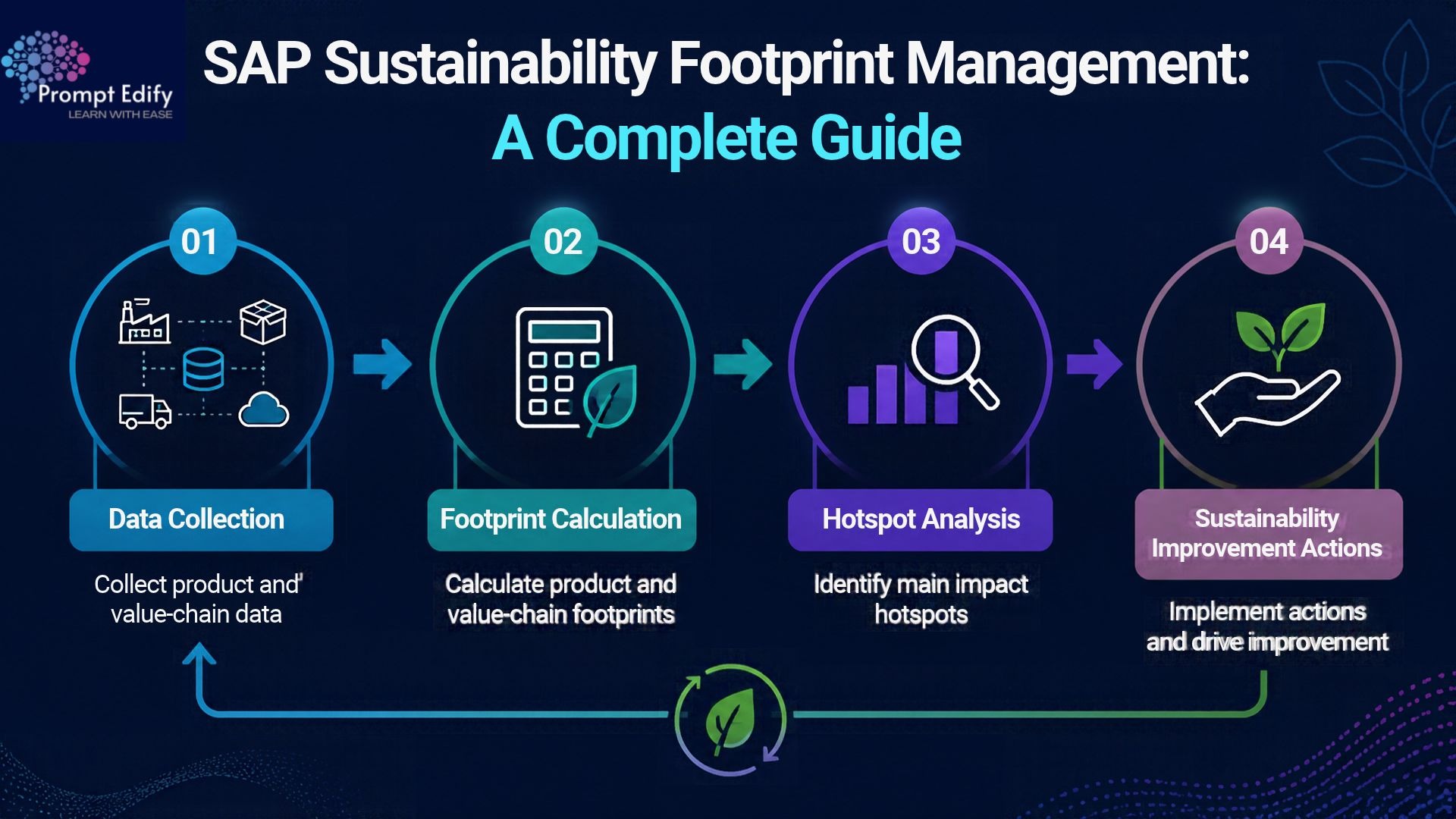
Calculation of carbon footprint is dependent on the availability of data in enterprises. The SAP Sustainability Footprint Management tool makes use of enterprise data in making the link between the operations and emission calculations.
The data provided and emission factors are used in the calculation of the carbon footprints. Companies can calculate their carbon footprints using various methods depending on the availability of data such as activity, cost and supplier data etc.
The quality of the output is determined by the availability of data, choice of emission factors, calculation method, organizational boundary and data source quality.
The tool makes use of available company information to perform carbon footprint calculations. This enables companies to integrate their sustainability management with ERP processes and avoid considering carbon footprint management as a stand-alone process.
An emission factor assists in converting business activities/resource consumption to the equivalent amount of greenhouse gases emitted. Relevant emission factors can be managed along with automation tools for mapping purposes.
An organization can do calculations for a product or an organization-wide footprint involving several products, sites, processes, and value chain activities. The types of calculation methods and allocation methodologies make it possible to take into account various business situations.
Various analyses allow for better understanding of what causes emissions. Companies can analyze their emissions and spot hotspots.
Such analyses can be useful in making decisions regarding procurement, manufacturing, distribution, and product design.
Before implementing SAP Sustainability Footprint Management solution, it is necessary that the organization conduct an evaluation of the present state of the ERP environment and data, sustainability reporting, and carbon accounting requirements.
The organization needs to evaluate organizational boundaries, emission sources, data quality and methods of calculation. Besides, the organization needs to assess the availability of data from the supplier, implementation efforts, and sustainability capabilities.
The product could serve well for the management of carbon emissions by the organization, but success will depend upon the correct preparation of the data and configuration of the product.
Studying the carbon footprint of products, organizations, carbon footprint calculations, and carbon management through ERP solutions could be a great way to discover new opportunities within SAP sustainability and transformation of enterprises.
Learn More About SAP Sustainability Training Through Prompt Edify and become an expert in SAP Sustainability solutions and processes in enterprises.
For further details, you can study more on learning materials provided by SAP on SAP Sustainability Footprint Management solution and footprint calculations.
Prompt Edify offers SAP training and consulting to individuals and organizations that wish to gain expertise in enterprise technologies. The company is made up of expert SAP consultants and trainers and uses realistic training methods and relevant training programs that enable professionals to acquire SAP knowledge. Interact with SAP professionals, trainers, and learners to learn more about industry trends, career prospects, interviews, and other resources.
By Team Prompt Edify
Have any enquiry? Call us
+(27) 740294414
(+91) 99932-86938
wecare@promptedify.com


Prompt Edify Africa (PTY) Limited
2nd Floor, Rivonia VillageCnr Mutual Road and Rivonia Boulevard Rivonia Village, 2191
Johannesburg , South Africa
Contact : +27740294414
Prompt Edify East Africa Limited
KN 78 ST, Kagarama, Kigali, Kigali, Nyarugenge, Umujyi wa Kigali, Rwanda
Contact : +250 727 845 771
Prompt Edify Private Limited
4th Floor #15, City Vista Tower, Fountain Road,
Kharadi, Pune(MH), India.
PIN- 411014
Contact : (+91) 99932 86938



Contact Us Today!
+27740294414 | (+91) 99932 86938 | +250 727 845 771
contact@promptedify.com | wecare@promptedify.com
🌐 https://promptedify.co.za/