
Learn how SAP Territory and Quota Management helps businesses organize sales territories, assign accounts, allocate quotas and improve overall sales coverage.

As an organization grows, it tends to grow geographically, horizontally in terms of industries, and across customer types. The sales force should be organized in such a way that there is a definition of responsibilities for each member of the sales force, the assignment of goals must be fair, and all key customers should be appropriately served. Otherwise, organizations face problems of duplicated sales effort, improper allocation of resources, missed opportunities, and performance tracking.
SAP Territory and Quota Management allows an organization to structure its sales process through creation of sales territories, allocating customer accounts, and assigning quotas to individuals and teams.
SAP Territory and Quota Management involves the planning of sales territories and the distribution of sales quotas among various sales teams, regions, and individual sales representatives.
The territory management defines who is accountable for particular customers, particular geographies, or particular markets. The quota management revolves around defining sales goals for those individuals who are accountable for business success.
These two processes assist companies to determine sales ownership and build a more balanced sales structure.
Thus, for instance, a business that operates in South Africa, Kenya, and Nigeria can plan its sales activities in terms of countries, regions, industries, and customer categories.
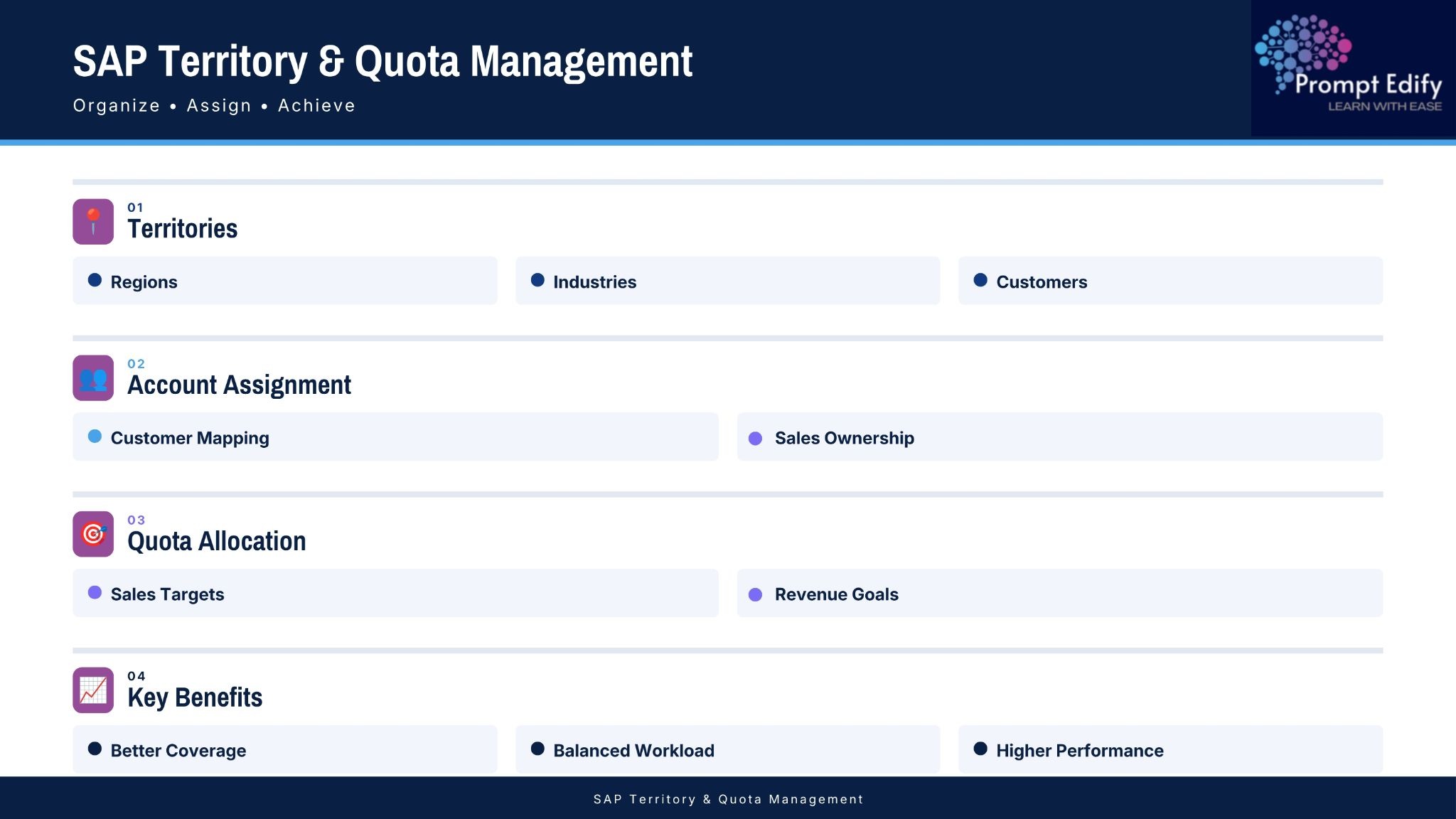
A sales territory structure refers to the process whereby an organization categorizes its markets and allocates sales responsibilities. This involves organizing territories hierarchically instead of letting the sales representatives contact their clients without any boundaries.
These territories can be categorized in various ways as follows:
Territory hierarchies may comprise parent and child territories, whereby regional sales managers have several smaller territories that are managed by individual representatives.
Territory formation is simply part of the sales process. The firm also needs to properly allocate its customers or prospective clients into different sales territories.
Account allocation refers to the connection of customer accounts with appropriate sales territories and sales representatives. This ensures that the account belongs to somebody who will manage and sell the product or service to the customers.
For instance, an industrial firm may choose to allocate large accounts to experienced sales representatives while small accounts go to regional sales representatives.
Proper account allocation prevents conflicts among the sales representatives and neglects important customers. It also makes it easy for management to monitor account allocation.
A sales quota is a quantifiable goal set for a sales person, sales team, or territory within a particular period of time. This quota could be tied to revenue, sales, number of new customers acquired, or any other measures of business performance.
The process of quota allocation can be defined as the allocation of overall business quotas among various sales teams in accordance with their roles and potential.
Generally, managers take into account such aspects as:
Thus, if a company sets itself an annual revenue quota of $5 million, it may allocate this quota among five different territories depending on their potential.
If one territory has more customers and demand than others, it will receive a bigger quota than developing territory.
Proper quota allocation ensures realistic expectations and motivation for business goals achievement.
The territory planning helps companies determine how effective the use of sales resources of the company is. Through territory planning, managers will be able to analyze territories, customer distribution and uncover opportunities that remain untapped.
Here are some significant advantages of territory planning:
Businesses need to continually review their approaches to territory and quotas, rather than thinking about them as something fixed.
Following are some best practices that can be followed:
SAP Territory and Quota Management is very important in the formation of a structured and responsible process of sales. With the help of territory hierarchy, account assignment, reasonable quota setting, and better sales coverage, organizations can properly manage their sales process.
Knowledge on the above concepts is essential in developing the necessary skills of sales planning and performance management.
Prompt Edify allows individuals to develop knowledge on SAP by providing training and education on the same. Learn about SAP through training to understand how sales operate and how businesses operate.
By Team Prompt Edify
Have any enquiry? Call us
+(27) 740294414
(+91) 99932-86938
wecare@promptedify.com


Prompt Edify Africa (PTY) Limited
2nd Floor, Rivonia VillageCnr Mutual Road and Rivonia Boulevard Rivonia Village, 2191
Johannesburg , South Africa
Contact : +27740294414
Prompt Edify East Africa Limited
KN 78 ST, Kagarama, Kigali, Kigali, Nyarugenge, Umujyi wa Kigali, Rwanda
Contact : +250 727 845 771
Prompt Edify Private Limited
4th Floor #15, City Vista Tower, Fountain Road,
Kharadi, Pune(MH), India.
PIN- 411014
Contact : (+91) 99932 86938



Contact Us Today!
+27740294414 | (+91) 99932 86938 | +250 727 845 771
contact@promptedify.com | wecare@promptedify.com
🌐 https://promptedify.co.za/