
Explore SAP Territory Management, territory hierarchies, customer account mapping, and sales responsibility to improve sales organisation and customer coverage.
Salesmen operating in different locations, industries, and business segments find it difficult to manage the increasing customer list without having any system in place. Salesmen with overlapping sales territories may end up covering the same customer while key accounts may not get enough attention and managers would be unable to measure their sales performance effectively.
By using the feature of SAP Territory Management, businesses can organize their sales function through territory management and customer account assignments. It brings about an organized approach to geographical territories, customer segments, and sales assignment.
The concept of territory assignment on SAP is especially relevant to salespeople.
The SAP Territory Management is a solution provided as a part of SAP sales management systems which enables businesses to configure their territories and assign their customer accounts to sales teams and individual salespersons.
Territory means a geographic area, industry sector, type of customers, or any other business parameter that can be used for building up territories. Thus, if the company operates on the African continent, it will have four territories corresponding to the following countries: South Africa, Kenya, Nigeria, and Egypt.
Every single territory will have its own sales person, manager, and customer accounts assigned. That makes it easier to understand who is responsible for particular customers, and sales activities become organized.
SAP Territory Management is the starting point of all territory management in SAP Sales Cloud.
One of the processes through which an organization can split its large sales territory into smaller sales territories is through territory hierarchy.
The layers are mainly:
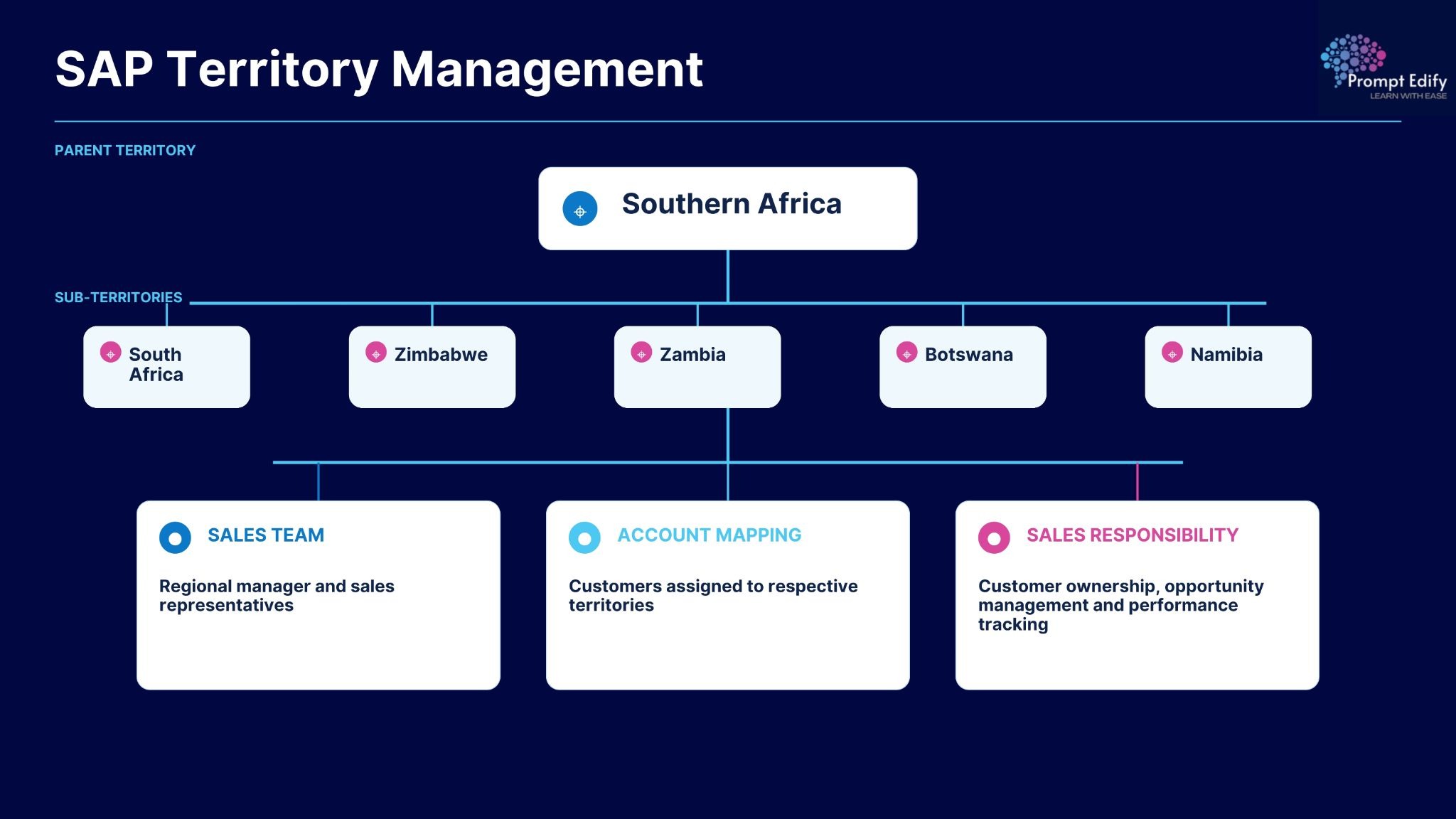
A parent territory refers to a larger territory, which could either take the form of a geographical area, a business unit or a sales region.
For instance, the organization may choose to split Southern Africa as the parent territory. The regional sales manager will be responsible for monitoring the performance and customer base within the territory.
These are small territories, which are broken down from the parent territory so as to allocate sales to different regions or customers.
For instance, the sub-territories of Southern Africa include:
South Africa
Zimbabwe
Zambia
Botswana
Namibia
In operations, sales representatives are assigned responsibilities regarding certain territories. They can perform functions such as communication with customers, managing opportunities, account development, and making sales follow-ups.
This organizational structure creates clear reporting lines and eliminates any confusions regarding the ownership of customers.
SAP territory assignment is where the customer accounts are allocated to the proper sales territories following some business rules.
The steps that normally occur during territory assignment are as follows:
This is where the geographical regions, customer groups, or industries are identified first. After that, the territories are created based on the sales strategy of the organization.
The accounts allocation method is determined. There are some of the commonly used rules, which include geographic locations, industry, account size, revenue potential and market segments.
Customer accounts are mapped to the territories using the above stated rules. For example, the customers located in Nairobi will be mapped to the Kenya territory.
Here the sales manager or administrator allocates the person/team responsible for that territory and its accounts.
The territories' analysis involves the account coverage, sales opportunities, customer interactions and performance. Territory structures can be changed.
An account map makes sure that client relationships are structured according to the sales structure of the business. Otherwise, sales departments will face duplicates in communication, ambiguity regarding the responsible party, and many other problems.
Using the account mapping method, the organization will be able to:
For instance, in case the firm launches operations in a new region, it is possible to create one more sub-region and allocate appropriate customer accounts to a local sales representative.
Sales responsibility is extremely important for sustaining good relations with the clients. As a result of every client having a dedicated owner, sales professionals are aware of the clients that they are responsible for.
Sales management will also be able to assign work in a balanced way with the help of territory management. It will allow sales managers not to overload some representatives with too many accounts.
Furthermore, it will facilitate sales forecasting and evaluation of the sales staff as well.
Sales territory and account management is a subject that can prove useful for you in building yourself as a specialist in sales management. Specialists dealing with SAP Sales Cloud may benefit from studying other domains like Account & Contact Management, Sales Activities & Task Management, Sales Pipeline Management & Forecasting, and SAP Sales Cloud Configuration & Implementation Basics.
The training course that we offer you in SAP Sales Cloud will give you information about the sales process, customers, opportunities, forecasting, and platform features.
Find out more about our course and increase your expertise in SAP Sales Cloud.
Increase Your Expertise in SAP Sales Cloud with Prompt Edify.
By Team Prompt Edify
Have any enquiry? Call us
+(27) 740294414
(+91) 99932-86938
wecare@promptedify.com

Prompt Edify Africa (PTY) Limited
2nd Floor, Rivonia VillageCnr Mutual Road and Rivonia Boulevard Rivonia Village, 2191
Johannesburg , South Africa
Contact : +27740294414
Prompt Edify East Africa Limited
KN 78 ST, Kagarama, Kigali, Kigali, Nyarugenge, Umujyi wa Kigali, Rwanda
Contact : +250 727 845 771
Prompt Edify Private Limited
4th Floor #15, City Vista Tower, Fountain Road,
Kharadi, Pune(MH), India.
PIN- 411014
Contact : (+91) 99932 86938



Contact Us Today!
+27740294414 | (+91) 99932 86938 | +250 727 845 771
contact@promptedify.com | wecare@promptedify.com
🌐 https://promptedify.co.za/