
Explore SAP TM implementation steps, from process mapping and configuration to ERP/EWM integration, testing, deployment, user training and ongoing support today
SAP Transportation Management, often abbreviated to SAP TM, is software that is deployed by companies in order to plan, execute, control and manage their transportation processes. The transportation processes include transportation planning, freight order management, carrier management, shipment management, and freight cost management.
SAP TM implementation involves the installation and implementation of SAP Transportation Management in order to address the transportation and logistics requirements of the company.
SAP TM implementation process involves requirements gathering, process design, configuration, integration with other SAP modules, and testing before implementation.
A proper SAP TM implementation will enable organizations to carry out their transportation processes efficiently and cost-effectively.
The first step that must be made before configuring the SAP Transportation Management system is collecting requirements. It is impossible to configure the system without understanding what the current transportation processes and goals are.
The consultants interview the business representatives and collect information about how the current transportation processes operate and what changes are required.
This information is very important:
Process mapping provides the consultants with the information about how the transportation processes should work in the SAP TM system.
Following the identification of business requirements, the next stage would be to design the solution. Consultants would be required to create a technical and functional design in order to detail how SAP TM will help organizations to manage their transportation operations.
In the solution design stage, consideration must be made about Transportation planning processes, Freight management, System integration, and Reporting needs.
Additionally, organizations would need to make a decision regarding the deployment of the system. SAP TM may be deployed either as an embedded solution within SAP S/4HANA or as a decentralized system according to business requirements.
Considerations would include:
Master data preparation is one of the crucial steps of SAP TM implementation. The proper master data is needed for the effective execution and planning of transportation processes.
The examples of common master data are as follows: business partners, locations, products, transportation lanes, carriers, and transportation resources.
After the master data preparation, consultants configure SAP TM to match the company's business needs.
SAP TM configuration involves the following activities:
Proper SAP TM configuration guarantees that transportation processes will be performed in accordance with the operational needs of the company.
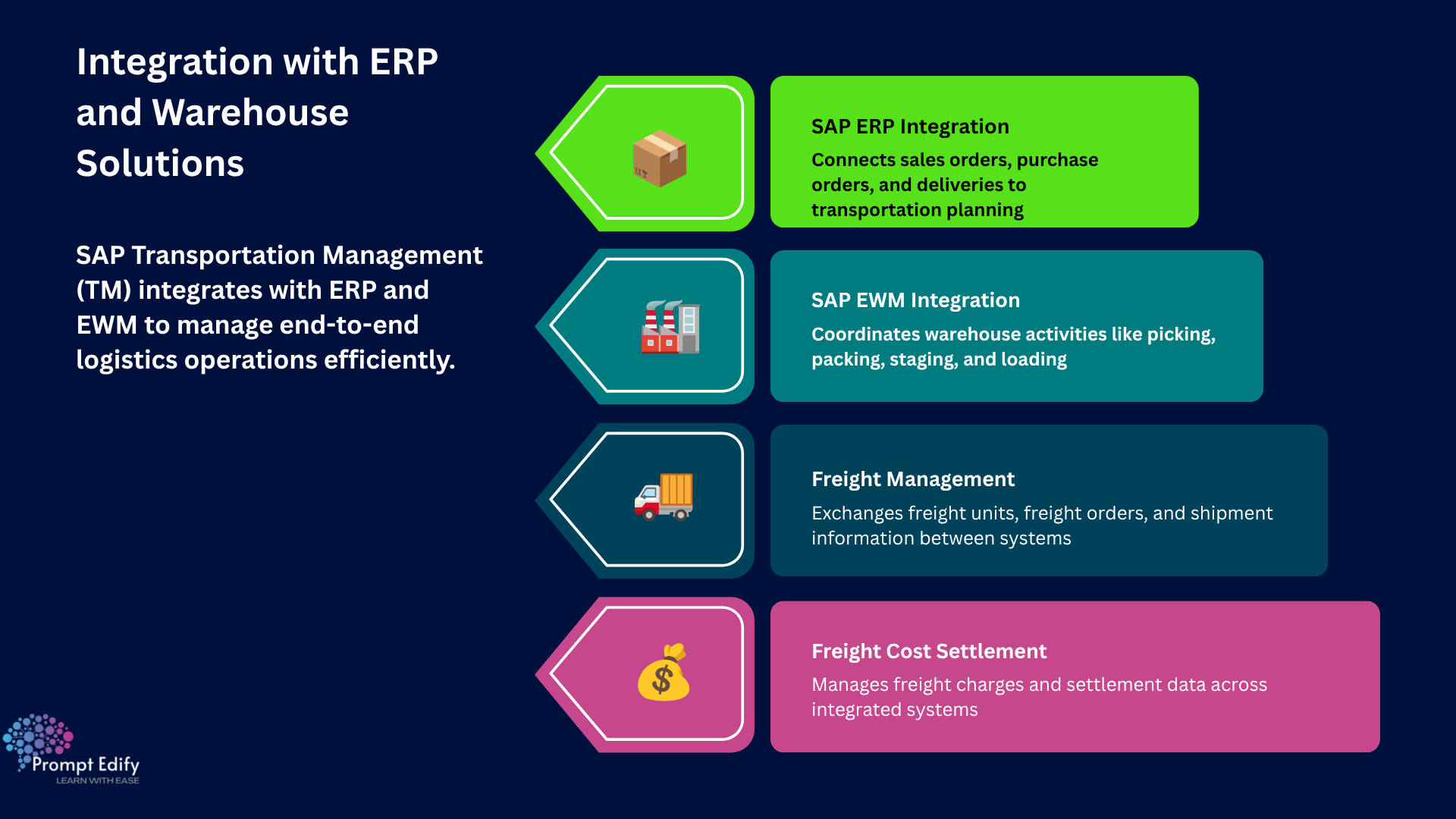
There is no denying the fact that the SAP Transportation Management component should integrate with other business solutions to manage end-to-end logistics processes.
Integration with SAP ERP or SAP S/4HANA would facilitate transportation requirements generation through the use of business transactions such as sales orders, purchase orders and deliveries.
Integration with SAP Extended Warehouse Management (EWM) connects the transportation planning process with warehouse operations including picking, packing, staging, loading and goods issuance.
Following are some important integrations which need to be carried out:
Everything depends upon the deployment and business process configuration.
It is very important to conduct testing before deploying SAP TM into the production environment. Thanks to testing, one can find the errors related to system configuration, integration, and business processes.
The main goal of SAP TM testing is to ensure the proper work of the transportation processes meeting all the business requirements.
Test Types:
The testing is needed in case of exceptions, invalid master data, unsuccessful document exchange, changes in transportation.
In the case of a successful testing phase the implementation phase takes place and involves deployment. Before the go-live activities take place, the organizations should train the end users and prepare the system to start working effectively.
The key steps include:
After the deployment, the support team evaluates the system performance, fixes technical issues and assists with management of transportation processes.
There could be a number of challenges faced during implementation. Some of the common challenges include wrong master data, difficult business requirements, failed integrations, wrong configurations, and lack of proper user training.
To successfully get rid of these challenges, organizations must have an effective SAP TM implementation approach that includes regular testing and correct master data management.
The process of implementing SAP TM entails a number of different stages such as requirement analysis of the business, solution design, master data preparation, configuration, integration, testing, and finally deployment.
Learning about the different implementation steps of SAP Transportation Management will definitely enable consultants and firms to plan their implementations well.
Looking for practical knowledge on SAP Transportation Management? Reach out to Prompt Edify for your SAP TM Training programs.
By Team Prompt Edify
Have any enquiry? Call us
+(27) 740294414
(+91) 99932-86938
wecare@promptedify.com


Prompt Edify Africa (PTY) Limited
2nd Floor, Rivonia VillageCnr Mutual Road and Rivonia Boulevard Rivonia Village, 2191
Johannesburg , South Africa
Contact : +27740294414
Prompt Edify East Africa Limited
KN 78 ST, Kagarama, Kigali, Kigali, Nyarugenge, Umujyi wa Kigali, Rwanda
Contact : +250 727 845 771
Prompt Edify Private Limited
4th Floor #15, City Vista Tower, Fountain Road,
Kharadi, Pune(MH), India.
PIN- 411014
Contact : (+91) 99932 86938



Contact Us Today!
+27740294414 | (+91) 99932 86938 | +250 727 845 771
contact@promptedify.com | wecare@promptedify.com
🌐 https://promptedify.co.za/