
Explore SAP TM integration with SAP S/4HANA, ERP and EWM, including orders, deliveries, freight units, execution, logistics data exchange and troubleshooting.

SAP Transportation Management (SAP TM) is a piece of software that helps businesses plan, execute, control, and manage their transportation operations. SAP TM can be used for planning, logistics, carrier selection, shipment, and transportation cost settlement.
The integration of SAP TM Integration with SAP S/4HANA helps companies to connect their transportation process to other business processes such as sales, procurement, inventories, warehousing, and accounting.
The integration of SAP TM helps companies to facilitate the exchange of business information between different systems.
Transportation planning needs sales orders and outbound deliveries data. Relevant data is fed into SAP TM by ERP or SAP S/4HANA systems to detect transportation needs.
For instance, in case there is a customer order, then it processes the sales order and generates the outbound delivery once the goods are ready to be shipped. Delivery data is thus fed into SAP TM for transportation planning.
These are some of the main integration processes that take place:
Requirements for transportation indicate that it is necessary to transport products from one place to another. This process is done in SAP TM, using order and delivery data.
The transportation requirements can then be transformed into freight units, which are planning objects in the field of transportation.
The information included in freight units includes:
In SAP TM, transportation planning is performed through freight units. Several freight units may be grouped together to make freight orders.
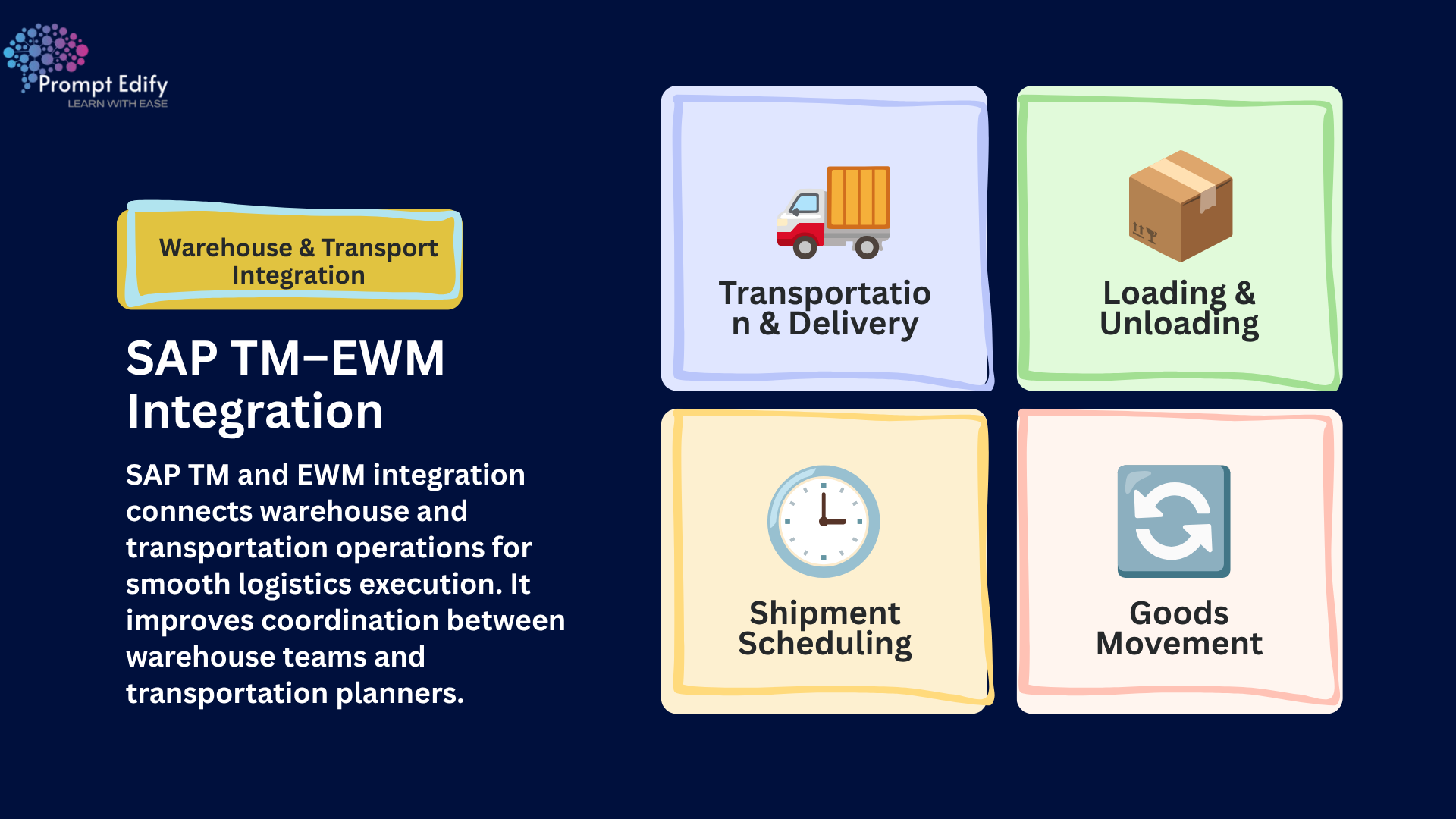
SAP EWM takes care of warehouse management functions such as goods receipt, storage, picking, packing, and goods issue. SAP TM takes care of the transportation function associated with warehouse operations.
Integration of SAP TM and EWM allows both the systems to communicate and coordinate warehouse and transportation functions.
Some important integration functions include:
For instance, SAP TM can share shipment and loading details that would help in the planning function of SAP EWM. When the goods are ready for dispatch, the required execution data is exchanged between the two systems.
This allows coordination between warehouse and transportation personnel.
SAP TM can be integrated with SAP ERP and SAP S/4HANA to tie up the transportation process and business process.
With SAP TM ERP Integration, business transactions and master data would be exchanged between the two applications. The typical documents that can be exchanged are sales orders, purchase orders, deliveries, business partner, goods, and locations.
With SAP TM Integration with SAP S/4HANA, the organization would be able to handle its transportation requirements using its core ERP application utilizing the data from its core ERP application.
Depending upon the architecture of the system, SAP TM can be implemented either as an integrated application in SAP S/4HANA or as a stand-alone application. The integration approach would depend upon how SAP TM has been implemented.
The following are the typical integration points:
The execution of freight is done when the process of freight planning is completed. The SAP TM system offers freight order management, freight coordination, freight shipment and monitoring, and freight settlements.
When executing the freight, the SAP TM system communicates with the carriers and logistics service providers along with other systems.
Some of the important data exchanges are as follows:
The SAP TM integration is implemented by companies depending on the logistics scenario that will meet their requirements.
These examples include the following:
During the integration process, companies may face issues including the lack of master data, incorrect document mapping, failed data transfer and inconsistent delivery statuses.
In order to resolve these issues, consultants need to ensure that proper connections, correct integration configurations, similar document statuses, consistent master data and no errors in the application log are made.
The integration of SAP TM with SAP S/4HANA, ERP, EWM, and other logistics software plays a vital role in building up a holistic transportation and logistics system for organizations. It is helpful in planning the transportation process, coordination of warehouses, implementation of transportation, and logistics visibility.
The knowledge of SAP TM integration process is required by SAP TM consultants and professionals who wish to work in the real-world transportation and logistics scenario.
Do you want to learn about SAP TM and its real-world use cases regarding integration? Contact Prompt Edify for professional SAP Transportation Management Training.
By Team Prompt Edify
Have any enquiry? Call us
+(27) 740294414
(+91) 99932-86938
wecare@promptedify.com


Prompt Edify Africa (PTY) Limited
2nd Floor, Rivonia VillageCnr Mutual Road and Rivonia Boulevard Rivonia Village, 2191
Johannesburg , South Africa
Contact : +27740294414
Prompt Edify East Africa Limited
KN 78 ST, Kagarama, Kigali, Kigali, Nyarugenge, Umujyi wa Kigali, Rwanda
Contact : +250 727 845 771
Prompt Edify Private Limited
4th Floor #15, City Vista Tower, Fountain Road,
Kharadi, Pune(MH), India.
PIN- 411014
Contact : (+91) 99932 86938



Contact Us Today!
+27740294414 | (+91) 99932 86938 | +250 727 845 771
contact@promptedify.com | wecare@promptedify.com
🌐 https://promptedify.co.za/