
Learn about SAP WM Training, course modules, warehouse processes, practical skills, and how to evaluate a training syllabus before enrolling in a course today.

The proper management of the warehouse is very important to organizations handling huge materials, inventories, and customer orders. The SAP Warehouse Management system (SAP WM) helps businesses in managing their warehouse activities, tracking movements, and increasing efficiency. Being familiar with the SAP WM module will provide you with an idea of how warehouse activities are managed using the SAP system.
When seeking SAP WM training, understanding the curriculum of such courses will help you decide whether the course fits your career objectives.
A proper SAP WM training program should combine warehouse operations and SAP functionality for managing them. Rather than selecting your program only because of the number of modules, see if the course highlights the relationship between various warehouse operations.
Topics in an SAP WM training program can be expected to include topics like the organizational structure of the warehouse, master data, inbound and outbound processes, transfer orders, inventory management, and stock movements. The training program should also contain monitoring and reporting and basics of configuration.
Practical sessions should not be overlooked when selecting your SAP WM training program. A training program that uses business cases, system practices, and various issues in the warehouse environment will prove beneficial for you.
One of the basic steps towards learning SAP WM is to comprehend the organisational structure of the warehouse. The organisation of the warehouse consists of several organisational levels for efficient storage and management of materials.
The following organisational structures must be taught in the SAP WM training course:
Master data to be understood comprises material master data, material data in warehouse and storage bin data.
The inbound and outbound processes play an important role in the warehouse operation. The SAP WM training class should cover how materials are loaded into the warehouse, stored, and then unloaded to meet operational needs.
Inbound processes start with the receiving of goods. The processes covered by the software include the goods receipt, putaway planning, and storage. The learner will learn how to assign received goods to the appropriate storage location.
Outbound processes deal with getting materials ready for shipment. These processes include the stock removal, pick, staging, and goods issue processes. The training will teach how to handle delivery requests and get the materials out of the warehouse storage.
Requirement and order for transfer are crucial aspects in SAP WM since they control the flow of stocks.
The Transfer Requirement (TR) expresses the need for moving goods either from or to warehouse stocks. It means that TR is a requirement for warehouse movement.
Transfer Order (TO) is used to perform and document the movement of goods from one storage bin to another or warehouse location.
In an ideal training session, learners will be made to understand how to create, process, confirm, and monitor transfer orders using practical examples.
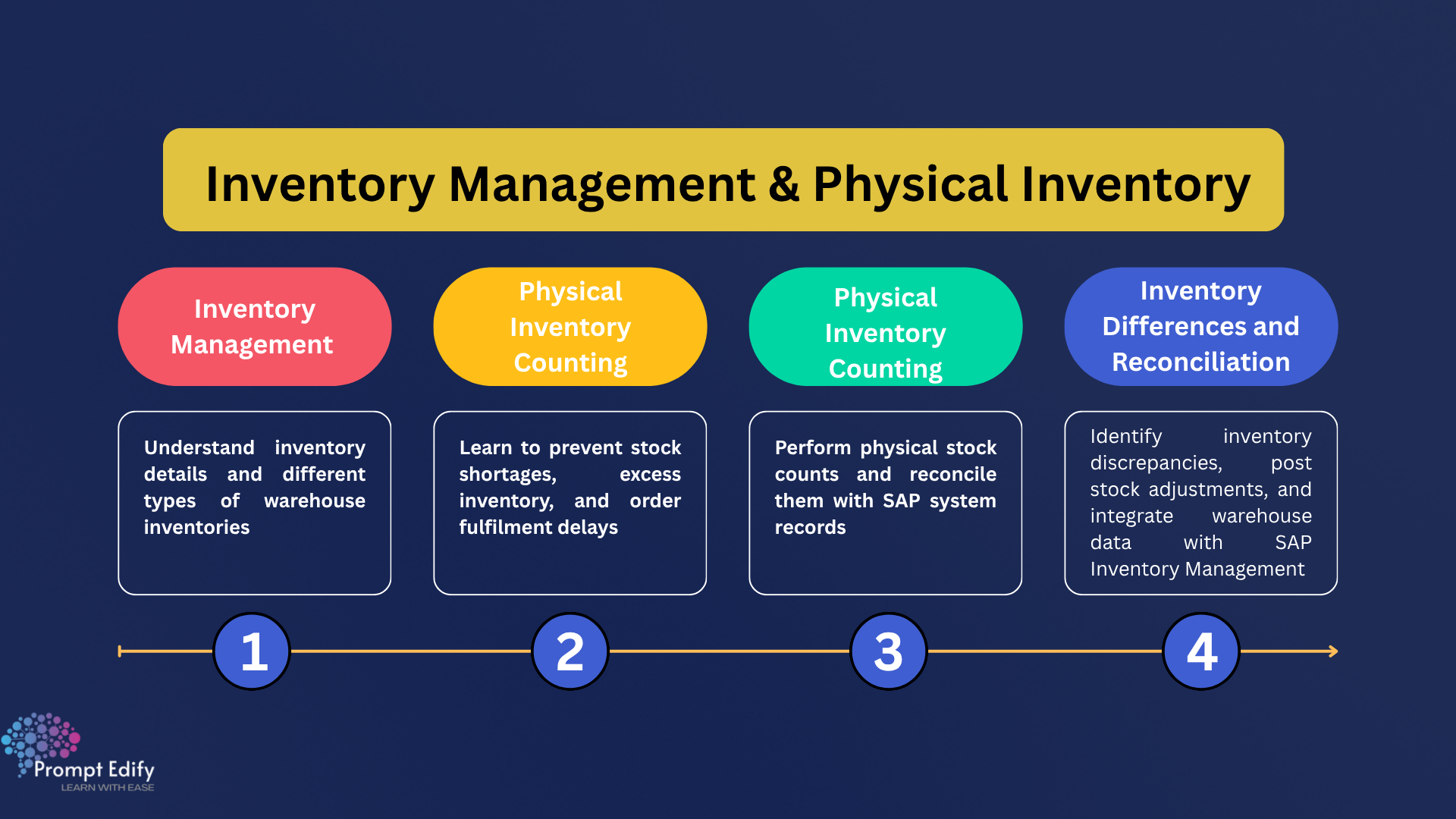
Inventory details will help in preventing shortages, surplus inventories, and delays in fulfilling orders. The SAP WM training program needs to include the management of inventories in the warehouses.
Some of the key areas include inventory details, types of inventories, inventory differences, and physical inventory counting. Trainees need to learn how physical inventories are reconciled with inventory data in the system and how inventory discrepancies are posted.
They should also learn about how warehouse inventory data links to inventory management in SAP in general.
Putaway and picking are part of daily warehouse operations. Putaway is the activity of storing the received material in the right storage bin whereas picking means extracting the materials in order to satisfy orders or other requirements within the warehouse.
In the SAP WM curriculum, it is necessary to cover issues related to storage techniques and stock withdrawal processes. This can be done using techniques such as fixed-bins storage, open storage, and others like FIFO, for example, based on the situation.
It will also be helpful for learners to know how the system identifies the right storage location and assists in the stock movement activities.
A comprehensive SAP WM curriculum must consider much more than warehouse transactions in its syllabus. Learners must be familiarized with tools for monitoring, reporting and configuration.
Learning the procedures for checking the stock, open transfer orders, pending processes and identifying processing problems will enable users to monitor their warehouse processes and analyze the errors that are encountered frequently.
As far as the configuration is concerned, some basic issues that learners must be made aware of could include those related to warehouse structure settings, storage types, movement types, among others.
Before joining any SAP WM module, it is important that you consider the following questions:
Just because a module covers many more topics than other modules does not necessarily mean that it would be good for you. Choose the most suitable modules for yourself according to your process flow, experience and career objectives.
Knowledge in SAP WM will enable individuals to learn how companies set up their warehouse architecture, manage inventories, move their stock, and meet their delivery needs. An efficient SAP WM Training Program should incorporate key concepts, critical course subjects, exercise, and configuration.
For those looking to improve on their warehouse management skills and also find job openings in SAP, connect with Prompt Edify to learn more about its SAP training courses.
By Team Prompt Edify
Have any enquiry? Call us
+(27) 740294414
(+91) 99932-86938
wecare@promptedify.com


Prompt Edify Africa (PTY) Limited
2nd Floor, Rivonia VillageCnr Mutual Road and Rivonia Boulevard Rivonia Village, 2191
Johannesburg , South Africa
Contact : +27740294414
Prompt Edify East Africa Limited
KN 78 ST, Kagarama, Kigali, Kigali, Nyarugenge, Umujyi wa Kigali, Rwanda
Contact : +250 727 845 771
Prompt Edify Private Limited
4th Floor #15, City Vista Tower, Fountain Road,
Kharadi, Pune(MH), India.
PIN- 411014
Contact : (+91) 99932 86938



Contact Us Today!
+27740294414 | (+91) 99932 86938 | +250 727 845 771
contact@promptedify.com | wecare@promptedify.com
🌐 https://promptedify.co.za/