
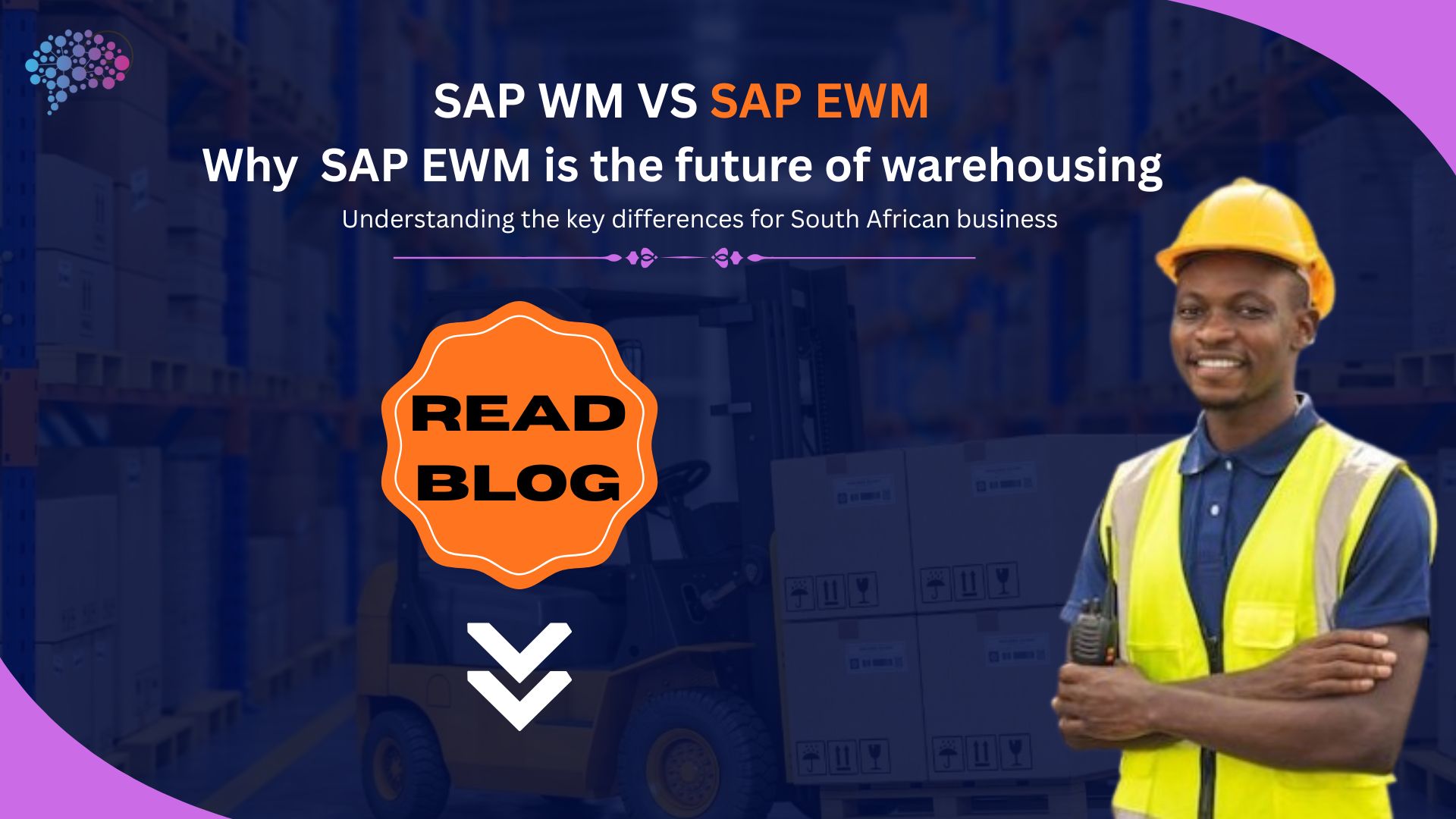
In the heart of South Africa’s logistics hubs, from the busy ports of Durban to the massive distribution centers in Johannesburg and Cape Town, the pressure to modernize is mounting. For years, many South African giants like Coca-Cola Beverages Africa, Aspen Pharma, and Ackermans have relied on robust systems to keep their supply chains moving. However, as global digital transformation accelerates in 2026, the conversation has shifted from if you should upgrade your warehouse technology to when.
For businesses currently running on the classic SAP ERP (ECC), the transition to SAP S/4 HANA brings a critical choice. You must decide between staying with the traditional SAP WM (Warehouse Management) or moving to the more powerful SAP EWM (Extended Warehouse Management). To stay ahead in a competitive market, understanding this shift is vital.
SAP WM has been the reliable workhouse of the SAP ERP ecosystem for decades. It provides basic functionality for managing inventory at the bin level, handling simple putaway and picking processes. For a local warehouse in Gqeberha or a smaller manufacturing site in East London with straightforward requirements, WM has historically been enough.
However, SAP WM is considered legacy technology. While it covers the essentials, it lacks the agility needed for the high volume automated environments that modern South African retail and logistics now demand. It was designed for an era before real time data and robotics became the standard.
SAP EWM is not just an upgrade. It is a complete reimagining of how a warehouse functions. Designed for the SAP S/4 HANA era, EWM handles complex processes that WM simply cannot touch. It is built for high speed operations where precision and real time data are non-negotiable.
Whether you are managing a massive facility in Midrand or a specialized cold chain hub in Stellenbosch, EWM provides the flexibility to optimize every square meter of your facility.
Understanding why EWM is superior requires looking at the technical and functional gaps between the two systems.
.jpg)
South Africa’s logistics landscape is unique. Our distances are vast and our supply chains are often impacted by infrastructure challenges. Companies like Imperial Logistics and Barloworld understand that efficiency in the warehouse is a competitive advantage. Here is why EWM is the essential choice for 2026 and beyond.
The move to SAP S/4 HANA is no longer a distant goal for South African enterprises. It is a current reality. EWM is the target architecture for this new era. While SAP offers a Stock Room Management option for those who want to keep basic WM like features, it is a dead end street with no new innovations. To leverage the full power of in memory computing and real time analytics, EWM is the only logical path.
As labor costs rise and the need for speed increases in Ethekwini or Centurion distribution hubs, automation is becoming standard. SAP EWM features a built in Material Flow System. This allows your SAP system to talk directly to automated guided vehicles and conveyor belts without needing expensive third party software.
In the old WM world, knowing exactly where a pallet was often required manual checks. With EWM, you get a Warehouse Management Monitor that acts as a central command center. Managers in Pretoria or Bloemfontein can see real time KPIs and identify bottlenecks instantly. This ensures that deliveries to the Northern Cape or Limpopo stay on schedule.
Implementing such a sophisticated system requires a workforce that knows how to use it. This is where Prompt Edify becomes an essential partner. As a leader in SAP training and corporate coaching, Prompt Edify helps South African teams bridge the skills gap. By providing hands-on experience with SAP S/4 HANA and EWM, they ensure your staff can navigate the new system with confidence. Prompt Edify has created role-based SAP courses for banking and finance personnel that include SAP Business One (B1), SAP S/4HANA End-User, SAP Finance (FICO), SAP MM, SAP Procurement, and Reporting. Prompt Edify's role-based SAP courses increase accuracy in finance, process transparency, and readiness for audits
The sunset of mainstream support for older SAP versions is drawing closer. For South African companies, the risk of staying on legacy SAP WM includes not just a lack of support but a lack of scalability. Whether you are a logistics provider in Polokwane or a retail giant in Sandton, the move to SAP EWM ensures your warehouse becomes a strategic asset rather than a bottleneck.
Across the African continent, from Nigeria and Kenya to our local hubs in South Africa, Prompt Edify delivers comprehensive training to banking and financial professionals. This includes commercial banks, fintech organizations, and government regulators who need to align their SAP ERP systems with modern financial standards.
In one specific case, a major client saw a dramatic transformation after their team completed training with Prompt Edify. By mastering the latest SAP technology, they achieved higher accuracy in financial reporting and faster closing of monthly accounts. This hands-on experience allowed their teams to better align their technology with the unique functional requirements of operating within the African banking sector.
The debate between SAP WM and SAP EWM is effectively over. While WM served us well during the era of traditional SAP ERP, the speed of modern business requires the Extended capabilities of EWM. By adopting EWM on SAP S/4 HANA and upskilling your team with Prompt Edify, your business can reduce operational costs and future proof its operations against the challenges of a global economy.
By Team Prompt Edify
Have any enquiry? Call us
+(27) 740294414
(+91) 99932-86938
wecare@promptedify.com

Prompt Edify Africa (PTY) Limited
2nd Floor, Rivonia VillageCnr Mutual Road and Rivonia Boulevard Rivonia Village, 2191
Johannesburg , South Africa
Contact : +27740294414
Prompt Edify East Africa Limited
KN 78 ST, Kagarama, Kigali, Kigali, Nyarugenge, Umujyi wa Kigali, Rwanda
Contact : +250 727 845 771
Prompt Edify Private Limited
4th Floor #15, City Vista Tower, Fountain Road,
Kharadi, Pune(MH), India.
PIN- 411014
Contact : (+91) 99932 86938



Contact Us Today!
+27740294414 | (+91) 99932 86938 | +250 727 845 771
contact@promptedify.com | wecare@promptedify.com
🌐 https://promptedify.co.za/