
Discover spend analysis in procurement, its key steps, spending patterns, supplier evaluation, category opportunities and ways to improve cost visibility.

Each business requires money to purchase products and materials necessary for the operation. In case there is no control in place, it may be hard for the procurement team to track how the money is spent, which companies get the largest amounts and whether the purchasing process results in any benefits. This is where spending analysis in procurement comes in handy.
Spending analysis allows businesses to track and analyze information about purchases and expenses. It helps to identify certain trends in procurement and find ways to save money on it.
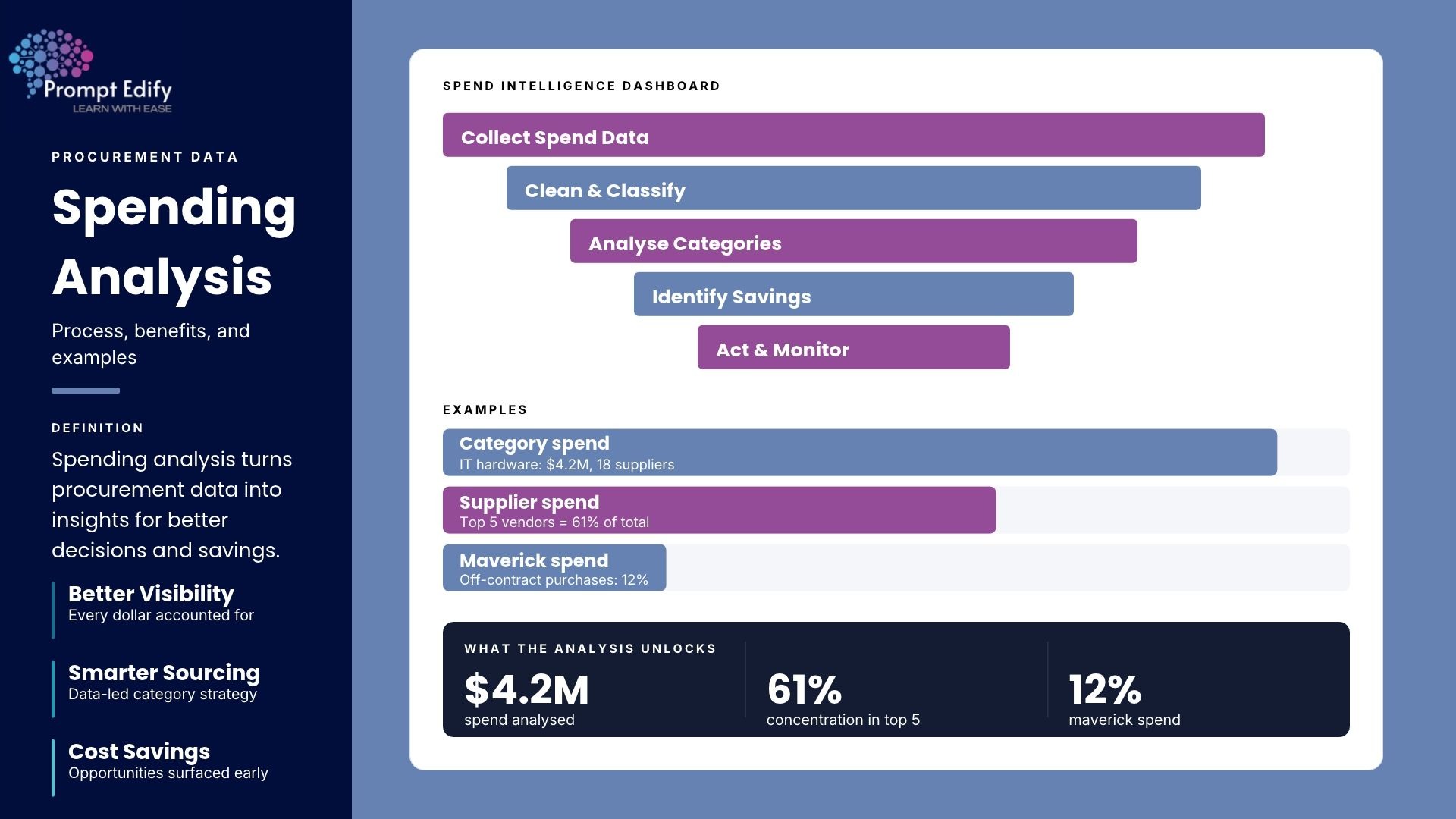
Spend Analysis in Procurement refers to the collection, classification, investigation and interpretation of purchasing expenditure in an organization. This entails the review of transaction records, supplier invoices, purchase orders and all other information that relates to procurement in order to establish spending trends.
The primary purpose is to ensure visibility into expenditure in the organization. Through spend analysis, it is possible to know how much money is spent, what departments are buying goods and services, which suppliers are being paid and areas where there may be unneeded expenses.
For instance, an organization that operates in several regions may purchase identical office supplies from various suppliers and at varied prices. This will be determined through spend analysis.
In order to conduct spend analysis, it is essential for organizations to be aware of the vital aspects involved in this process.
Spending behavior depicts how the procurement budget of the organization is being used during a particular period of time. These are used to determine frequently purchased goods, recurring expenses, seasonal needs and variations in buying patterns.
For instance, in a manufacturing organization, there might be a variation in the spending pattern of procurement of raw materials in certain months.
Spend profile presents the organized description of expenditure in the organization. The expenditure of the organization is organized based on suppliers, department, business unit, location or material type.
This enables procurement managers to have an insight into where the biggest chunk of the budget is spent.
The study of categories will assist organizations in finding ways of improving procurement activities within the different categories.
This means that an organization buying packaging products from several sellers will find out that ordering from a few selected sellers might improve procurement costs.
Procurement cost visibility involves having full knowledge regarding procurement costs in the organization. It helps in identifying hidden costs, duplicate procurement, cost differentials and unnecessary costs.
A spend analysis process normally has different steps that depend on the need for the analysis and availability of procurement data.
Step 1: Gathering of Procurement Information
Information related to purchases can be gathered from many sources including purchase orders, invoices, supplier records, procurement systems and financial databases.
Gathering information from various departments enables the formation of a bigger picture regarding the expenditure in an organization.
Step 2: Cleaning and Organization of Information
Data in procurement can be duplicated, have missing information, incorrect information, inconsistent product description and classifications.
Cleaning and organizing of the data improves the quality of information that will be analyzed.
Step 3: Classification of Expenditures
Classification of expenditures is based on the purchasing category which could include raw materials, IT equipment, transport, office supplies and professional services among others.
Step 4: Analysis of Spend Trends
This is followed by analysis of spend trends, relationship with suppliers, procurement frequency, and pricing.
Spend analysts will be able to detect unusual spend amounts, areas that are costly, and supplier consolidation.
Step 5: Identifying Areas of Savings
Areas of savings will include negotiation of supplier terms, elimination of duplicate spends, development of good procurement policies and supplier consolidation.
Step 6: Monitoring and Reviews
Spend analysis is an ongoing process and not a one-off.
There are many benefits that can be reaped through adopting a good spend analysis process.
An instance of spend analysis would be where a manufacturing firm is sourcing raw materials from 15 different suppliers. On analyzing its procurement records, the team finds that some of the suppliers are supplying the same material but at different prices. As a result, the organization gains insight on negotiating better prices and consolidating certain purchases.
Another case would be where a firm that operates from different offices realizes that its various departments have been buying laptops and computer accessories independently. This fragmented buying process is revealed by spend analysis.
Such examples show the practical use of spending information.
Spend Analysis in Procurement aids an organization to gain insight into their procurement practices, visibility on cost and financial control. Procurement departments can analyze spending behavior through accurate data collection, spending profile creation, category level expenditure analysis, and monitoring of supplier costs.
Organizations that wish to enhance their knowledge and comprehension on SAP based business processes can consider Prompt Edify’s professional learning programs which allow organizations to gain expertise in SAP procurement solutions and purchasing processes.
Get in touch with Prompt Edify to explore professional learning programs on SAP procurement solutions.
By Team Prompt Edify
Have any enquiry? Call us
+(27) 740294414
(+91) 99932-86938
wecare@promptedify.com


Prompt Edify Africa (PTY) Limited
2nd Floor, Rivonia VillageCnr Mutual Road and Rivonia Boulevard Rivonia Village, 2191
Johannesburg , South Africa
Contact : +27740294414
Prompt Edify East Africa Limited
KN 78 ST, Kagarama, Kigali, Kigali, Nyarugenge, Umujyi wa Kigali, Rwanda
Contact : +250 727 845 771
Prompt Edify Private Limited
4th Floor #15, City Vista Tower, Fountain Road,
Kharadi, Pune(MH), India.
PIN- 411014
Contact : (+91) 99932 86938



Contact Us Today!
+27740294414 | (+91) 99932 86938 | +250 727 845 771
contact@promptedify.com | wecare@promptedify.com
🌐 https://promptedify.co.za/