
Understand supplier lifecycle management, including identification, registration, onboarding, qualification, performance evaluation and supplier status changes.
Each company has to use the services of suppliers for getting necessary raw materials, products and services. Nevertheless, working with suppliers means not only choosing a contractor and issuing purchasing orders but identifying appropriate suppliers, gathering necessary information about them, evaluating their capabilities and maintaining the business relationship with them.
Coordinating all these actions needs a certain methodology. This is the moment when supplier lifecycle management comes into play. Supplier lifecycle management helps to control relations with suppliers starting from identifying them up to the end of the relations with them. This knowledge is helpful for those who are interested in procurement, supply chain and SAP learning.
Supplier lifecycle management is the whole process involved in the management of a supplier's relationship within an organisation during their business relationship.
There are various activities that are part of the process including identifying the supplier, registering the supplier, onboarding the supplier, qualifying the supplier and managing performance.
The main goal is to make sure that organisations use the right suppliers who are capable of meeting their business needs, adhering to the policies and delivering their goods/services accordingly.
The supplier lifecycle management usually includes certain stages which might differ according to the procurement policy of the organisation.
In this stage, the procurement department will identify potential suppliers who may offer the required products or services.
The procurement department may conduct a search for suppliers through industrial contacts, recommendations, databases and so forth.
While doing that, the organisation will evaluate various parameters such as experience of the supplier, availability of the products or services, technical skills and so forth.
The aim of this stage is to create a list of potential suppliers who might suit the needs of the organisation.
After identifying the suppliers, organisations gather the necessary information that is needed for establishing the business relationship.
Information that is required for supplier registration normally includes the following:
Registration of accurate information will assist organisations in keeping track of their suppliers.
Supplier onboarding refers to the process where the supplier is formally introduced and set up in the procurement environment of the organisation.
This could be the process of verifying the documents, reviewing internally, communicating the business policy and other administrative tasks to complete.
Onboarding could also depend on the organisations where it could be the process of accessing the system, making payment arrangements, etc.
This is the process of determining whether the supplier has the capabilities to meet the necessary requirements to conduct business with the organization or participate in the specific procurement procedures.
This can be done through use of the following criteria:
The outcomes of the supplier evaluation process will help the organization to determine whether the supplier is qualified enough to operate in a particular category, project or business.
This is not the end of the supplier management process. The organization must continue evaluating its suppliers to determine whether they are meeting its expectations.
Performance measurement will include time of delivery, product quality, service provision, pricing, compliance and issue resolution.
Ongoing evaluations will help procurement professionals to determine performance gaps, identify good suppliers and formulate ways of improving performance where need be.
The business relationship of a supplier can be altered at various points. The supplier can become approved, inactive, restricted, or unsuitable for any future work.
The alterations in the supplier’s position can be made on account of performance, expiry of documentation, compliance problems, restructuring, or termination of the business relationship.
It is important for the organisations to keep the proper record and take the required approvals within their organisation in case of supplier’s position changes.
In case of the termination of supplier’s relationship, the organisations may need to settle any pending payments and close the supplier’s account in the system.
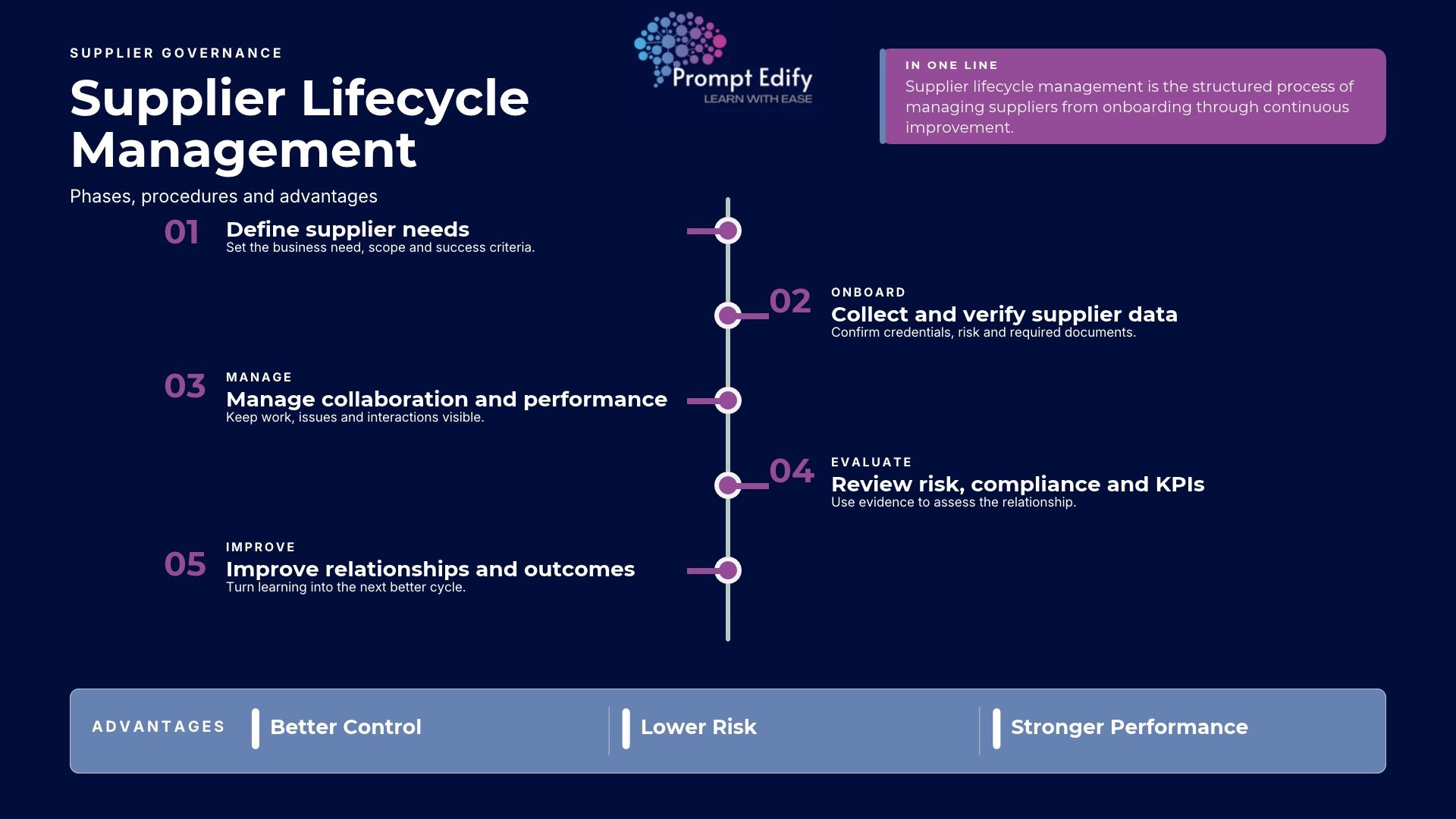
An efficient supplier lifecycle management system offers many benefits.
There are different solutions provided by SAP that can be helpful in managing supplier processes. However, depending on the particular products used in the organization, some functionality can be applied.
In particular, SAP Ariba Supplier Lifecycle and Performance is the solution that can facilitate the supplier registration, qualification, segmentation, and performance management processes.
SAP Business Network allows buyers and suppliers to communicate and exchange necessary business information and procurement documentation.
SAP S/4HANA allows managing the supplier master data and other supplier processes in procurement and billing.
These products can be integrated into a combined solution of supplier management. However, not all phases of the supplier lifecycle management can be managed through the same SAP product.
Supplier Lifecycle Management is one concept that needs to be understood by procurement professionals, supply chain management professionals, SAP consultants, and even procurement beginners.
Prompt Edify provides SAP training courses that can enable you to learn more about SAP solutions, business processes and procurement. Find out about the available SAP training programs.
By Team Prompt Edify
Have any enquiry? Call us
+(27) 740294414
(+91) 99932-86938
wecare@promptedify.com


Prompt Edify Africa (PTY) Limited
2nd Floor, Rivonia VillageCnr Mutual Road and Rivonia Boulevard Rivonia Village, 2191
Johannesburg , South Africa
Contact : +27740294414
Prompt Edify East Africa Limited
KN 78 ST, Kagarama, Kigali, Kigali, Nyarugenge, Umujyi wa Kigali, Rwanda
Contact : +250 727 845 771
Prompt Edify Private Limited
4th Floor #15, City Vista Tower, Fountain Road,
Kharadi, Pune(MH), India.
PIN- 411014
Contact : (+91) 99932 86938



Contact Us Today!
+27740294414 | (+91) 99932 86938 | +250 727 845 771
contact@promptedify.com | wecare@promptedify.com
🌐 https://promptedify.co.za/