
Understand the supplier registration process in SAP Ariba, from initial requests and information collection to questionnaire completion, reviews and approvals.

Suppliers are one of the key players in procurement activities in any organization. Every organization depends on suppliers for products, raw materials and services which it requires for its day-to-day functioning. But, before establishing a business relationship, there is a need for collecting data about the supplier, validating it and checking whether it fits their criteria or not.
Manually managing all these activities via emails, spreadsheets and documents may result in confusion and delay in the process. This is where the Supplier Onboarding and Registration in SAP Ariba comes into picture. It assists the organizations in organizing the supplier data and managing the activities of supplier registration.
It is important to understand the supplier request, registration questionnaire and information validation activities.
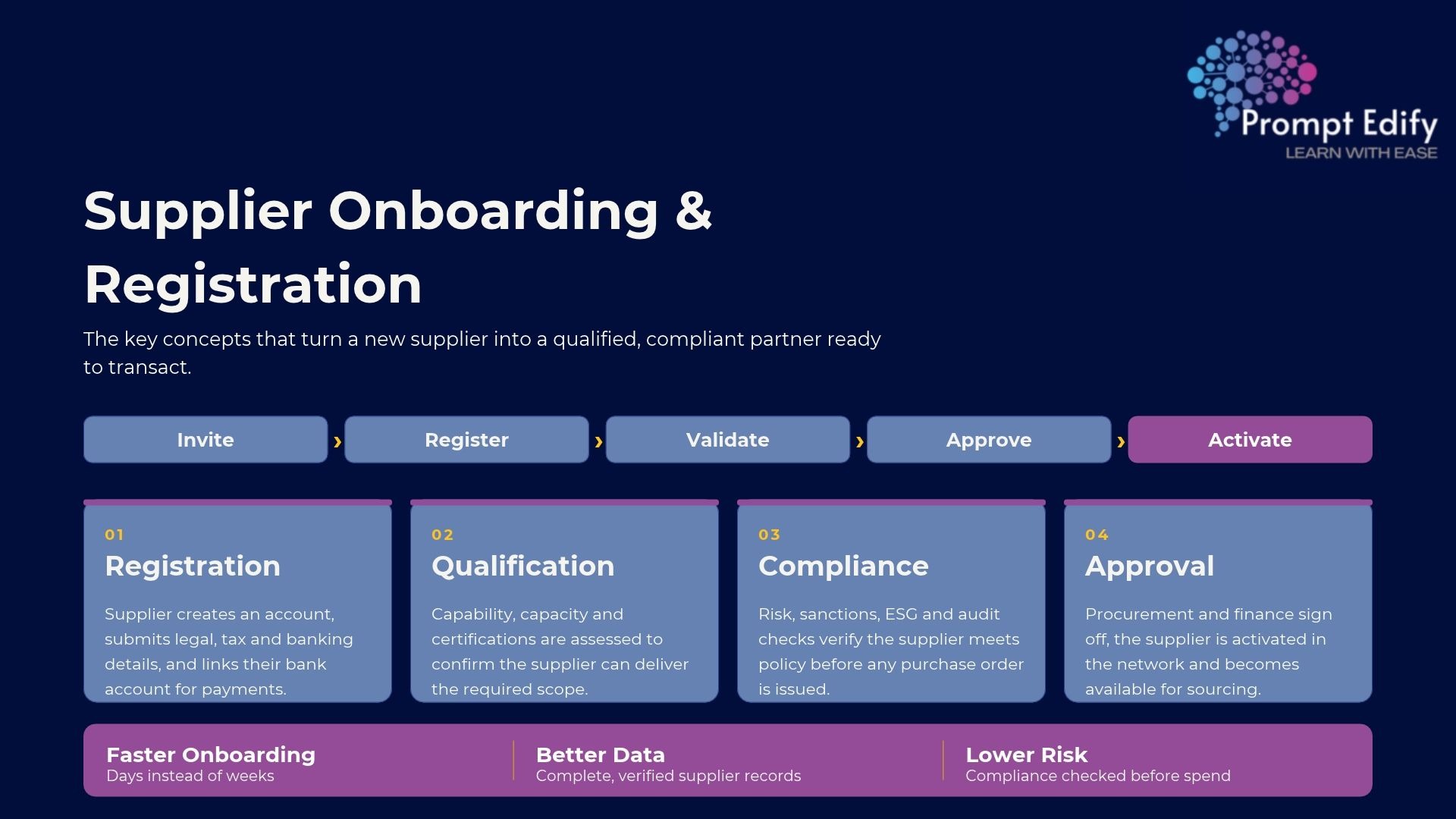
Supplier onboarding can be understood as the process by which a new supplier is brought to the buying organization. This process is done by gathering information about the supplier, examining documents and carrying out any other activity that is needed for supplier registration.
Supplier registration is one of the most critical components of the supplier onboarding process because it helps organizations to store supplier information in a proper format.
The SAP Ariba platform includes functionalities for managing suppliers, including supplier requests, supplier registration, supplier qualification and supplier information management.
The supplier onboarding process may be prompted by the department that identifies the requirement for onboarding a new supplier.
For example, the procurement department may require onboarding of a new supplier of raw materials, while the operations department requires onboarding of a new service provider supplier.
Users may create a request for supplier onboarding by inputting some basic data about the supplier and the business requirement.
Depending on the configuration of the onboarding process, the request will include:
When the application of a particular supplier is accepted, there is the need for him/her to give some additional information during the registration process.
What kind of information is needed depends on what information the business requires and whether there is any compliance process involved.
The most common kinds of information are as follows:
Questionnaire is an important term that becomes important in the case of SAP Ariba Supplier Management Solution. Questionnaire allows companies to gain some information about their suppliers.
Questions related to their business, quality, finances, certifications, and compliance issues may be posed to them.
Various questionnaires serve different purposes as follows:
In SAP Ariba, questionnaire-based processes can be configured depending upon the solution and its implementation.
Once the supplier supplies the necessary information, the firm will go ahead to evaluate the information before registration.
Typically, it is the responsibility of the procurement department to assess whether the provided information is complete and relevant. However, other departments like the finance and legal department may be involved in the process depending on the supplier and the needs of the firm.
This could involve evaluating company information, checking the validity of the documents provided, bank information and missing information.
If the information provided by the supplier proves to be inadequate and inaccurate, the supplier will be required to provide updated information.
This process will ensure that the firm is able to keep up to date with accurate information of the suppliers.
The need for supplier approval will vary from organization to organization. Whereas some organizations will have procurement approvals, some will have other approvals through other departments such as finance, legal, and compliance.
As part of the process of registering suppliers, organizations will need to be aware of the common challenges in data quality as follows:
There are many advantages to having a structured onboarding process of a business:
Supplier Onboarding & Registration in SAP Ariba allows organizations to create structured processes for capturing, evaluation, and maintenance of supplier information. Be it the process of making supplier requests, completing questionnaires or validating data accuracy – all of this helps manage suppliers effectively.
If one wishes to learn about these processes and gain hands-on experience of working with them, Supplier Management Training is a good place to start to learn about supplier lifecycle processes and capabilities in SAP Ariba.
SAP Skill Building Through Prompt Edify
Prompt Edify provides professional training courses to enable students to comprehend SAP solutions and enterprise business processes.
By Team Prompt Edify
Have any enquiry? Call us
+(27) 740294414
(+91) 99932-86938
wecare@promptedify.com


Prompt Edify Africa (PTY) Limited
2nd Floor, Rivonia VillageCnr Mutual Road and Rivonia Boulevard Rivonia Village, 2191
Johannesburg , South Africa
Contact : +27740294414
Prompt Edify East Africa Limited
KN 78 ST, Kagarama, Kigali, Kigali, Nyarugenge, Umujyi wa Kigali, Rwanda
Contact : +250 727 845 771
Prompt Edify Private Limited
4th Floor #15, City Vista Tower, Fountain Road,
Kharadi, Pune(MH), India.
PIN- 411014
Contact : (+91) 99932 86938



Contact Us Today!
+27740294414 | (+91) 99932 86938 | +250 727 845 771
contact@promptedify.com | wecare@promptedify.com
🌐 https://promptedify.co.za/