
Discover Supply Chain Visibility and SAP Business Network, including supplier updates, order status, inventory information, exception monitoring and resilience.

In the contemporary competitive environment, businesses must conduct their supply chain operations effectively while keeping in mind the changing needs of customers, problems related to suppliers and changing market conditions. Managing various suppliers, inventories, purchase orders, and deliveries becomes difficult without effective information sharing.
Supply Chain Visibility helps in such situations, as it facilitates tracking and monitoring of the supply chain activities, availability of updated information, identification of possible disruptions and operational decision-making.
SAP Business Network facilitates such information sharing by bringing together buyers, suppliers and other trading partners through digital collaboration.
This blog will discuss Supply Chain Visibility, the key concepts of Supply Chain Visibility, SAP Business Network and digital collaboration for improving supply chain operations.
Supply Chain Visibility is defined as the capability of the organisation to monitor and obtain information about the supply chain process.
It gives businesses an insight into what is going on in their supply chain operations ranging from procurement, inventory management, manufacturing, and transportation.
For instance, the manufacturing firm will be required to determine if the supplier has acknowledged the receipt of the purchase order, if there is enough raw material, and if the materials will arrive on time.
Without visibility, there can be delays in production, lack of material, and additional costs that could have been avoided.
Visibility in the supply chain operations assists the business to:
The overall goal of Supply Chain Visibility is making sure that information is available to the right people in the organisation.
Visibility in the supply chain through SAP Business Network is an insight that firms are able to generate from digital connections with their suppliers and other trading partners through the various services offered by SAP Business Network.
SAP Business Network helps in exchanging business data and documentation between buyers and suppliers as well as collaborating in the supply chain.
The types of collaborations made possible by SAP Business Network are:
For example, the buyer could be sending forecasts to the supplier, getting supplier commitment and shipment status from the supplier.
This will enable firms to identify problems in the supply chain at an early stage and come up with measures to address such problems.
SAP provides visibility in inventory managed by supplier, material requirements and quality management.
Supply Chain Visibility is made up of a number of key components that will enable companies to track their operations.
Supplier visibility gives the information regarding the performance of the suppliers, availability of material, order confirmation and deliveries.
It enables companies to know if the suppliers will be able to fulfill their procurement and production needs.
Order status tracking is the process of tracking the status of the orders from generation to confirmation and delivery of orders.
Visibility in inventories assists in providing the company with the relevant information on the availability of stocks, inventory at suppliers, material requirements, and replenishments.
The visibility in inventories assists in ensuring that the organization maintains an adequate inventory level, and that there is no risk of material shortage.
Visibility in shipments assists in tracking the delivery of the products.
This provides relevant information concerning the delivery status of the shipment, milestones in the process of delivery, and any possible delay in delivery.
Visibility in operational exceptions assists in identifying issues such as shortage in material, delivery delays, confirmation from the supplier, and quality issues.
Through Digital Supply Chain Collaboration, buyers, suppliers, manufacturers and logistics providers can collaborate through digital platforms.
Organizations don’t have to depend on emails, excel sheets and manual updating of the business information but can do it through the connected system.
Some of the activities done by SAP Business Network for performing digital collaboration are:
Supply Chain Monitoring is the tool which is utilized to carry out the constant monitoring of the supply chain process and to identify any problem and analyze the performance of the organization.
It helps organizations to keep track of the following critical areas:
Quality of the product.
Tools which have the ability to monitor and alert are available within SAP Business Network to help users detect exceptions and concentrate on critical issues.
For instance, if there is any problem in purchase order confirmation or material shortage, the concerned department can work on this area and solve the problem.
Supply Chain Resilience refers to the ability of the organization to be able to cope up with, respond to, and recover from disruptions in the supply chain.
This can happen because of supplier problems, transport delays, change in customer demands, production problems, and market surprises.
Greater visibility helps in knowing such risks beforehand so that they could be managed before they impact the business.
The following are some of the advantages:
Hence, through greater visibility and digital collaboration, a resilient supply chain can be created.
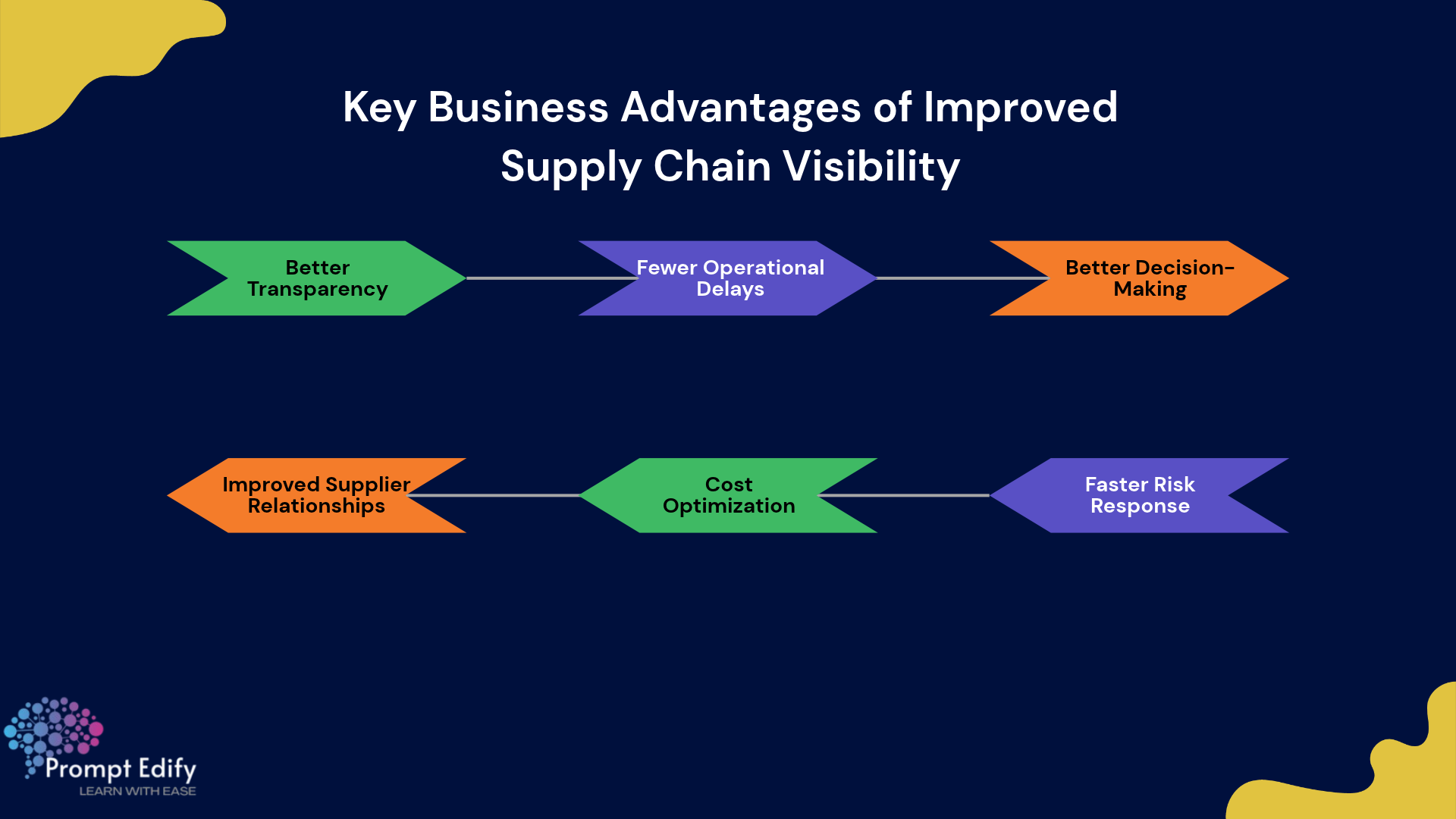
This is one of the ways in which the implementation of supply chain visibility software could be beneficial to the organization:
SCV is an extremely important tool for those organizations that strive to have a controlled supply chain in today’s business environment. This tool enables organizations to trace supplier alerts, purchase orders, inventory information, deliveries, and exceptions.
SCV may be utilized through SAP Business Network by working together and exchanging information between the buyer and the supplier.
Decision making, prevention of disruptions, and improvement of SC resilience becomes easy due to transparency, communication, and SCM.
Would you like to improve your knowledge in SAP Business Network and SCM? Connect with Prompt Edify.
By Team Prompt Edify
Have any enquiry? Call us
+(27) 740294414
(+91) 99932-86938
wecare@promptedify.com


Prompt Edify Africa (PTY) Limited
2nd Floor, Rivonia VillageCnr Mutual Road and Rivonia Boulevard Rivonia Village, 2191
Johannesburg , South Africa
Contact : +27740294414
Prompt Edify East Africa Limited
KN 78 ST, Kagarama, Kigali, Kigali, Nyarugenge, Umujyi wa Kigali, Rwanda
Contact : +250 727 845 771
Prompt Edify Private Limited
4th Floor #15, City Vista Tower, Fountain Road,
Kharadi, Pune(MH), India.
PIN- 411014
Contact : (+91) 99932 86938



Contact Us Today!
+27740294414 | (+91) 99932 86938 | +250 727 845 771
contact@promptedify.com | wecare@promptedify.com
🌐 https://promptedify.co.za/