
Transnet is modernising its ERP landscape by moving from SAP ECC to S/4HANA with a strong hybrid cloud strategy in Pretoria. This transformation enhances real-time insights, operational efficiency, and long-term digital resilience.
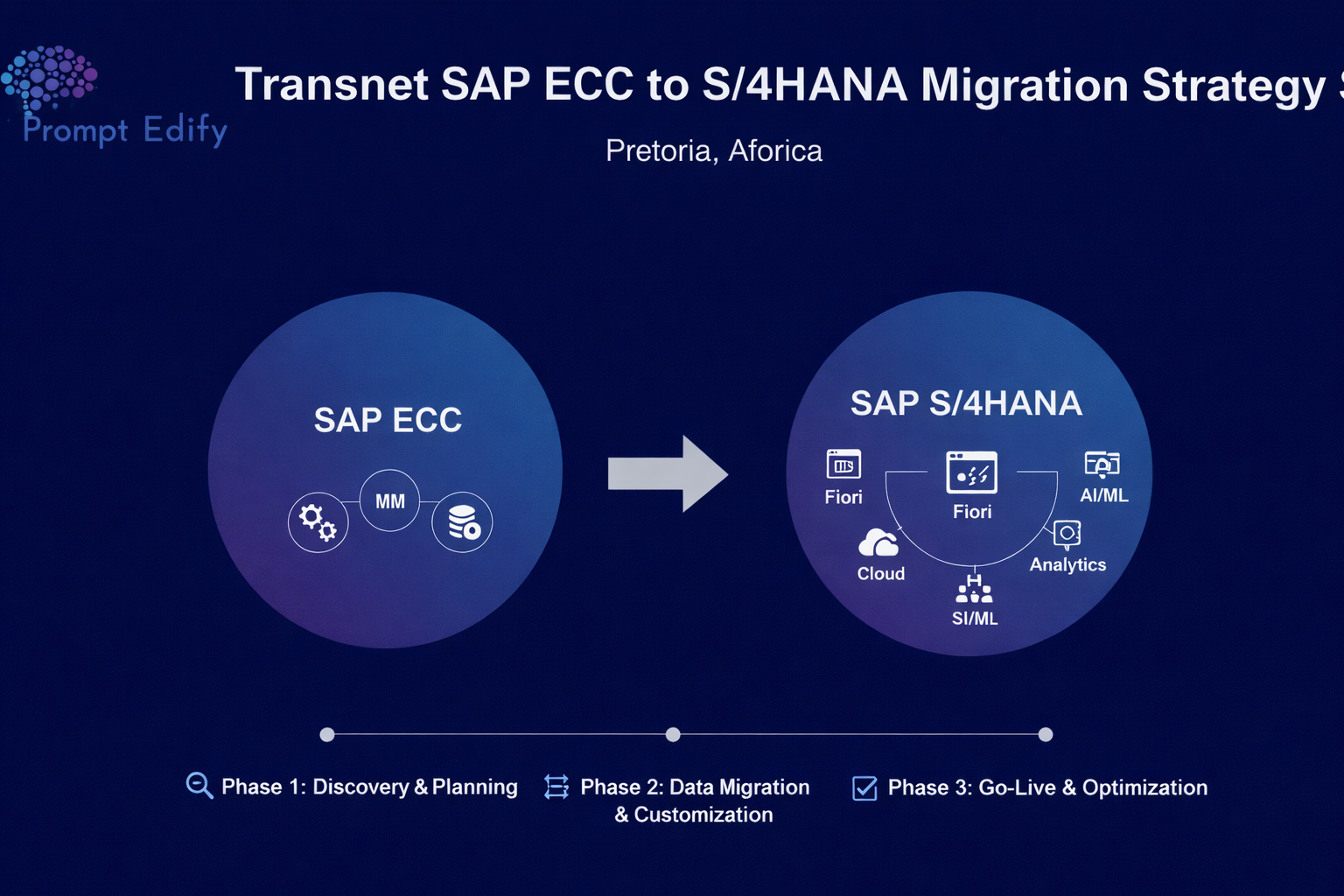
Companies throughout the world are modernising their IT infrastructure to be competitive, resilient, and agile due to the changing digital economy. The most ambitious example of this transformation in South Africa is taking place at the state-owned freight logistics company Transnet. Transnet is responsible for rail, ports, and pipelines in South Africa and is executing one of the largest digital transformation journeys in the world. To support this transformation, Transnet is moving from an older version of SAP (SAP ECC) to a newer version called SAP S/4HANA on a robust hybrid cloud infrastructure. This blog will investigate the reasons behind Transnet's decision to migrate from ECC to S/4HANA (the roadmap) and the expected results.
Transnet's legacy network was effective for much of its past, but as the company evolved, the organisation faced certain challenges as a result:
To modernise its ERP backbone, Transnet is undertaking a complete migration to the SAP S/4HANA platform, which will provide the organisation with enhanced performance, better decision-making capabilities, and the flexibility for continued growth.
Moving from SAP ECC to SAP S/4HANA is a major project for all big enterprises. Due to Transnet's large operational footprint, it is significantly more complicated than other moves. The migration has generally been built on four main types of principles:
Before the migration can begin, an in-depth analysis of all legacy applications will be done, including, among many other things:
Based upon this analysis, a detailed strategy for migrating to SAP S/4HANA was developed, including risk, business priorities, and technical feasibility.
When it comes to large companies like Transnet, two options for migration are usually taken into consideration:
Transnet opted for a blended approach that would incorporate existing configurations and redesign old or inefficient business processes where necessary. This hybrid approach offered a continuity of service while modernising their business solution offering.
An important factor in Transnet's successful migration was its use of SAP's Cloud S/4HANA Migration Cockpit. This software from SAP made transferring/transferring data between the legacy environment and SAP S/4HANA much easier. Specifically for Transnet:
Through the use of Cloud S/4HANA's Migration Cockpit, Transnet was able to reduce manual input, reduce human error during data transfer and compress the overall duration of its migration project.
Transnet adopted a strategic approach to the implementation of its SAP system, transitioning to a hybrid approach that utilises both cloud and on-premise resources. The advantages of this hybrid approach are the flexibility, cost-effectiveness and compliance to operate a balanced business.
The following is an explanation of the hybrid cloud model:
By leveraging a hybrid cloud model in conjunction with SAP S/4HANA, Transnet is positioned to achieve the following goals:
Therefore, by using a hybrid cloud to integrate with SAP S/4HANA, Transnet can obtain flexibility from digital technologies and build resiliency to a rapidly changing business model.
Transnet has achieved numerous direct benefits as a result of transitioning from SAP ECC to SAP S4HANA while also utilising a hybrid cloud strategy:
Through S4HANA's in-memory computing capabilities, Transnet can access real-time analytics for quicker and higher-quality decision-making related to logistics, maintenance, finance, and operations.
Transitioning to S4HANA has removed legacy technical debt and simplified their IT landscape, allowing for:
Automation and standardisation of workflows provided by SAP S4HANA have:
Utilising a hybrid cloud infrastructure gives Transnet the ability to integrate new technologies, such as:
These advanced capabilities allow better proactive decision-making and asset management.
Migrating on a large scale has various barriers. The following were some of the challenges that Transnet faced during its migration:
However, by embedding governance, training and communication as part of the migration strategy, Transnet met these challenges successfully.
Transnet’s SAP S4/HANA migration can serve as a reference guide for any South African company that has an out-of-date ERP system and wants to:
These principles can be applied in any industry and will give Transnet a solid foundation to migrate its existing data successfully through well-planned installations, hybrid implementation strategies and proven SAP Migration tools available today.
Transnet has made the transition from SAP ECC to SAP S/4HANA through a strategic roadmap that includes using the SAP S/4HANA migration cockpit and adopting a hybrid cloud approach. The transition to SAP S/4HANA is a transformational step towards the future and exemplifies the importance of modernising business processes, simplifying business processes, and adopting cloud technologies in building resilient, future-ready companies.
Transnet provides a tested model for how to modernise legacy systems to support digital transformation due to rapid change in business technology brought on by digital disruption. With the right strategy and execution, businesses can modernise their complex legacy systems and position themselves to compete in a digital world successfully.
Want deeper insights into SAP S/4HANA migration and SAP FICO best practices?
Register for our upcoming live session:
👉 Webinar Registration:
https://www.promptedify.com/live-webinar/sap-fico-live-session/register
By Team Prompt Edify
Have any enquiry? Call us
+(27) 740294414
(+91) 99932-86938
wecare@promptedify.com

Prompt Edify Africa (PTY) Limited
2nd Floor, Rivonia VillageCnr Mutual Road and Rivonia Boulevard Rivonia Village, 2191
Johannesburg , South Africa
Contact : +27740294414
Prompt Edify East Africa Limited
KN 78 ST, Kagarama, Kigali, Kigali, Nyarugenge, Umujyi wa Kigali, Rwanda
Contact : +250 727 845 771
Prompt Edify Private Limited
4th Floor #15, City Vista Tower, Fountain Road,
Kharadi, Pune(MH), India.
PIN- 411014
Contact : (+91) 99932 86938



Contact Us Today!
+27740294414 | (+91) 99932 86938 | +250 727 845 771
contact@promptedify.com | wecare@promptedify.com
🌐 https://promptedify.co.za/