
Understand how SAP S/4HANA connects sales orders, inventory, deliveries, billing, and payments to improve business operations and customer satisfaction.

It goes without saying that any successful company relies upon a well-managed process of transforming customers' orders into money. But in case such processes are managed through independent systems, this may prove to be difficult. Poor communication, incorrect data regarding stock, and billing problems may cause dissatisfaction among clients and cash management problems.
In this regard, the process of order to cash in SAP S/4HANA is of great importance. The order to cash process in SAP S/4HANA integrates various sales and financial processes.
Order to Cash (O2C) refers to the business process in which an entire order cycle of the client is managed from the moment an order is received by the organization until it receives payment for its goods or services.
In the SAP S/4HANA system, O2C process integrates sales, stock management, logistics, invoicing and accounts receivable processes. Companies no longer have to work on separate information systems as they can rely on an integrated system that will allow them to achieve better coordination.
For instance, a client order can be checked for availability of products and pricing, a sales order can be generated. As the order goes through its stages, it is managed by the warehouse and delivery personnel as well as by the finance department in terms of billing and payments.
Knowing each and every step is essential for companies to understand how SAP S/4HANA helps them in their sales and accounting processes.
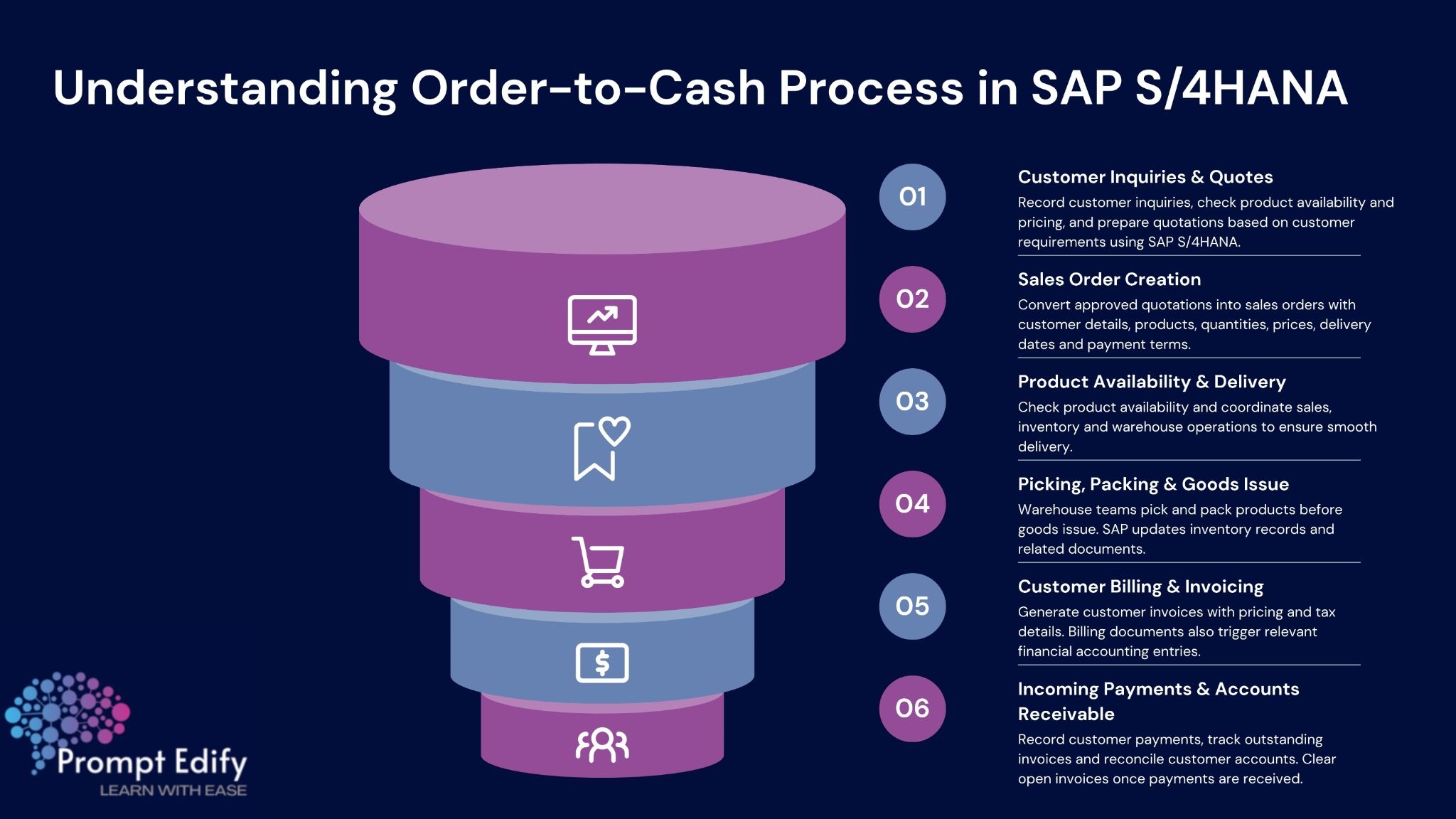
This process may begin when the customer asks whether the certain product is available, its price and delivery conditions. The sales team records these inquiries and creates the quote according to the needs of the customers.
Using SAP S/4HANA, the companies will be able to organize information related to their customers, conditions of pricing and quotes. This information will be used by the salespeople to create the quotes and stay in touch with the customers.
After the customers confirm the quote or order it, the salespeople create the sales orders through SAP S/4HANA.
The sales orders include the data like customers' data, product description, quantities, prices, delivery date and payment conditions.
The system is capable of checking the availability and conditions of pricing. This will help companies identify possible problems in the order processing.
Once the orders are made, the system then goes ahead and checks if the requested products are available for delivery. Should the products be available, the company will now proceed to deliver the products.
The SAP S/4HANA software integrates sales, inventory management, and warehousing processes. Based on how a business is configured, companies can now engage in picking, packing, and material issues.
This is an important process since good inventory management will enable businesses to avoid any unnecessary delivery problems.
Now once the delivery process starts, the workers at the warehouse will perform the tasks of picking, packing and issuing the products.
Once the issue of the products takes place, the inventory system within SAP S/4HANA will update and prepare the documents related to the materials and the accounts.
Once the goods issue takes place or once the billing milestone occurs, an invoice of the goods sold to the customer will be created.
SAP S/4HANA provides facilities for billing according to the type of business process like delivery related or order related billing process. It will have details related to the goods like price, tax, etc.
A billing document can also create accounting entries that establish the relationship between sales and financial accounting.
In the end, collection of the payment by the customer becomes necessary.
SAP S/4HANA has provision for handling the incoming payments, accounts receivables and customer account reconciliation. The financial team can see which invoices need to be paid.
Once the payment of the invoices is made, the open customer item can be cleared.
There are the following advantages of the integrated order to cash process in business:
Learning about the O2C process is beneficial for those people who work in areas like sales, distribution, finance, logistics, and SAP consultancy. It gives a good understanding of how business transactions flow from one department to another.
By learning about the O2C process, a professional will gain insights into the various important concepts of SAP SD such as sales order management, delivery, pricing, billing, and financial accounting integration.
The SAP S/4HANA order-to-cash process involves the integration of core business processes right from creating customer orders to collecting payment. In integrating sales, stock, logistics, and finance, it enables organizations to be efficient and to manage their operations better.
For you who are a budding SAP consultant or a business person, knowledge of this process would certainly enhance your knowledge of enterprise integration.
Prompt Edify offers SAP training programs tailored to industry needs with guided instruction for the professional development of skills. Explore SAP S/4HANA training options at Prompt Edify.
By Team Prompt Edify
Have any enquiry? Call us
+(27) 740294414
(+91) 99932-86938
wecare@promptedify.com


Prompt Edify Africa (PTY) Limited
2nd Floor, Rivonia VillageCnr Mutual Road and Rivonia Boulevard Rivonia Village, 2191
Johannesburg , South Africa
Contact : +27740294414
Prompt Edify East Africa Limited
KN 78 ST, Kagarama, Kigali, Kigali, Nyarugenge, Umujyi wa Kigali, Rwanda
Contact : +250 727 845 771
Prompt Edify Private Limited
4th Floor #15, City Vista Tower, Fountain Road,
Kharadi, Pune(MH), India.
PIN- 411014
Contact : (+91) 99932 86938



Contact Us Today!
+27740294414 | (+91) 99932 86938 | +250 727 845 771
contact@promptedify.com | wecare@promptedify.com
🌐 https://promptedify.co.za/