
Explore the SAP MM procurement process, including purchase requisitions, RFQs, supplier selection, purchase orders, goods receipts and invoice verification.

Material purchase is a vital business activity for any enterprise irrespective of its industry. Companies have to rely on some system to recognize the material requirements, choose the right supplier, place the order, deliver the material, and confirm the invoice. However, without proper management of these processes, businesses might face delays in purchasing, wrong ordering, controversies with suppliers, and erroneous payments.
With the help of the SAP MM procurement process, enterprises can handle these activities systematically. The integration of procurement process, stock management, and invoice validation is possible in SAP ERP and SAP S/4HANA.
SAP MM procurement process means the set of processes used to buy material or service using SAP Materials Management. It begins when there is a need to be identified and ends when the supplier’s invoice is checked and processed for payment.
This process is also referred to as Procure-to-Pay (P2P). It is helpful to the purchasing team to manage the supplier communication, purchasing documents, goods receipt, and invoices all under one roof.
A regular procurement process consists of purchase requisition, quotation request, supplier quotation, purchase order, goods receipt, and invoice check.
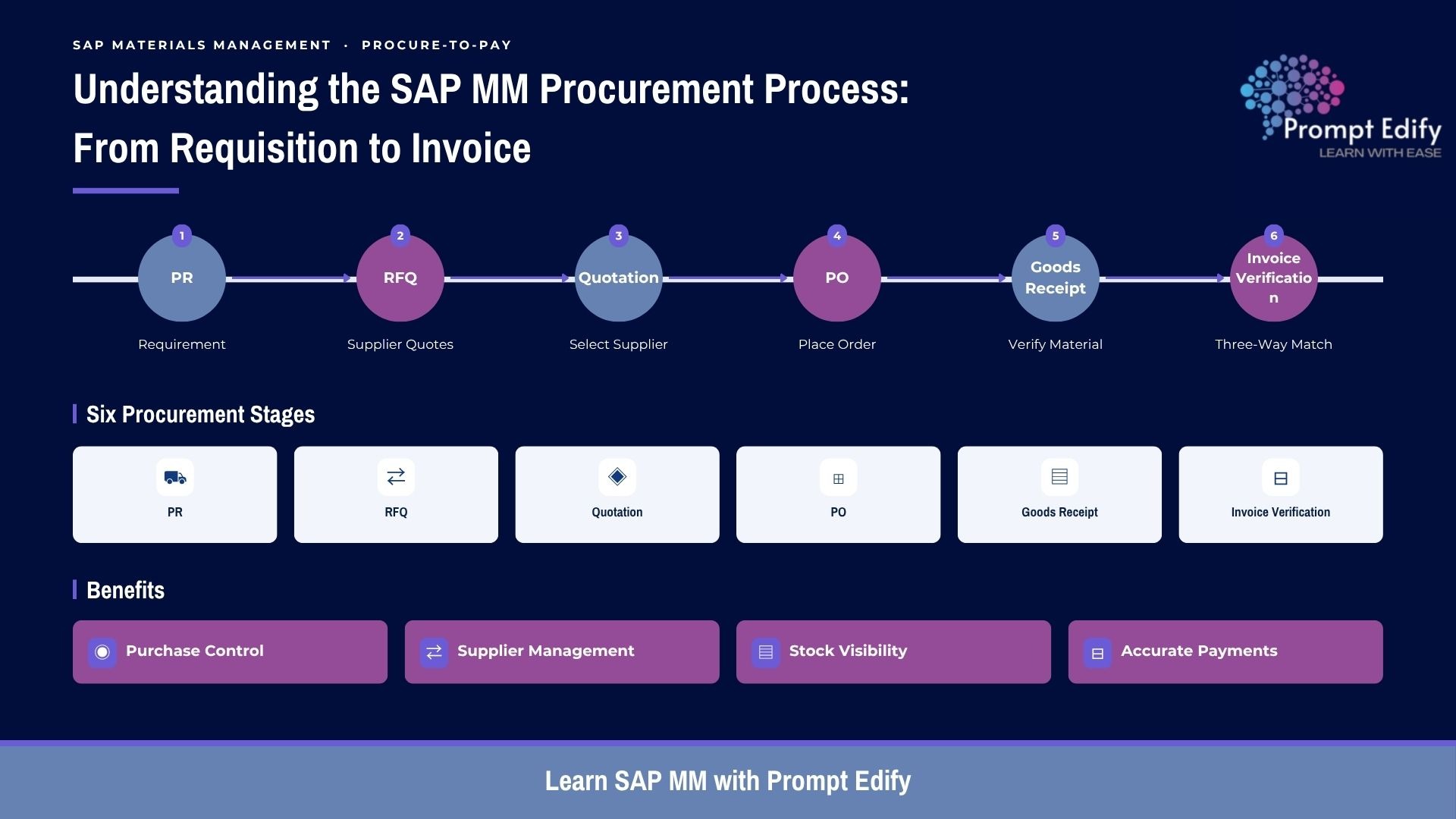
It will be better to see what occurs in each stage and how the interaction between the documents takes place in the entire procurement process.
Purchase requisition is the first step of any procurement process. It is an internal document raised when there is a need for materials or services that are needed to perform the activity.
That means, the manufacturing department needs additional raw materials; in that case, it raises a purchase requisition that consists of:
Account assignment (if any).
Upon determination of the requirement, the procurement department will be issuing a Request for Quotation (RFQ) to the selected suppliers.
A Request for Quotation (RFQ) is an expression used to describe the price and terms of trade of the products or services that are desired from the prospective suppliers.
The contents of a Request for Quotation (RFQ) include the following:
After receiving responses from suppliers to the RFQ, the purchasing department evaluates their quotations.
Such evaluations usually consider aspects like costs of materials, delivery schedules, payment schedules, quality of products, and supplier reliability.
The SAP MM tool assists the purchasing department in maintaining and comparing the data about quotations during the procurement process in order to choose an appropriate supplier based on the company’s needs and not just the cost of the offer.
After assessing quotations, the company chooses the supplier of its preference.
Having selected the best supplier, the next step involves preparing the purchase order. The purchase order is an official document that signifies the decision of the organization to acquire the material or service under particular circumstances.
A purchase order contains the following information:
The purchase order can be prepared using purchase requisition and quotation from the RFQ.
Upon approval of the PO and communicating with the supplier, the PO becomes the document of reference for material receipt.
The next stage is performed when the required materials have been delivered to the company by the supplier.
The receiving department carries out verification of the materials delivered in accordance with the purchase order, and material description, quantity, and other necessary information are being verified before performing goods receipt in SAP.
The goods receipt helps companies to:
In SAP MM, the goods receipt may create necessary accounting records depending on the process of material valuation and procurement.
It should be noted that this stage allows verifying the receipt of materials prior to invoice creation.
Invoice verification is the second last major step in the SAP MM procurement process.
After the delivery of the materials, the supplier sends the invoice for payment. The account or invoice team verifies the information in the invoice with regard to PO and GR.
This is commonly referred to as "the three-way match".
Verification of information includes:
If there is a discrepancy within the tolerable level, then the invoice will be posted in SAP MM; otherwise, it will remain blocked till all the issues have been sorted out.
The process of invoice verification aids in integrating SAP MM and SAP FI (Financial Accounting).
Organizations may get more information about this integration from SAP FI training.
The many benefits of an organized procurement process include:
SAP MM procurement process is the process of integrating all the critical processes involved in purchasing, from identifying material requirements to invoicing suppliers. The entire process adds to the correctness of procurement, cooperation with suppliers, and inventory visibility.
The process is critical for those working on procurement, inventory management, supply chain, and finance. Prompt Edify is the right place for you to develop your SAP knowledge.
Discover SAP MM Procurement and Inventory Management Processes and discover how SAP improves business processes.
Learn SAP at Prompt Edify.
By Team Prompt Edify
Have any enquiry? Call us
+(27) 740294414
(+91) 99932-86938
wecare@promptedify.com


Prompt Edify Africa (PTY) Limited
2nd Floor, Rivonia VillageCnr Mutual Road and Rivonia Boulevard Rivonia Village, 2191
Johannesburg , South Africa
Contact : +27740294414
Prompt Edify East Africa Limited
KN 78 ST, Kagarama, Kigali, Kigali, Nyarugenge, Umujyi wa Kigali, Rwanda
Contact : +250 727 845 771
Prompt Edify Private Limited
4th Floor #15, City Vista Tower, Fountain Road,
Kharadi, Pune(MH), India.
PIN- 411014
Contact : (+91) 99932 86938



Contact Us Today!
+27740294414 | (+91) 99932 86938 | +250 727 845 771
contact@promptedify.com | wecare@promptedify.com
🌐 https://promptedify.co.za/