
Learn what OCC APIs are in SAP Commerce Cloud, how they support headless commerce, product search, carts, checkout, integrations and omnichannel experiences.

Contemporary e-commerce enterprises must create shopping experiences across websites, mobile applications, digital channels, and various other customer interactions. Consumers expect to study products, compare costs, verify the availability of items, fill their carts, and also make purchases regardless of the medium.
Classic commercial platforms tightly integrate the frontend experience with the backend technology. However, companies prefer to build customizable digital experiences while using a unified e-commerce platform to manage product details, pricing information, stock availability, consumer information, and orders.
This is where OCC APIs come to the rescue and help front-end applications work with e-commerce services via APIs while still providing innovative shopping and headless commerce solutions.
OCC stands for Omni Commerce Connect, which is defined as a set of RESTful web services in SAP Commerce that allow businesses to expose their e-commerce capabilities to frontend applications, other systems, and digital channels.
Rather than requiring the frontend to perform the internal commerce activities directly, the OCC API gives organizations access to a number of structured endpoints that they can use to request and deliver data.
In SAP Commerce Cloud, the OCC API bridges the backend components of commerce with any frontend application including web shop, applications, and any custom interfaces.
By way of illustration, when a customer visits his online store, he may retrieve information about the products, display prices, check product availability, and add items to the shopping cart using OCC APIs.
Headless commerce is an architecture wherein the presentation layer in the front end is decoupled from the commerce back end. Various technologies can be used to build the front end, while the back end performs its role in the commerce process as usual.
The communication between the front end and back end occurs through APIs, making it unnecessary to create a tight coupling in the storefront environment.
In the environment of SAP Commerce Cloud, OCC APIs allow for this separation to happen since they expose REST endpoints that can be called by the front-end applications in order to perform different activities related to commerce.
For instance, a company may create an adaptive storefront using a front-end framework connected to the back end SAP Commerce Cloud for managing products, catalogues, customers, carts, and orders. The front end sends an API call to SAP Commerce to receive the necessary information.
OCC APIs facilitate numerous commerce activities, especially in SAP Commerce Cloud.
OCC APIs enable the frontend applications to obtain product details, catalog details, product descriptions, characteristics, images, and other important product information.
This is important for the storefront, where products are represented by product lists, product detail pages, categories, and product search results. Companies have an opportunity to manage product data in the SAP Commerce system and make it available to various front-end channels.
Product search is a vital component of the online shopping experience. The OCC APIs allow implementation of search options and enable customers to search for products through keywords and other search criteria.
Depending on the configuration, the frontend applications can use search API capabilities and get a variety of results, including product results, product filter options, sorting, and product finding functions.
OCC APIs are used to perform operations related to shopping carts, such as adding products to the cart, changing quantity selections, checking the contents of a cart, and obtaining information about cart activity.
These APIs also make it possible to perform operations related to checkout processes, depending on the configured implementation. The front end can thus create an interactive shopping experience, while SAP Commerce performs commerce processes in the background.
APIs related to customers allow customers to register, view information about their accounts, as well as access customer data, depending on the permissions and endpoint defined on a certain API.
APIs related to orders allow applications to obtain all the necessary information about the order as well as perform order management operations. Performing these functions enables companies to deliver a consistent customer experience across digital channels.
OCC APIs provide advanced commerce capabilities, including promotions, vouchers, product ratings, points of sale, and stock data.
Such features enable frontend applications to give shoppers useful offers, product reviews, and availability data while shopping.
The availability of OCC functionality is subject to the endpoints, extensions, configurations, authentication, and implementation criteria.
OCC API interaction generally operates by sending a request and receiving a response from the front-end application to the backend of SAP Commerce.
The example below shows a standard product search and cart management.
OCC APIs present numerous benefits for businesses utilizing SAP Commerce Cloud.
Thanks to all these advantages, companies are able to revise their digital commerce strategy while keeping a single process flow in one place.
Traditional commerce architecture often connects the storefront closely with the backend commerce platform. Headless commerce separates these layers and uses APIs to facilitate communication between them.
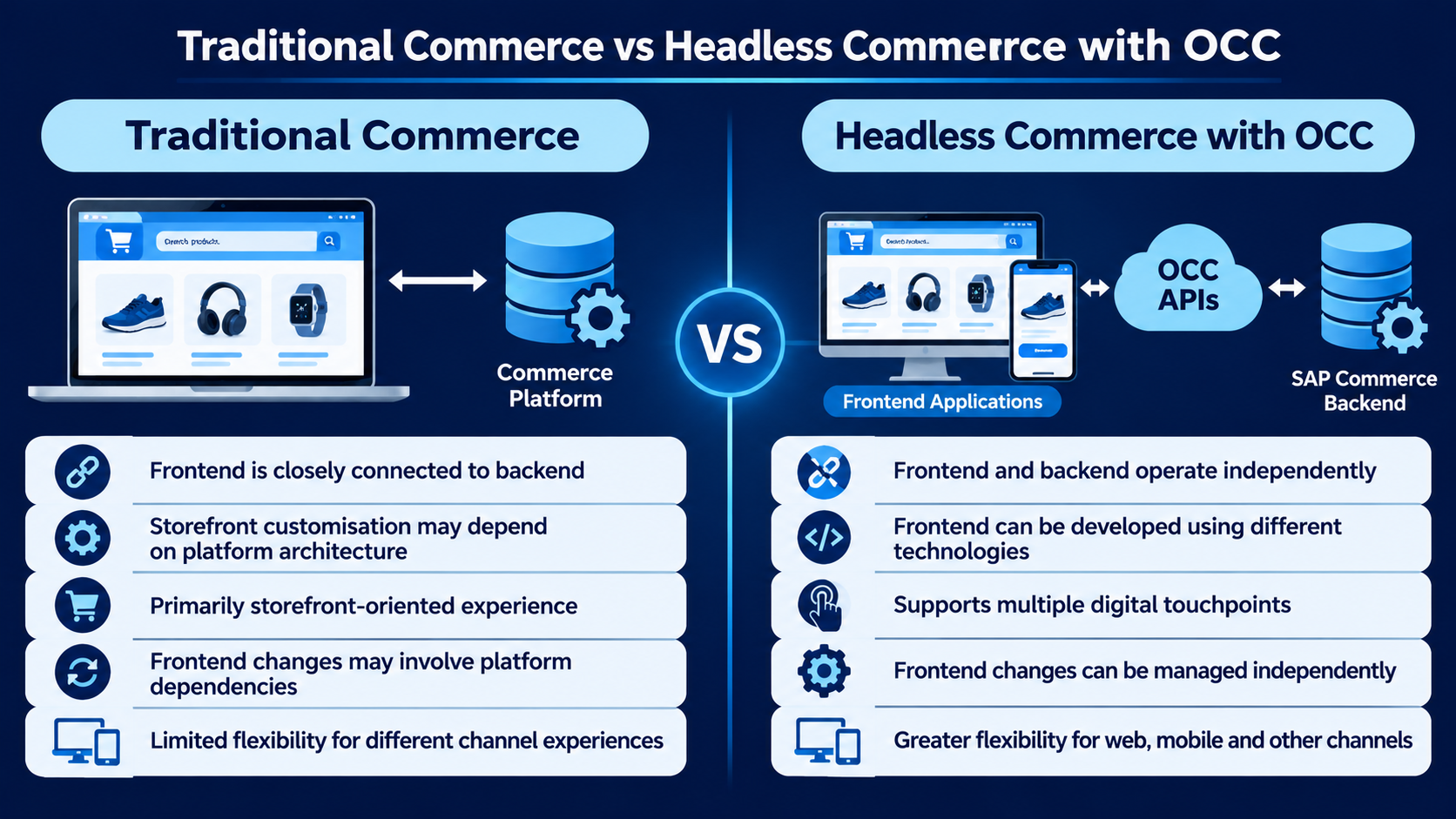
With OCC APIs, SAP Commerce Cloud can support headless commerce implementations where businesses want more control over frontend design, technology, and customer experience.
When exposing commerce capabilities through APIs, safety is an important factor to take into consideration. The SAP Commerce OCC utilizes OAuth 2.0 as the standard authorization framework for commerce-related web services.
Authentication based on OAuth makes it possible to restrict access to the API resources with the help of access tokens instead of repeatedly prompting clients for their users’ credentials. Companies like SAP have to set up authentication, authorization, access rights, and security of APIs in accordance with the requirements of the business application they develop.
This is especially critical when dealing with sensitive commerce information such as customer data, shopping carts, order info, etc.
OCC APIs are quite significant for headless and omnichannel commerce with SAP Commerce Cloud. They link the frontend apps with backend commerce functions, meaning that through the APIs, companies can manage items, perform searches, manage user accounts, handle carts and orders, activate promotions, and conduct various other commercial processes.
Knowing the basics of OCC APIs is important for specialists who would like to know more about SAP Commerce, headless commerce, frontend-backend integration or digital commerce development in general. As many companies aim to grow in terms of digital commerce, API-based commerce allows them to create excellent customer experiences while having all commerce solutions in one place.
Familiarity with OCC APIs may help SAP Commerce developers, consultants, and specialists to learn how modern commerce solutions communicate with each other and provide seamless shopping experience.
By Team Prompt Edify
Have any enquiry? Call us
+(27) 740294414
(+91) 99932-86938
wecare@promptedify.com


Prompt Edify Africa (PTY) Limited
2nd Floor, Rivonia VillageCnr Mutual Road and Rivonia Boulevard Rivonia Village, 2191
Johannesburg , South Africa
Contact : +27740294414
Prompt Edify East Africa Limited
KN 78 ST, Kagarama, Kigali, Kigali, Nyarugenge, Umujyi wa Kigali, Rwanda
Contact : +250 727 845 771
Prompt Edify Private Limited
4th Floor #15, City Vista Tower, Fountain Road,
Kharadi, Pune(MH), India.
PIN- 411014
Contact : (+91) 99932 86938



Contact Us Today!
+27740294414 | (+91) 99932 86938 | +250 727 845 771
contact@promptedify.com | wecare@promptedify.com
🌐 https://promptedify.co.za/