
Learn how a Supply Chain Control Tower improves visibility, tracks shipments, monitors inventory, manages disruptions, and boosts supply chain efficiency.
The contemporary supply chain consists of multiple suppliers, warehousing, transportation, and distribution. The management of these processes might become a problem in some way because of delays, issues with inventories, or even disruption. To avoid these problems, it is required to make sure that the supply chain operations have visibility and control.
Here comes the concept of Supply Chain Control Tower which may provide assistance to companies. With this concept, it becomes possible to track supply chain operations, anticipate possible problems, and make decisions based on data interconnection.
Thus, what is Supply Chain Control Tower? What are its working principles and advantages for businesses?
Supply Chain Control Tower refers to an advanced system which allows for visibility of activities associated with the supply chain process like procurement, inventory, transportation, order management, and fulfillment.
This system gathers and analyses data from various sources to enable organizations to know what is going on in their supply chain process.
Unlike other ways of tracking processes, the use of control towers enables organizations to spot problems, track performance, and coordinate their actions.
For instance, if there is a delay in delivery of products, then the control tower will enable the organization to track the problem and choose an alternative means of transportation.
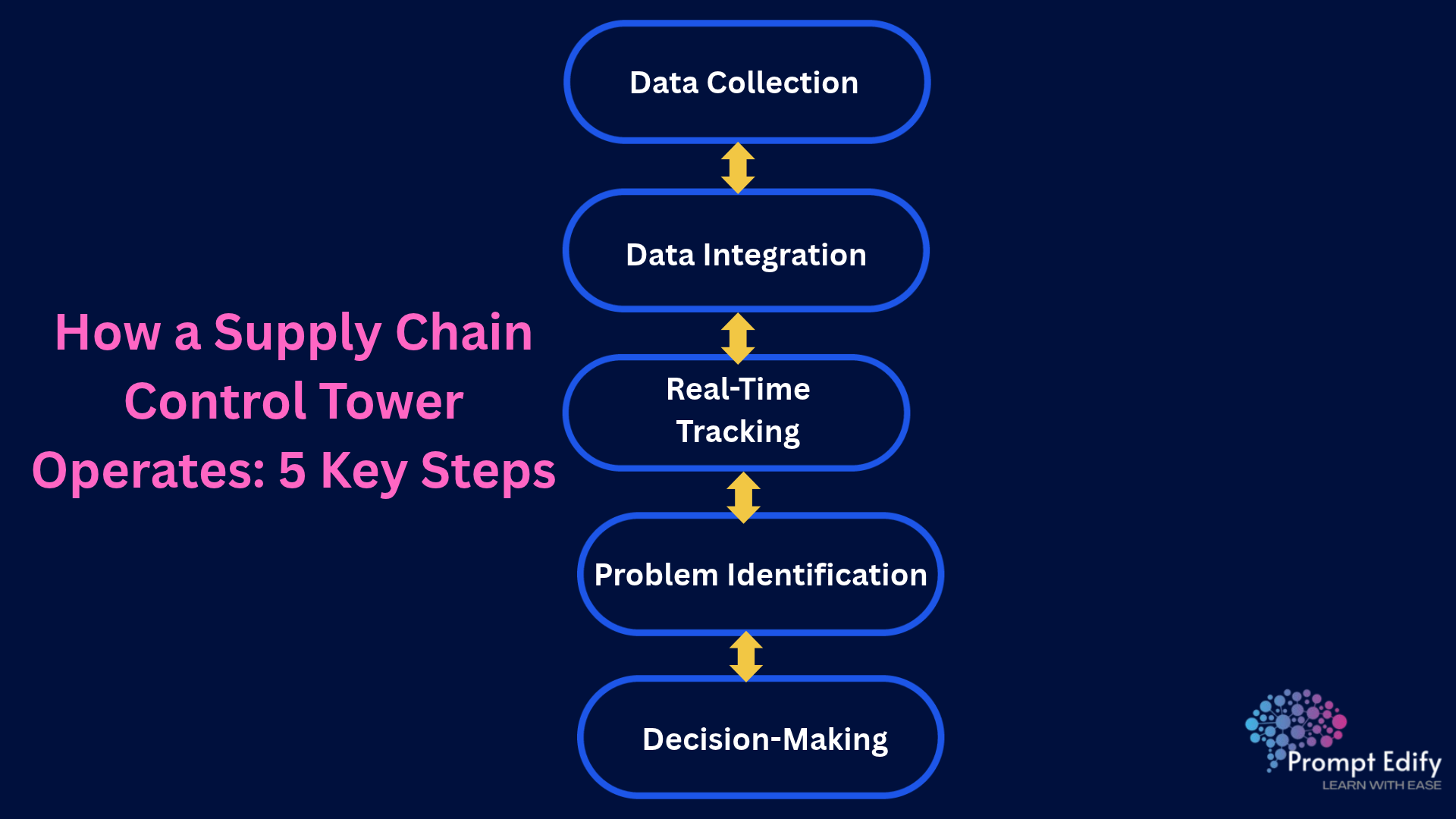
Execution of Supply Chain Control Tower involves integration of different supply chain data sources as well as presenting the needed data via the integrated system.
The process of execution involves the following:
Below are some of the features that are expected from the contemporary Supply Chain Control Tower.
1. Supply Chain Visibility end-to-end: Provides a complete view of the suppliers, inventories, orders, and logistics/filling operations.
2. Supply Chain Visibility real time: Allows organizations to monitor the flow of the shipments, change in inventories, and order status by using up-to-date information.
3. Supply Chain Monitoring: Monitors any significant event during the supply chain process and recognizes any issue/change.
4. Alerts and Notifications: Sends any alert regarding the shipment delay, inventory issue, any problem with the supplier and other disturbances.
5. Data Analytics and Reporting: Helps organizations to analyze the performance of the supply chain process and make informed decisions.
6. Exception Management: Provides any critical issue that requires an urgent solution.
While all of these terms can be utilized together at once, they have their own purposes.
The difference is that while the dashboard provides information, the control tower offers not only visibility but also analysis and decision-making processes in order to monitor supply chains.
A Control Tower for Supply Chain can be helpful in solving various operational problems in a company.
Example 1: Discovery of a Delay in Delivery
Assume there is a delivery of materials that is late in its way. The control tower identifies the problem and informs the supply chain department about the problem. The department considers the options of changing the delivery route or methods of delivery in order to minimize the delay.
Example 2: Inventory Shortage Management
Consider a retail company facing an unexpected rise in demand for its products. The control tower will signal the inventory shortages and help the team find alternate stock places and replenish inventory.
Example 3: Dealing with Supplier Interruption
In case the supplier is unable to provide the required material in time, the control tower will help in identifying the disrupted orders and production schedules. Alternative suppliers can be evaluated by businesses accordingly.
This is how supply chain visibility enables decision-making.
There are several benefits that come with the Implementation of a Supply Chain Control Tower. These include:
Even though there are several benefits, implementation of the Supply Chain Control Tower can be faced with certain challenges.
These may be faced by firms in terms of data quality, fragmented systems, and difficulties in consolidating data from different suppliers and logistics providers.
Implementation may also demand considerable financial input in terms of technology, personnel training, and process improvement.
The other issue is ensuring that teams make optimal use of the information. A control tower may spot a problem, but there should be accountability on how to act on it.
For this reason, firms should set their objectives, enhance data integration, and measure performance first.
Supply Chain Control Towers aid organizations in enhancing their visibility, operational performance, identifying any disruptions, and making effective decisions in the supply chain. With the integration of information through suppliers, inventories, orders, logistics, and fulfillment, companies can create more flexible and efficient supply chains.
While there are costs, data and cooperation involved in implementation, it can still help organizations achieve better operational and supply chain performance.
Interested in learning more about supply chain management and SAP? Please contact Prompt Edify for our professional SAP training programs.
By Team Prompt Edify
Have any enquiry? Call us
+(27) 740294414
(+91) 99932-86938
wecare@promptedify.com


Prompt Edify Africa (PTY) Limited
2nd Floor, Rivonia VillageCnr Mutual Road and Rivonia Boulevard Rivonia Village, 2191
Johannesburg , South Africa
Contact : +27740294414
Prompt Edify East Africa Limited
KN 78 ST, Kagarama, Kigali, Kigali, Nyarugenge, Umujyi wa Kigali, Rwanda
Contact : +250 727 845 771
Prompt Edify Private Limited
4th Floor #15, City Vista Tower, Fountain Road,
Kharadi, Pune(MH), India.
PIN- 411014
Contact : (+91) 99932 86938



Contact Us Today!
+27740294414 | (+91) 99932 86938 | +250 727 845 771
contact@promptedify.com | wecare@promptedify.com
🌐 https://promptedify.co.za/