
Explore Product Catalogue Management in SAP Commerce Cloud, including product categories, attributes, catalog versions, synchronization, and how businesses manage product data

Precise product information is of crucial significance in every single e-commerce business. Clients have grown to expect precise and correct descriptions of products, images, prices, characteristics, as well as availability information while shopping online. However, it is difficult to control the information about hundreds of products belonging to different categories and sold across different channels.
The role of Product Catalogue Management in SAP Commerce Cloud comes to the forefront. This functionality enables companies to arrange, maintain, and manage the product-related data in one central commerce platform. It helps companies efficiently organize product-related information for the purposes of digital commerce activities.
SAP Commerce provides the necessary tools for product catalogue management, which enables organizations to keep product information and arrange categories of products.
Product Catalogue Management means creating, organizing, maintaining, and sharing information about products on different platforms used for digital commerce. It refers to managing product names, product descriptions, product images, pricing, category, specifications, and other relevant features.
In an e-commerce environment, a product catalog serves as a systematic summary of information regarding products sold to customers.
For instance, in an electrical shop that sells products, the product catalog includes all the information about the products like the type of product (smartphone, laptop, TV set, or an accessory), the model, price, features, and many other details.
If there is no structured catalog, it can be difficult to manage product information efficiently among different product categories and online stores.
SAP Product Catalogue Management assists in managing information through SAP Commerce Cloud. The tools it offers allow products to be structured, catalogues composed, and product information to be supplied for commerce purposes.
SAP Commerce Cloud provides businesses with a platform to manage product catalogues in an orderly manner. Firms can create their catalogues, group products by types, manage product attributes, etc.
The process has several key activities.
A product catalogue refers to a way of collecting products and information. Businesses create catalogues according to the product offered, market or commerce needs.
For example, a retailer can create a separate catalogue under product ranges, market types or commerce needs.
SAP Commerce Cloud includes catalogue management systems that allow firms to classify their collections depending on business need.
Classes provide a method through which retailers can classify related products together so that customers can find their way around an e-commerce shop with ease.
For instance, an electronics shop can have the following categories:
Each category can have its subcategories to further divide the products.
An effective categorization enables customers to find the right products easily.
Product attributes are characteristics and specifications of products within a business. They will provide customers with the necessary data to understand and compare different products.
Product attributes can include:
For example, the specifications for a certain type of laptop may include its RAM, processor type, storage, and size of screen, among other specifications.
SAP Commerce makes it easier for companies to organize their product information by means of attributes that are relevant for their types of products and for the catalogs they must use.
Catalog versions are used by companies to manage various phases of product details before making updates live through their online store.
In SAP Commerce Cloud, catalog versions consist of:
During the Staged phase, business teams can enhance product descriptions, populate categories, and prepare catalog changes. After the desired changes are reviewed and confirmed, they can be copied to the Online version.
The whole process allows companies to manage catalog updates and control the content provided to consumers.
Catalog synchronization means transferring the authorized data from the catalog editions.
For instance, when a company changes a particular product description or introduces a new product in the Staging catalog, synchronization allows this information to be used in the Online catalog as well.
This ensures consistency in what has been produced by the business teams and what is exhibited in the storefront.
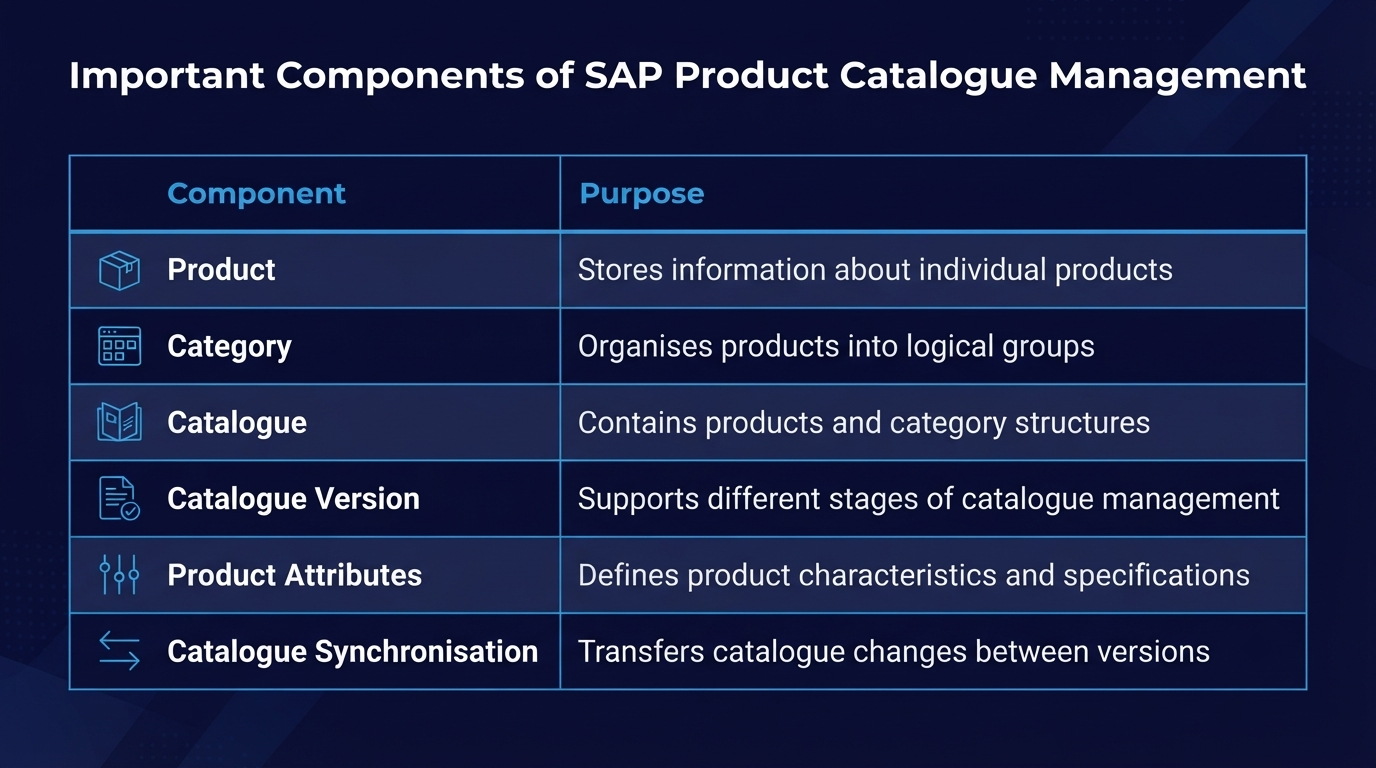
These components provide a structured approach to managing product information and maintaining catalogue content.
With the help of effective product catalogue management, companies can streamline their approach to storing and managing their product-related data.
Companies can store product information in a structured catalogue environment. This makes it easy to manage product descriptions, specification sheets, and images, among other types of information.
Creating a category structure allows companies to classify large quantities of products, thus providing customers with easier navigation across different product sections.
A structured catalogue management system ensures there is continuity in product information throughout the catalogues. Versions and synchronisation in catalogue management also aids controlled updates.
With the help of catalogue management, businesses are able to plan and execute catalogue updates accordingly.
Data consistency enables the automatic presentation of products to customers through e-commerce. It also supports customers in their choices.
Let's consider a clothing store, which sells clothes and accessories through an online platform.
The business provides products in several segments, like men’s apparel, women’s clothing, footwear, and accessories.
By using SAP Commerce Cloud, the retail company can categorize its product catalog into suitable categories and subcategories. The product can have data about size, color, material, manufacturer, pictures and descriptions.
When a new clothing line appears, all the product data can be stored in the Staged catalog. After the information is reviewed, it can be synchronized with the online catalog.
Thus, the retailer will be able to keep organized information about products.
Various business and technical teams might be making use of product catalog management depending on their jobs.
Understanding these positions will be useful for various specialists working in e-commerce and SAP Commerce implementations.
The SAP Commerce Cloud's Product Catalogue Management enables businesses to have a common platform for organizing and maintaining product data. Being able to create product catalogs, establish product categories, manage product characteristics, and synchronize versions makes for effective digital commerce operations.
The importance of SAP Product Catalogue Management lies in understanding of how SAP Commerce deals with product data issues and how the management of product data is able to secure the successful functioning of online stores. The knowledge of various products and product groups, catalog versions, and synchronization is also essential for understanding other functions of SAP Commerce and their application for back office, pricing, marketing and order processing.
By Team Prompt Edify
Have any enquiry? Call us
+(27) 740294414
(+91) 99932-86938
wecare@promptedify.com


Prompt Edify Africa (PTY) Limited
2nd Floor, Rivonia VillageCnr Mutual Road and Rivonia Boulevard Rivonia Village, 2191
Johannesburg , South Africa
Contact : +27740294414
Prompt Edify East Africa Limited
KN 78 ST, Kagarama, Kigali, Kigali, Nyarugenge, Umujyi wa Kigali, Rwanda
Contact : +250 727 845 771
Prompt Edify Private Limited
4th Floor #15, City Vista Tower, Fountain Road,
Kharadi, Pune(MH), India.
PIN- 411014
Contact : (+91) 99932 86938



Contact Us Today!
+27740294414 | (+91) 99932 86938 | +250 727 845 771
contact@promptedify.com | wecare@promptedify.com
🌐 https://promptedify.co.za/