
Discover how sales quota management helps businesses set realistic targets, allocate sales quotas, track performance, and improve sales team productivity.

Sales team management consists not only of allocating duties to employees and hoping that they will bring in revenue for the company. Organizations require certain goals in order to be able to measure performance, motivate salespeople, and meet their revenue goals. Otherwise, there is a risk that the sales team will fail to set its priorities right, and sales managers will not be able to properly assess their efforts.
Here is when sales quota management comes in handy. Through sales quota management, companies will be able to set realistic goals, allocate them among sales people, and monitor their performance during a certain period of time.
The term sales quota management refers to the procedure of determining, allocating, measuring, and assessing the sales goals set for individual salespeople, teams, or organizational departments. Usually, these goals are specified during a particular time frame such as month, quarter, or year.
Sales quota refers to the performance goal set for an individual salesperson or sales team. The quota could be established in terms of income generation, product selling, customer acquisition, and other kinds of sales-related activities.
As an example, a firm can allocate a revenue goal of $50,000 per month to a salesperson. Then, the manager measures the performance of that person against that goal to assess his or her performance.
Quota management helps ensure that the goals are set properly and align with the organizational objectives and employee goals.
Various sales quotas are employed by companies based on the nature of their products and business sales strategy.
Revenue quotas are based on the total amount of money made within a certain period of time. Revenue quotas are often used by businesses targeting revenue targets on a monthly and quarterly basis.
Volume quotas are used for the measurement of the total volume of products sold. For instance, a sales representative can be tasked to sell 100 software subscription packages every month.
Activity quotas are based on the activities carried out by sales representatives. Such activities can be customer contacts, meetings, demonstrations, follow-ups, and prospecting.
Profit quotas are based on the amount of profit made from the sale of goods or services. It encourages salespeople to make profits.
In some organizations, a combination of different quotas is used for more insight into sales performance.
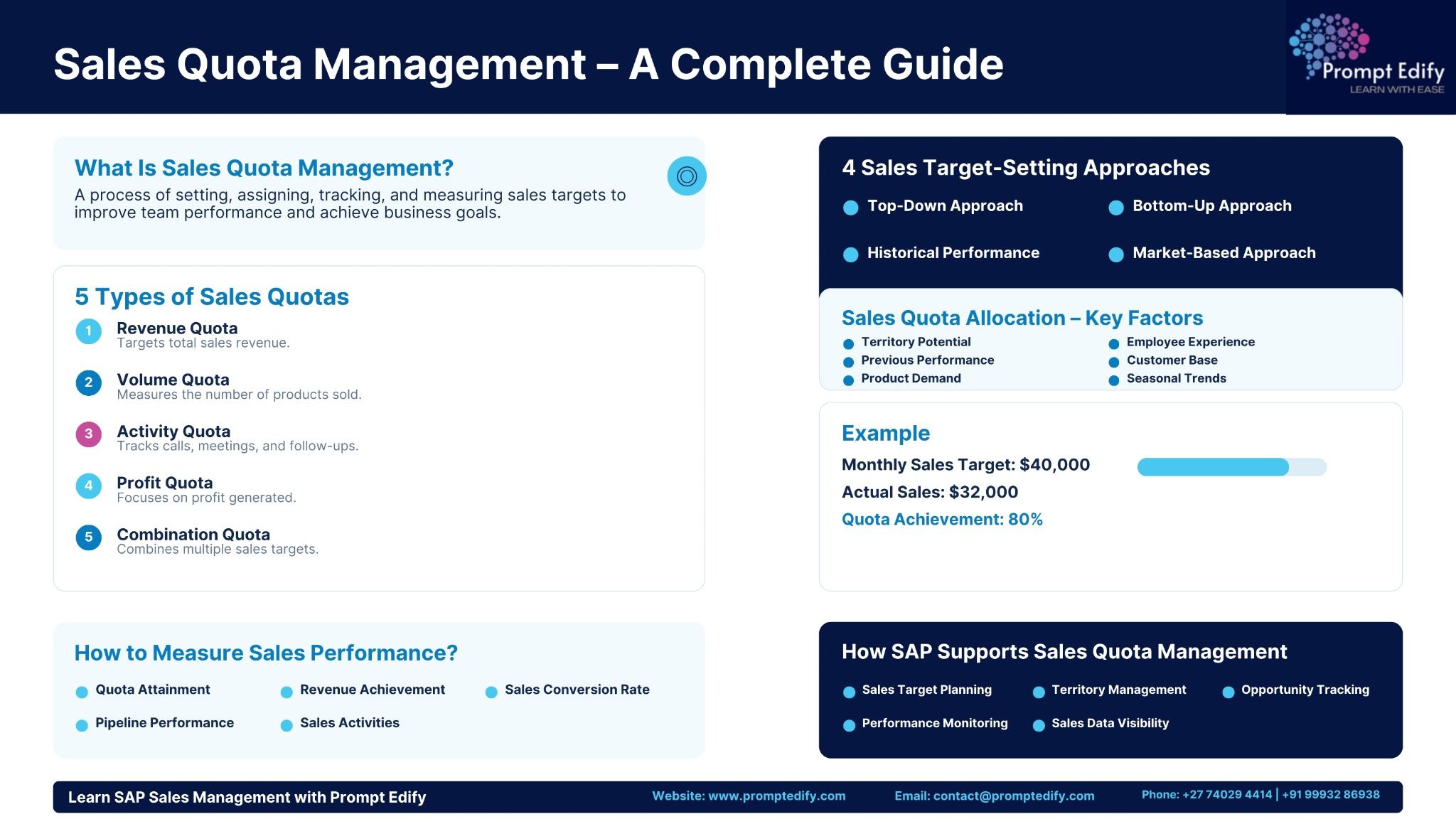
To make sure that sales targets are realistic, there has to be proper planning and understanding of the environment. Unrealistic sales targets discourage the employees while realistic ones do not contribute towards organizational growth.
Following are some methods through which sales targets can be made:
The process of sales quota allocation involves the division of the total quota among different sales representatives, territories, sales teams, or departments.
For instance, if a company has a quarterly target of $500,000, this figure will be divided into five sales representatives depending on their experience, territory capacity, existing customers, and past performance.
There are a number of issues that must be taken into account when allocating sales quotas correctly:
Quota allocation allows eliminating unfair distribution of tasks and makes responsibilities clear for sales representatives.
After the quotas have been set, there is a need to measure and compare the actual performance to the quotas.
Performance metrics that can be used include:
For instance, if a sales person has a monthly quota of $40,000, but earns $32,000, he or she achieves 80% of the quota.
Performance evaluations allow managers to identify problem areas and high performers among others.
Sales quotas that have to be managed within several groups or regions may become very difficult to handle if businesses rely solely on spreadsheets and separate systems. With SAP solutions, businesses can benefit from increasing sales visibility, organizing customer data, and planning sales performances.
By means of SAP sales management skills, businesses are able to manage sales territories, track sales opportunities, assess sales team performance, and ensure alignment of sales activities with business goals.
If you want to learn more about the process, you can consider taking the SAP Quota Management course.
The sales quota management provides an opportunity for organizations to develop a systematized way of setting goals, assigning tasks and assessing the sales performance. This process involves many stages such as selection of quotas and assessment of performance, among others.
Due to proper tools and assessment of performance, organizations will be able to identify their weaknesses, increase efficiency and boost revenues.
By Team Prompt Edify
Have any enquiry? Call us
+(27) 740294414
(+91) 99932-86938
wecare@promptedify.com


Prompt Edify Africa (PTY) Limited
2nd Floor, Rivonia VillageCnr Mutual Road and Rivonia Boulevard Rivonia Village, 2191
Johannesburg , South Africa
Contact : +27740294414
Prompt Edify East Africa Limited
KN 78 ST, Kagarama, Kigali, Kigali, Nyarugenge, Umujyi wa Kigali, Rwanda
Contact : +250 727 845 771
Prompt Edify Private Limited
4th Floor #15, City Vista Tower, Fountain Road,
Kharadi, Pune(MH), India.
PIN- 411014
Contact : (+91) 99932 86938



Contact Us Today!
+27740294414 | (+91) 99932 86938 | +250 727 845 771
contact@promptedify.com | wecare@promptedify.com
🌐 https://promptedify.co.za/