
Learn how SAP Ariba Category Management supports spend analysis, category profiles, supplier relationships and strategic procurement planning for businesses.

The procurement process contributes significantly to keeping down business costs, fostering relations with suppliers and ensuring that items and services are available on time. But when there is no system in place for managing such activities, things may get quite complex. In comes SAP Ariba Category Management.
It assists in organizing expenditure into categories, determining what should be purchased and how to go about purchasing it. With the help of this method, firms can evaluate their expenditures in their totality rather than considering each individual purchase separately.
The definition of SAP Ariba Category Management is a way of structuring procurement operations according to spending by specific categories of goods or services. Categories in this case stand for groups of spending in particular areas.
For instance, an organization could group spending into such categories as IT hardware, office supplies, logistics, marketing services, raw materials and professional services.
Spending on various categories may have a number of different suppliers, markets, procurement needs and costs associated with it. This makes it necessary to manage each category individually, to be able to understand spending patterns and identify possible ways to improve procurement.
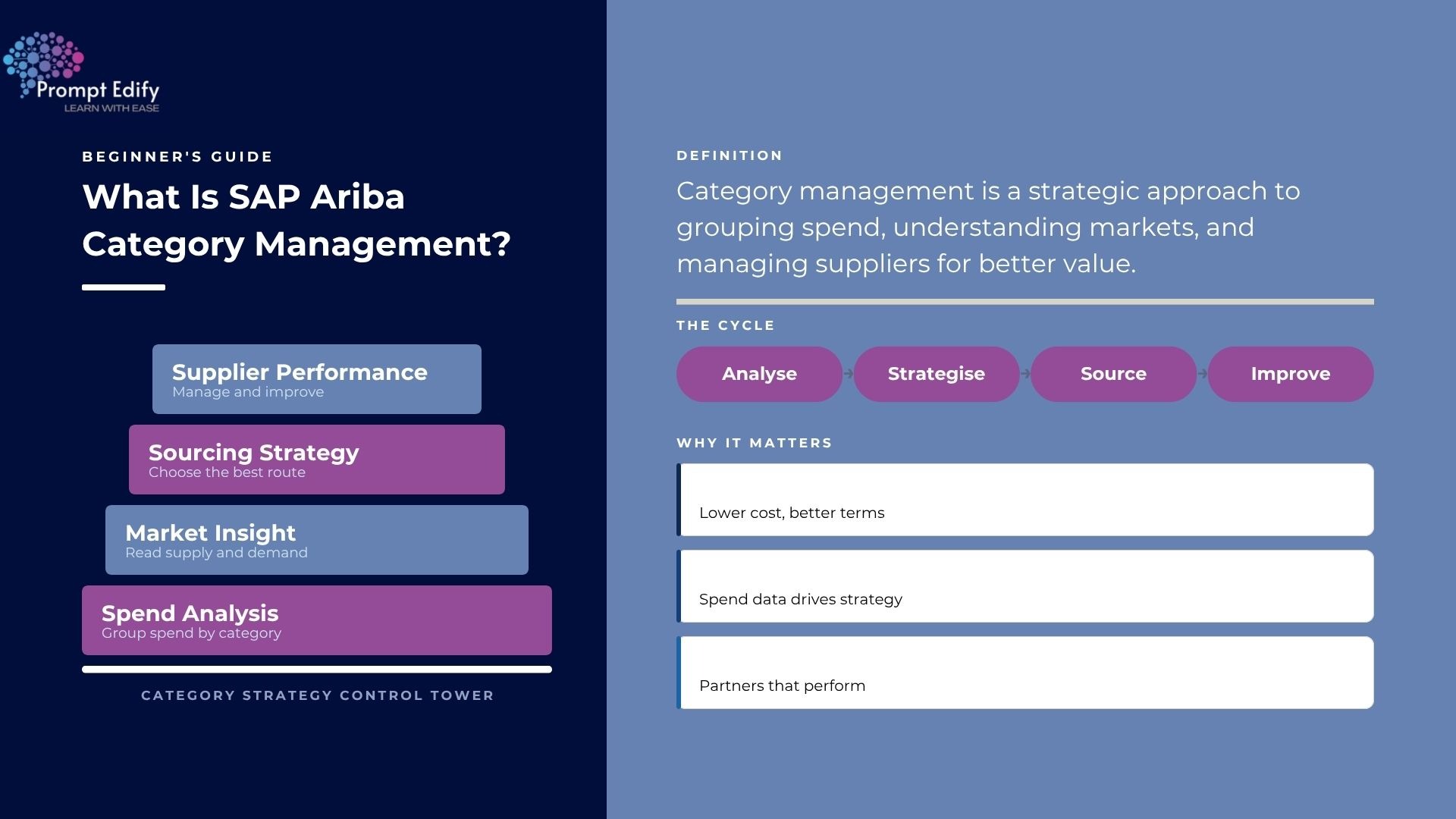
Category management involves development of a detailed strategy for each spending area, considering the needs of the business, suppliers, markets, risks and procurement strategy.
In the context of SAP Ariba environment, category-related functionality may help procurement teams with spend visibility, supplier data, sourcing processes and strategic decisions
.
Procurement that is not categorized may make it hard to determine how money is used and if purchases align with business goals.
The SAP Ariba Category Management offers a better approach to procurement due to the following reasons.
Firms are able to categorize similar purchases and analyze spending in different departments and among various suppliers. It enables procurement teams to determine main areas of spending and potential cost savings through purchase consolidation.
Different categories demand different skills from suppliers. IT services demand particular skills as well as the ability of raw materials suppliers to deliver the materials on time and of required quality.
The procurement team can come up with sourcing strategies depending on the needs of categories, competitions among suppliers and the market situation. This helps make better purchasing decisions instead of making decisions according to purchasing practices only.
The knowledge of category spending will help to determine any differences in pricing, dependency of suppliers and risks of supply. This way, the procurement managers can think of alternatives to the suppliers and create commercial agreements and risk management strategies.
Category management will help the procurement team to collaborate with finance, IT and other teams for better purchasing decisions.
A category profile is structured data regarding the procurement category. The category profile helps the procurement specialists understand what the features, requirements, and priorities of the procurement category are.
For example, if the company needs to procure its IT hardware category, then it will need information about the laptops, servers, network equipment, the list of suppliers, specification and quantity of purchase.
There can be a number of aspects in the category profile depending upon the solution and configuration. The following aspects can include in a category profile:
This kind of information helps in understanding the current status of procurement.
Category strategies are key components of category management. A category strategy is the approach that an organization will adopt to purchase goods within the category, the suppliers, cost and risks associated.
A category strategy guides procurement decisions and links purchase decisions to overall business objectives.
In creating a category strategy, there are usually several steps involved.
1. Examine Spending Patterns: Examine the spending history in order to assess expenditures, supplier mix, demand, etc.
2. Supplier Marketplace: Analyze the supplier marketplace, competitor situation, pricing, supply availability, etc.
3. Business Requirements: Talk to the departments to determine the requirements of the business.
4. Risk and opportunity assessment: Identify the risks of disruption, dependence of suppliers, differences in costs, and opportunities that can be used for optimization of the sourcing strategy.
5. Category Strategy Development: Identify the right sourcing strategy, communication with suppliers, cost objectives and performance standards.
6. Performance Measurement: Evaluate periodically the performance of categories and adjust strategy according to the need.
For example, in the logistics category, it would focus on certain parameters like delivery reliability, cost of transport, availability of regional suppliers and their service levels. In case of IT category, the following parameters could be considered:
Compatibility Security This is the reason why different strategies are required for each category.
There are SAP Ariba solutions available for procurement that help with various phases of strategic procurement. Based on the product used by the company, organizations can leverage their respective features to help them manage the data of the suppliers, spend analysis, sourcing efforts, and procurements visibility.
Through the available procurement data, the category managers can leverage the information to discover new opportunities, communicate with all the necessary stakeholders, and align the category strategies with the sourcing efforts.
But category management isn't just about utilizing the software solution to classify the purchases.
SAP Ariba Category Management enables an organization to adopt an organized method of procurement by grouping expenditures into categories, creating category profiles and formulating strategies based on business needs.
Knowledge of these basics can prove helpful for procurement professionals, category managers and learners of SAP.
Build Your SAP Ariba Skills with Prompt Edify
Prompt Edify provides targeted SAP training programs which assist learners to understand procurement methods, SAP products and their application in business. Learn about SAP Ariba training here.
By Team Prompt Edify
Have any enquiry? Call us
+(27) 740294414
(+91) 99932-86938
wecare@promptedify.com


Prompt Edify Africa (PTY) Limited
2nd Floor, Rivonia VillageCnr Mutual Road and Rivonia Boulevard Rivonia Village, 2191
Johannesburg , South Africa
Contact : +27740294414
Prompt Edify East Africa Limited
KN 78 ST, Kagarama, Kigali, Kigali, Nyarugenge, Umujyi wa Kigali, Rwanda
Contact : +250 727 845 771
Prompt Edify Private Limited
4th Floor #15, City Vista Tower, Fountain Road,
Kharadi, Pune(MH), India.
PIN- 411014
Contact : (+91) 99932 86938



Contact Us Today!
+27740294414 | (+91) 99932 86938 | +250 727 845 771
contact@promptedify.com | wecare@promptedify.com
🌐 https://promptedify.co.za/