
Learn what SAP Commerce Backoffice is, its key features, functions, catalogue management capabilities, and how it supports product administration.

E-commerce involves managing many products, along with product categories, prices, content information, and customer orders, which requires an efficient central administration platform. Such a dedicated platform will help companies to have efficient and organized systems that will allow their teams to manage product information, maintain the catalogs, track data and run operations of online shops well.
SAP Commerce Backoffice provides this very platform that can be used by business users and administrators to manage data, product information, catalogs, and various backend activities. Thanks to SAP Commerce Backoffice, teams can run daily activities related to e-commerce without the necessity to interact with the actual technological setup behind.
Having knowledge about SAP Commerce Backoffice is vital for professionals dealing with e-commerce operations, product management, catalog administration, and SAP Commerce Cloud implementation.
The SAP Commerce Backoffice is a web-based control panel that enables the management and administration of business data as well as backend operations of an SAP Commerce solution. Access to the Backoffice interface allows users to create, modify, search, and organize data via a configurable interface.
Business users are able to handle backend data without using technical programming and database operations thanks to the Backoffice interface. The tool allows for various business functions to be performed, such as managing product content, handling catalogs, overseeing data, configuring searches, and processing workflows.
The SAP Commerce Backoffice is built on the framework called Backoffice Framework that affords companies the means to configure their administrative interface to fit their business needs.
SAP Commerce Backoffice provides various functions that allow e-commerce firms to run their e-businesses.
With Backoffice, authorised users can access and control business data in a central place within SAP Commerce. Different functions can be made available through configurable views and interfaces.
Users can manage product records, business objects, catalogs, and other system data according to the permissions granted to them and the configuration of the platform.
Product management is one important function of SAP Commerce Backoffice. Companies can create, modify, search and update product records to keep the information accurate and organised.
Product information may involve:
Centralized product information allows businesses to minimize discrepancies across their e-commerce channels.
Effective catalogue management helps businesses structure products into various categories and hierarchies. The Backoffice system allows users to view various catalogue elements, as well as provides an option to browse through product collections, adjust their interrelations, and manage catalogue structures that include categories.
Depending on their market, storefront, language, or type of content, companies may need different catalogues.
Accessing particular products/business records gets easier with effective data collection. SAP Commerce Backoffice allows searching and browsing through systems, with users being able to search for necessary records using appropriate criteria.
Different forms of searching can be used — filtering, facet-based searching, and other search techniques.
SAP Commerce Backoffice supports a variety of operational functions that help teams maintain the backend environment.
The administrators of products may keep and update records related to products, alter descriptions, and make announcements about products. The process of data maintenance on a regular basis allows these workers to keep correct and timely information about products displayed in the commercial outlet.
Using the Product Content Management system in Backoffice, users are capable of examining product information. They can access product pages, view the structure of the assortment, as well as compare records of products and work with the information using different services.
All these views given to the users are relevant when their duty is to analyze the attributes of products, see the differences between the products, and deal with certain catalogs or assortments of goods.
With the help of the SAP Commerce Backoffice, the workers use the feature of product importation and exporting.
It includes procedures for using Excel in the process of product content management.
Synchronization is essential to let companies move catalogue data through the available catalogue versions, such as staged and online catalogue, depending on implementation.
Synchronization is important in distributing correct product information in the designated storefront environment. This will ensure that changes made on the product during maintenance are included in the process of distribution.
The process of product management performed by SAP Commerce Backoffice involves much more than just the creation of product records. This process also includes organisation of the product information, provision of information, and other functions that will allow for easing the path of product information to consumers.
For example, when an electronics retailer releases a new laptop, it can use Backoffice to control the name of the product, give a description and technical specifications.
Product information can also be organised in a relevant catalogue before users receive access to it through an online shop.
A typical product management workflow may include:
This process helps connect backend product administration with the customer-facing shopping experience.
SAP Commerce Backoffice and the storefront serve different purposes within an e-commerce environment.
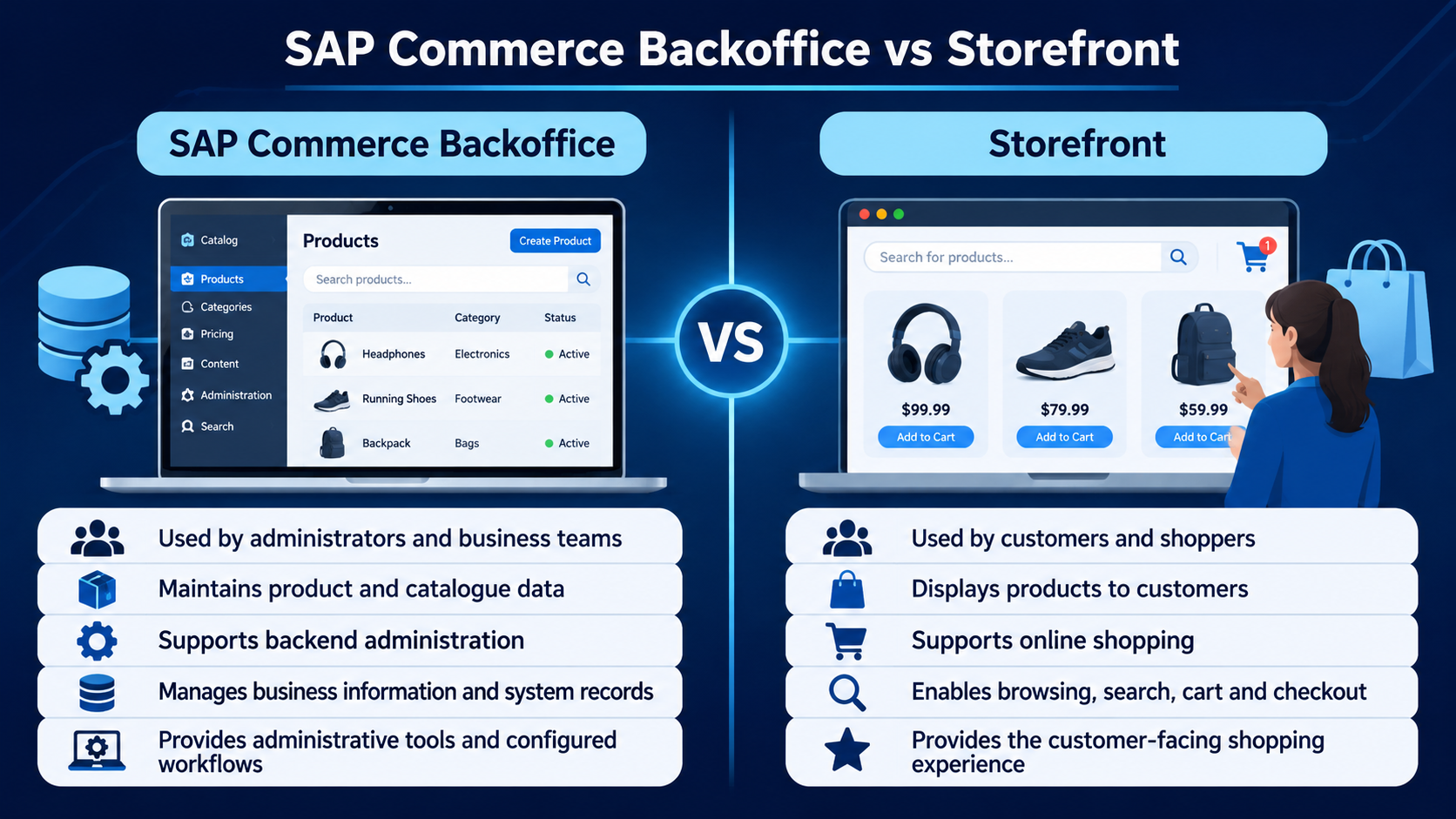
Both components are important for an e-commerce platform. Backoffice helps teams maintain the business data and operations, while the storefront uses relevant information to deliver the shopping experience.
SAP Commerce Back Office is beneficial for professionals working in the management of digital commerce systems, including:
The exact features the users can leverage depend on roles, permissions, configuration, and implementation specifications.
The SAP Commerce Backoffice is the key administrative interface in the SAP Commerce ecosystem. It allows companies to oversee product information, catalogue structure, backend information, search capabilities, and administrative aspects right from a centralized location.
Also, its product management features are very useful for e-commerce teams that work on ensuring accurate information about the products and maintaining orderly catalogues. The knowledge of how Backoffice functions shall help professionals in understanding the link between product administration, catalogue management, and the entire digital commerce experience.
Gaining knowledge of SAP Commerce Backoffice can be a good foundation for those who want to develop skills in the areas of SAP Commerce Cloud, e-commerce product management, catalogue management, and backend commerce processes.
By Team Prompt Edify
Have any enquiry? Call us
+(27) 740294414
(+91) 99932-86938
wecare@promptedify.com


Prompt Edify Africa (PTY) Limited
2nd Floor, Rivonia VillageCnr Mutual Road and Rivonia Boulevard Rivonia Village, 2191
Johannesburg , South Africa
Contact : +27740294414
Prompt Edify East Africa Limited
KN 78 ST, Kagarama, Kigali, Kigali, Nyarugenge, Umujyi wa Kigali, Rwanda
Contact : +250 727 845 771
Prompt Edify Private Limited
4th Floor #15, City Vista Tower, Fountain Road,
Kharadi, Pune(MH), India.
PIN- 411014
Contact : (+91) 99932 86938



Contact Us Today!
+27740294414 | (+91) 99932 86938 | +250 727 845 771
contact@promptedify.com | wecare@promptedify.com
🌐 https://promptedify.co.za/