
Explore SAP Commerce, its key features, B2B and B2C applications, product catalog management, system integration, and benefits for modern digital businesses.

The experience that customers get when buying goods online is expected to be easy, fast, and efficient. They want to be able to locate and compare different products, obtain information, and make purchases without being bogged down with too much trouble. To achieve all of that, a business will need more than just an internet presence; it will require integration of customer information, purchasing, sales and other processes into a single platform, which SAP Commerce offers.
Learning about SAP Commerce training can assist companies in finding new ways to benefit from its capabilities.
SAP Commerce is the digital commerce platform for companies to build up their own e-commerce sites. It is a solution for B2C and B2B commerce allowing companies to reach various customers via digital channels.
The list of its functions includes the management of product catalogs, promotions, shopping carts, the process of checkout and customer experience management. Moreover, it allows integration with other enterprise applications so that online transactions could be connected to business processes.
For instance, a manufacturing company selling its products to distributors and end-users requires different pricing, product information and order processes. This could be achieved with the help of SAP Commerce.
Poorly designed online stores can make clients feel frustrated and cause purchase abandonments. Poor product information, complex checkout process, and inconsistencies in prices can impact sales and the reputation of the brand.
SAP Commerce can help companies overcome the mentioned challenges by having the following functionality:
• Product discovery: Categorise and arrange product information so that the client can discover relevant products.
• Customer experience: Customize content, promotions, and customer journey.
• Ordering experience: Provide support in terms of shopping carts and checkouts.
• B2B purchasing: Take into account specific account pricing, products, and business purchasing processes.
• Connectivity: Communicate with corresponding enterprise systems.
All the functionality mentioned above enables enterprises to design a better purchasing experience.
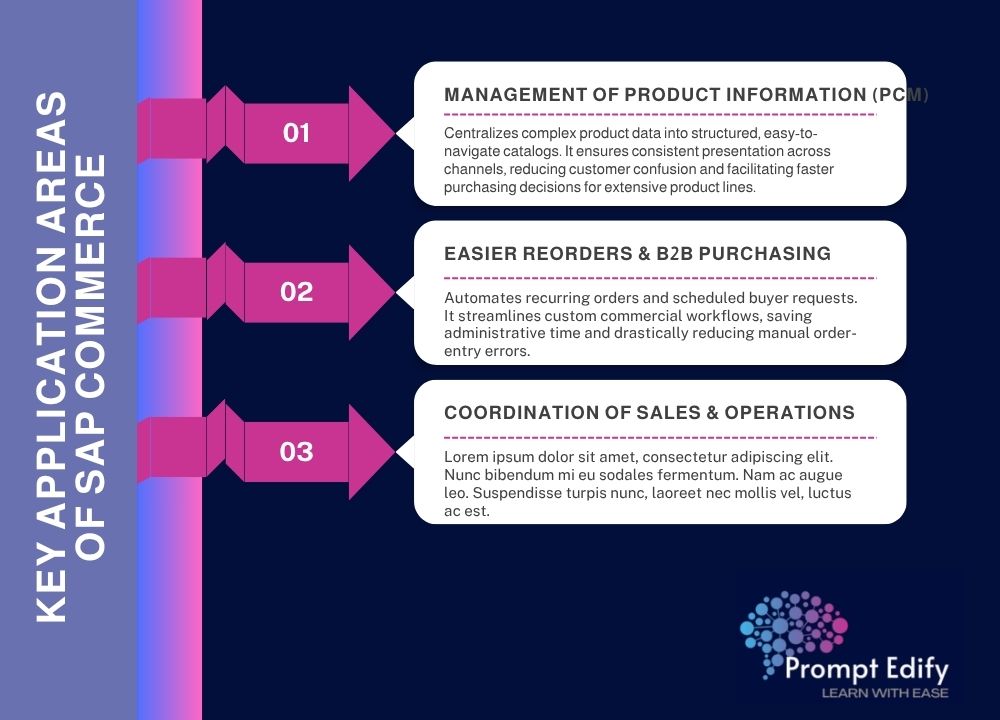
1. Management of Product Information
Such information disorder leads to difficulties with purchasing decisions.
SAP Commerce allows maintaining structured catalog management which makes product information presentation consistent. It is especially beneficial for manufacturers, wholesalers, and retailers dealing with numerous product lines.
2. Easier Reorders
It often happens that business customers place the same order according to the set schedule. Typing this information repeatedly consumes time and can lead to mistakes.
Properly configured commerce solutions will allow placing reorders and conducting custom commerce relations with customers.
3. Coordination of Sales and Business Operations
Orders placed via the Internet might impact inventory, fulfillment, billing, customer support and other operations. These operations conducted by separate systems might lead to problems.
Integration needs would be defined depending on particular circumstances.
SAP Commerce can work with multiple industries in accordance with their business needs.
• Manufacturing: Offer product data and digital orders to distributors.
• Wholesale distribution: Enable recurrent orders and account-based buying.
• Consumer goods: Create direct-to-consumer sales channels and improve online product presentation.
• Technology: Arrange complicated product portfolios and facilitate digital buying process.
For example, a wholesaler dealing with multiple enterprises might require separate prices for each account. Such SAP Commerce configuration will be able to handle this issue while working in conjunction with systems that manage inventory and orders.
Implementation starts with well-formulated business objectives. Companies should identify any existing problems and decide how the use of digital commerce technology can solve those problems.
It is important to consider the following:
• Integration of systems: To identify which applications will need to share information about customers, inventory, prices and orders.
• Quality of data: It is necessary to make sure that product descriptions, categories and prices are correct.
• Customer needs: To understand how different target groups of customers buy products.
• Security and performance: To create proper access controls and tests.
• Training of employees: To prepare people who will be working with a new system.
• Measurement of performance: To track the rate of conversion, order accuracy and customer satisfaction.
The development of a digital commerce solution is a process that includes planning, configuring, testing, integration, and improvement. SAP Commerce Services can assist companies in analysing their needs, implementing solutions, configuring platform capabilities, integrating enterprise systems, solving problems, and improving digital commerce processes. This list varies depending on the service provider and the requirements of the company.
By adopting the proper implementation strategy, companies will be able to create digital experiences for their customers both now and in the future.
Starting from catalog management, B2B order processing, and integration, it provides a range of functionalities that could be useful for organizing their digital sales process.
SAP skills development will give professionals an advantage when they want to learn more about enterprise technology and how it is used in real-world applications. Prompt Edify has several courses dedicated to developing SAP skills.
Contact: +27 740 294 414 | +91 99932 86938
Email: contact@promptedify.com
Website: https://promptedify.co.za/
By Team Prompt Edify
Have any enquiry? Call us
+(27) 740294414
(+91) 99932-86938
wecare@promptedify.com


Prompt Edify Africa (PTY) Limited
2nd Floor, Rivonia VillageCnr Mutual Road and Rivonia Boulevard Rivonia Village, 2191
Johannesburg , South Africa
Contact : +27740294414
Prompt Edify East Africa Limited
KN 78 ST, Kagarama, Kigali, Kigali, Nyarugenge, Umujyi wa Kigali, Rwanda
Contact : +250 727 845 771
Prompt Edify Private Limited
4th Floor #15, City Vista Tower, Fountain Road,
Kharadi, Pune(MH), India.
PIN- 411014
Contact : (+91) 99932 86938



Contact Us Today!
+27740294414 | (+91) 99932 86938 | +250 727 845 771
contact@promptedify.com | wecare@promptedify.com
🌐 https://promptedify.co.za/