
Understand SAP CO, its components and uses, and how SAP Controlling helps organisations manage costs, plan budgets, analyse profitability and support decisions.
It is essential for any business to know its expenses, identify areas of excessive spendings, and monitor its business operations to check whether it produces the expected results or not. Knowledge about those issues is crucial for planning budgets, controlling expenses, and making financial decisions. This is where SAP CO comes into play.
Those who have just started working with SAP systems may wonder what SAP CO is and how it relates to corporate activities. SAP CO is a component of SAP, and it provides companies with services for monitoring and estimating their internal costs.
In this beginner's guide, we will find out what SAP CO means, analyze its basic elements, present its applications, and explain the collaboration with other SAP components.
SAP CO is an abbreviation for SAP Controlling. This is the main part of the SAP Financial Management application, which is designed to provide internal accounting and cost management support to a company.
Financial accounting deals with financial transactions and creating financial reports for outside agencies. SAP Controlling provides internal analysis that helps the management to get information on the costs of the business activities.
For example, if a factory wants to know the costs to create a certain product, it needs to review all expenses associated with the purchase of materials, workers, manufacturing operations, etc. SAP CO is the tool that will help the company to get the desired information.
In more general terms, SAP CO gives the answer to the questions of where the money goes and how effectively the budget is used.
SAP Controlling can be defined as management accounting because it deals with gathering, classifying, controlling, and examining the data about expenses and revenues necessary for internal decision-making.
The SAP CO system provides companies with methods for planning their expenses, making comparisons between actual costs incurred and planned costs, and measuring financial performance of departments, projects, products, and fields of activity.
As an example, suppose a certain division is given a budget for each month. The finance department is capable of using the controlling data to compare its actual expenses with the planned budget for this month. This enables the management to find out as to what the differences are and make appropriate adjustments.
From the above, it follows that SAP Controlling is useful for companies that need to know better what is going on with their finances inside their organisations.
SAP CO has several components that provide assistance to companies in controlling different processes involved in cost accounting and profit analysis. The specific components would depend on the needs of the business and the SAP configuration of the business.
1. Cost Element Accounting
Cost element accounting is a process that allows the company to categorize its costs into different classes, including material costs, salary expenses, production costs, administrative costs and so on.
This process enables the finance department to learn what types of costs are present in the company, and how they are accounted for.
2. Cost Centre Accounting
Cost centre accounting is a procedure that allows the organization to track its expenses incurred in different departments or divisions of the company.
For instance, a company may organize its expenses into separate cost centers like marketing, human resources, production and administration.
3.Internal Orders
Internal orders can be described as instruments through which organisations plan, collect and control costs related to certain activities or short-term projects. For example, a company may create an internal order for tracking marketing activities or costs incurred in such forms of projects as employee training or equipment maintenance.
4.Product cost controlling
Product cost controlling is the process used for calculating and analysing the costs of producing goods. It takes various cost components into account, including cost of raw materials, labour and overhead costs, and thus helps organisations assess their product costs and make correct pricing and production decisions
5. Profitability Analysis
The process of Profitability Analysis, generally known as CO-PA, assists firms in evaluating profits and losses per various market segments. The profitability analysis may help companies assess their performance based on the product sold/ customer serviced or the region in which sales were made.
6. Profit Centre Accounting
Profit centre accounting makes it possible for organisations to check the financial performance of multiple business units or areas responsible for generating revenue and handling costs.
SAP CO is an essential part of diverse business operations that are used for internal cost control and financial planning.
Some popular ways to use SAP CO include:
With the help of these functionalities, companies will be able to learn more about their cost structure.
SAP FI and SAP CO are two closely related components of SAP financial management, but they are designed to do different things.
SAP FI (Financial Accounting) is responsible for processing financial transactions and managing external reporting, while SAP CO (Controlling) incorporates management of internal costs and planning of resources.
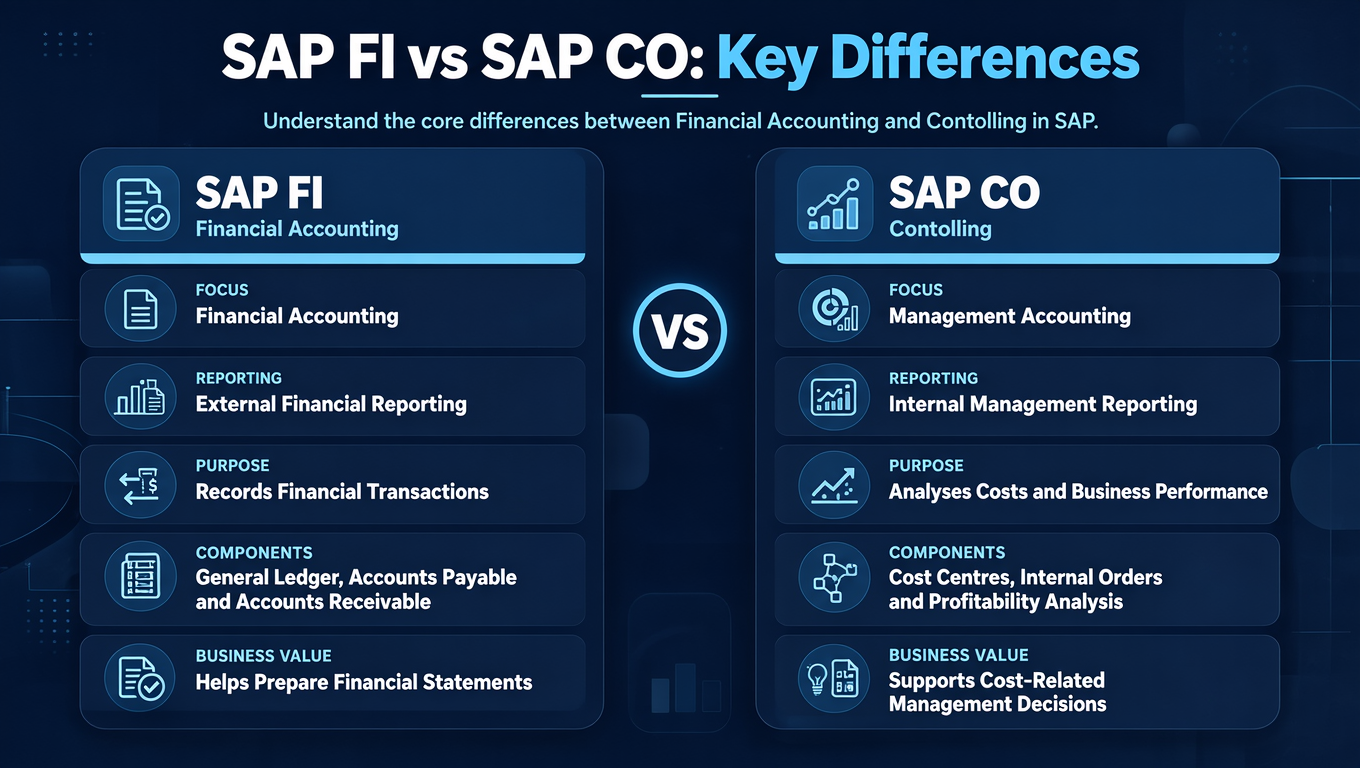
Together, these components provide a broader understanding of an organisation's financial activities.
SAP CO is designed to work smoothly alongside different SAP systems in order to obtain a holistic view of costs and financial results.
To illustrate, SAP CO interacts with SAP FI, allowing the financial data to be integrated into the control process. Related to the procurement of materials SAP CO also uses information from SAP MM relevant for the cost analysis. Furthermore SAP CO relies on information obtained from SAP SD for computing the profit made from sales.
Finally, SAP PP is used in production activities and assists with tracking expenses connected with the production process.
SAP CO can benefit people who want to know about the concepts employed in management accounting and cost management in an SAP environment.
It is relevant for:
Knowledge of SAP Controlling teaches learners how organisations are able to manage costs, and measure profit and internal financial decisions.
Prompt Edify provides SAP solutions and business processes training as well as consulting services. Its courses in SAP finance cover numerous important areas related to financial accounting, controlling, and SAP S/4HANA Finance.
Whether you are just starting to learn SAP or you want to deepen your knowledge of the finance sphere, knowing SAP CO will offer a good basis for exploring SAP management accounting processes.
By Team Prompt Edify
Have any enquiry? Call us
+(27) 740294414
(+91) 99932-86938
wecare@promptedify.com


Prompt Edify Africa (PTY) Limited
2nd Floor, Rivonia VillageCnr Mutual Road and Rivonia Boulevard Rivonia Village, 2191
Johannesburg , South Africa
Contact : +27740294414
Prompt Edify East Africa Limited
KN 78 ST, Kagarama, Kigali, Kigali, Nyarugenge, Umujyi wa Kigali, Rwanda
Contact : +250 727 845 771
Prompt Edify Private Limited
4th Floor #15, City Vista Tower, Fountain Road,
Kharadi, Pune(MH), India.
PIN- 411014
Contact : (+91) 99932 86938



Contact Us Today!
+27740294414 | (+91) 99932 86938 | +250 727 845 771
contact@promptedify.com | wecare@promptedify.com
🌐 https://promptedify.co.za/