
Explore SAP Demand Planning, demand forecasting, historical data, demand drivers, and demand sensing, and discover how SAP IBP improves supply chain planning.
In today’s highly competitive business world, companies have to ensure that their products reach the right time and right place. The improper planning of demands will result in inventory problems, stockout problems, increased operational cost and unhappy customers. In such cases, SAP Demand Planning is of utmost importance.
SAP Demand Planning enables companies to predict future demands of customers through proper analysis of past data related to sales, market trends and other business elements. By using the software such as SAP Integrated Business Planning (SAP IBP), businesses can get the accurate forecasts and make the right decisions regarding inventory.
So, what exactly is SAP Demand Planning, how is demand forecasted, and where does SAP IBP come into picture? Let us find out.
SAP Demand Planning is a tool that can be employed when calculating future customer demand for products and services through data analysis and other considerations.
The technique will help companies determine the quantity of goods that consumers are going to purchase in a specific time. These predictions will assist the company in decision-making concerning production, procurement, and much more regarding the operations of the supply chain.
For example, retail firms can make demand predictions in anticipation of the holiday seasons through sales, seasonality, promotions, and behavior of customers amongst other factors.
An effective demand planning tool will ensure that the company:
To conclude, SAP Demand Planning is a method whereby companies will be transformed from being reactive to proactive in the management of their supply chains.
Demand forecasting is an important element of demand planning that involves the use of past data, statistics, and market information to forecast future demand for products.
Through the forecasts, companies can plan to meet future customer needs rather than react to the changes in the demand level.
For example, the company producing electronic items will have forecasts regarding future demand based on past sales figures and new product launch. Forecasts will assist in determining how many products to produce and how much material to buy.
The importance of demand forecasting lies in:
However, for the process of forecasting, there should be quality data and an understanding of the factors influencing customer demand.
The historical data of the demands is the basis for making accurate forecasts. The historical data of the demands comprises information about past sales, orders, seasonal demand trends, and buying behavior of customers.
By studying such data, companies can recognize trends and learn how the demand evolves over time.
Thus, for instance, an apparel company can detect that the sale of winter clothes grows from November to January. Such a historical trend will enable the company to plan the stock prior to the season of increased demand.
The historical data is useful for recognizing abnormal sales variations, patterns of long-run growth, and evolution of the demand of customers.
SAP planning solutions can employ the historical data along with statistics for producing demand forecasts.
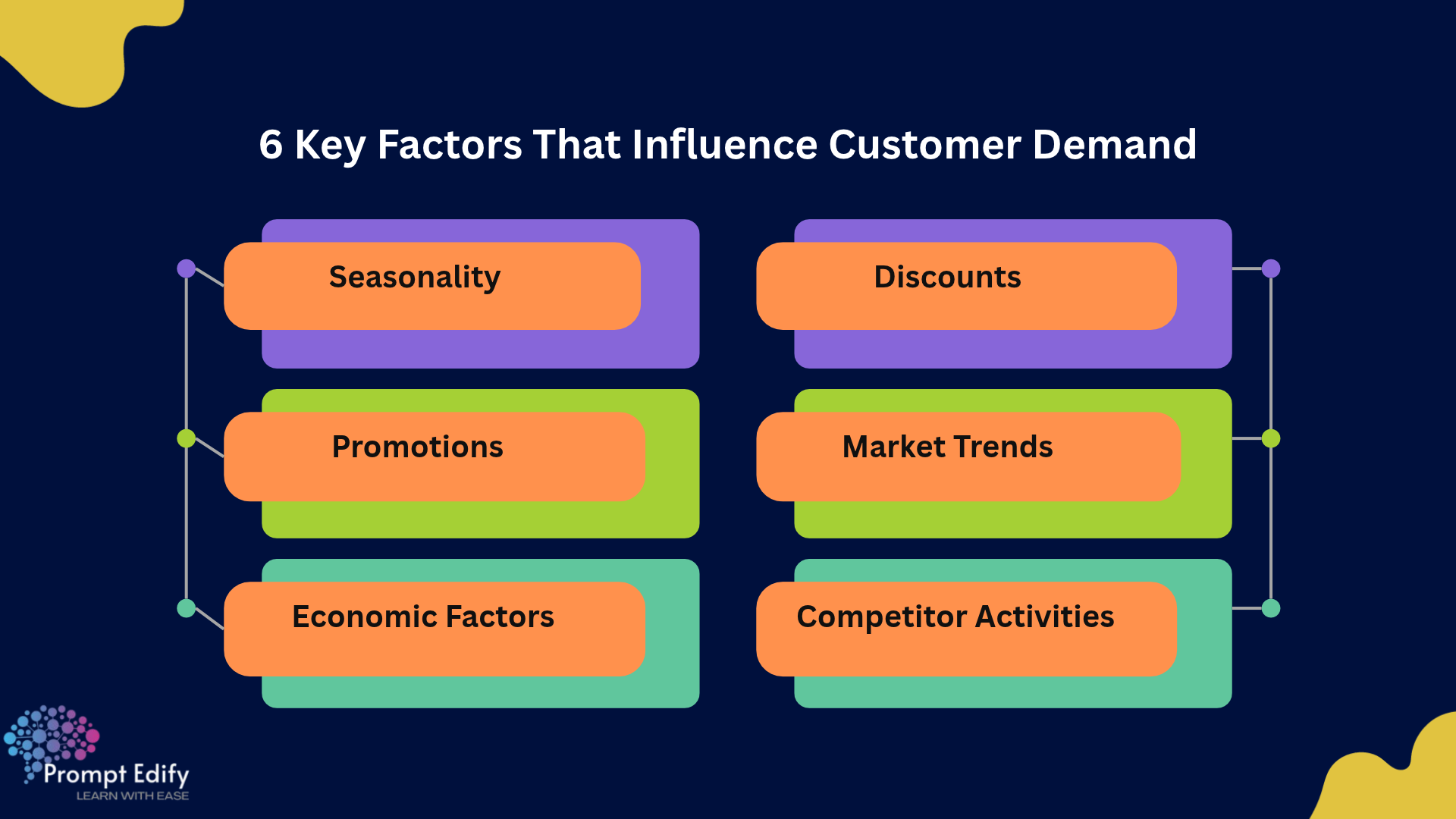
The demand drivers are the internal and external forces which impact the customer's demand for products/services.
It is important to analyze these factors so that one could make a forecast of the future demand more accurately.
Examples of demand drivers include:
Analyzing demand drivers will help us to make statistical forecasting more accurate based on the real-life situation.
The practice of demand sensing involves the use of recent demand signals and information to understand short-term changes in the demands of consumers.
In traditional demand forecasting methods, there is too much concentration on the historical data; in contrast, demand sensing takes into consideration the recent information such as customers' orders, point of sales information, and market information.
For example, when a retailer sees that there has been a sharp rise in the demands of certain products, it would be possible to detect this rise in demand using demand sensing techniques and take necessary actions accordingly.
Demand sensing helps organizations to:
The SAP Integrated Business Planning (IBP) is an on-demand solution for supply chain planning, which enables an organization to link demand planning, supply, inventories and business planning activities.
The SAP IBP provides features that support demand planning, demand sensing, scenario planning and collaboration between different business groups.
The demand planning feature in SAP IBP enables organizations to make use of historical data, statistical forecasting and business intelligence to forecast a better demand plan.
The major features of SAP IBP include:
Demand planning plays a crucial role in inventory management and supply planning of companies.
If there is a dependable demand forecast, then the company will be able to know how much inventory needs to be kept, how production will be done, and when and how material purchasing will be done.
For instance, if there is an expectation that there will be high demand for any particular item next month, then the company may increase its production capacity, material purchasing, and supply arrangements accordingly.
On the other hand, if there is an expectation that the demand will fall, then companies can plan their production and purchasing activities accordingly so as not to keep unnecessary inventory.
SAP Demand Planning is an important element of supply chain management today. It is easy to predict future demands due to the use of historical data on demand, demand drivers, forecasting, and demand sensing.
It is achieved through the use of SAP Integrated Business Planning (SAP IBP), which comprises the following functions: forecasting, collaboration, scenario planning, and supply chain integration.
In case an organization needs to enhance its supply chain planning, knowing more about SAP Demand Planning will be important.
Do you want to know more about SAP and supply chain planning? Please contact us today at Prompt Edify.
By Team Prompt Edify
Have any enquiry? Call us
+(27) 740294414
(+91) 99932-86938
wecare@promptedify.com


Prompt Edify Africa (PTY) Limited
2nd Floor, Rivonia VillageCnr Mutual Road and Rivonia Boulevard Rivonia Village, 2191
Johannesburg , South Africa
Contact : +27740294414
Prompt Edify East Africa Limited
KN 78 ST, Kagarama, Kigali, Kigali, Nyarugenge, Umujyi wa Kigali, Rwanda
Contact : +250 727 845 771
Prompt Edify Private Limited
4th Floor #15, City Vista Tower, Fountain Road,
Kharadi, Pune(MH), India.
PIN- 411014
Contact : (+91) 99932 86938



Contact Us Today!
+27740294414 | (+91) 99932 86938 | +250 727 845 771
contact@promptedify.com | wecare@promptedify.com
🌐 https://promptedify.co.za/