
Learn how SAP Digital Manufacturing connects shop-floor operations, production monitoring, operator dashboards and S/4HANA to improve visibility and efficiency.

Manufacturing companies are embracing digital platforms to increase efficiency, maintain quality in their products and manage complex manufacturing processes. Much of the existing manufacturing is still manual in both data collection and isolated systems, which makes it difficult to get visibility on factory activities and solve problems when they occur.
That's the benefit of SAP Digital Manufacturing. It connects manufacturing operations to the business, helping manufacturers achieve production visibility and synchronized execution and make data-driven decisions.
So, but just what is SAP Digital Manufacturing and how can it benefit modern manufacturing companies? Read on to find out what it offers, the benefits of it, how we use it and the learning opportunities.
SAP Digital Manufacturing SAP Digital Manufacturing is a cloud-based manufacturing operations management system that allows organizations to plan, monitor, and optimize manufacturing.
It bridges shopfloor level with enterprise level processes. Manufacturers can get a view of the shopfloor by providing shopfloor information and access to the shopfloor, including the production flow, manufacturing data collection, and performance measurement.
In other words, SAP Digital Manufacturing provides organizations with real-time insights into what is happening on the shop floor and the ability to take action to maximize productivity.
Improves all kinds of manufacturing like repetitive, discrete and process manufacturing.
Supports companies to achieve Industry 4.0 by utilizing connected devices, automation, and just-in-time information.
Contemporary producers have to deal with sometimes demanding customers, tight deadlines, quality requirements and a lack of resources.
Without connected systems, production teams face delayed data, lack of visibility, and poor communication between functions.
Digital manufacturing bridges the gap between manufacturing and enterprise systems.
It allows your organization to gain transparency into operational metrics, pinpoint production problems, eliminate manual reporting, and gain insight from manufacturing data.
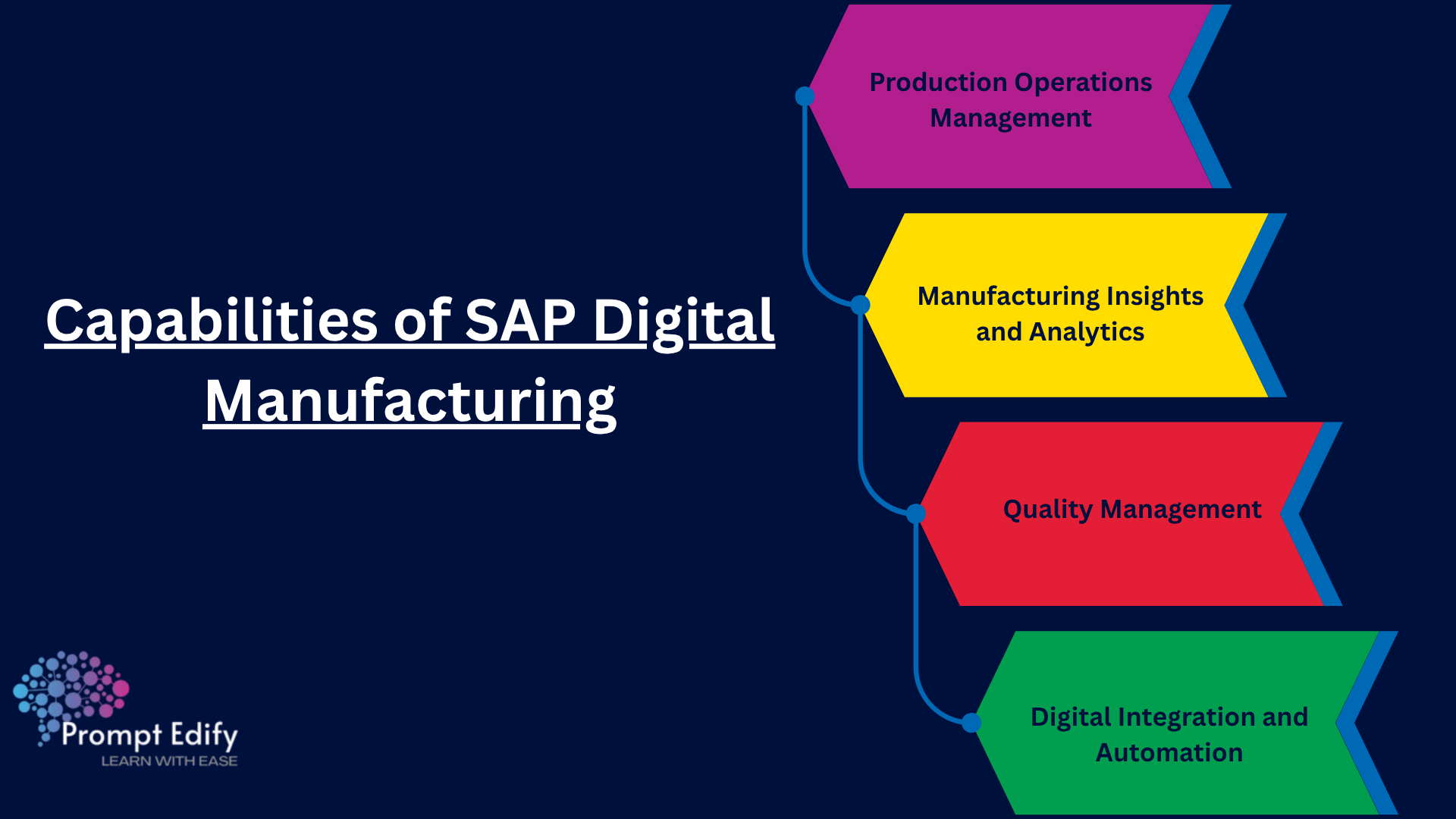
Shop floor control: Supports and structures manufacturing operations at the shop floor level.
Production Monitoring: Provides information about production status, the amount of material ready, and the line status.
Operational Analytics: Understand the process of analyzing manufacturing KPIs and identifying opportunities for improvement.
It's all about production scheduling, dispatching and worker alignment.
Data Collection: production data, quality data and processing data.
Enables workers to coordinate the use of human activity, work flows and the digital technology associated with its use.
They help organizations to have a better control of production activities and better coordinate the manufacturing.
Manufacturing Execution is one of the core SAP Digital Manufacturing modules.
It allows shop floor personnel to manage production activities like starting and stopping production, viewing work-in-progress, consuming materials, and tracking production orders.
As another example, after the manufacturing order enters production, shop floor operators can view the instructions, perform their jobs, record production quantities, and report issues.
It yields an enhancement between the production planning and the production execution.
The Production Operator Dashboard (POD) is the primary user interface in SAP Digital Manufacturing. It provides shop-floor operators with the information they need to perform manufacturing activities.
The dashboard can be personalized according to the manufacturing requirements as well as operator roles. Hence, companies can actually send the right information to the right people without any issues.
Production monitoring can be used to track how manufacturing is performing.
Production data collection such as quantities produced, scrap, downtime, quality data and machine performance metrics.
This data allows the manufacturer to study efficiency, bottlenecks, and common operational failures.
For example, if your machine is breaking down several times, then you can go back to the data that's been saved and look into what could have caused it.
SAP Digital Manufacturing with SAP S/4HANA to connect business planning with shop-floor execution.
SAP S/4HANA can generate data about material masters, BOMs, routings, work centres, production orders, etc. SAP Digital Manufacturing manages the execution and monitoring of work.
The systems may also transfer information related to transactions, such as information about orders and information pertaining to inventory.
The integration also helps organizations to ensure that high level planning is carried out in accordance with the work being performed.
SAP Digital Manufacturing can benefit many industries including but not limited to:
It is also helpful for: manufacturing engineers, production supervisors, shop-floor operators, SAP consultants, manufacturing IT professionals.
It could enable these professionals to get more visibility into production, better collaborate, and get insights into manufacturing performance.
SAP Digital Manufacturing is ready to help within the following areas:
It is also significant for manufacturing engineers, production line supervisor, shop floor operator, SAP consultants & manufacturing IT.
It can support them in gaining production visibility, aligning activities, and benchmarking manufacturing.
Interested in discovering how digital solutions are being built in modern manufacturing? How can I learn about SAP technologies and get hands-on skills that are relevant to the industry?
Get in touch with Prompt Edify now to discover more about SAP Digital Manufacturing and career training, and start on your SAP and digital manufacturing career path.
By Team Prompt Edify
Have any enquiry? Call us
+(27) 740294414
(+91) 99932-86938
wecare@promptedify.com


Prompt Edify Africa (PTY) Limited
2nd Floor, Rivonia VillageCnr Mutual Road and Rivonia Boulevard Rivonia Village, 2191
Johannesburg , South Africa
Contact : +27740294414
Prompt Edify East Africa Limited
KN 78 ST, Kagarama, Kigali, Kigali, Nyarugenge, Umujyi wa Kigali, Rwanda
Contact : +250 727 845 771
Prompt Edify Private Limited
4th Floor #15, City Vista Tower, Fountain Road,
Kharadi, Pune(MH), India.
PIN- 411014
Contact : (+91) 99932 86938



Contact Us Today!
+27740294414 | (+91) 99932 86938 | +250 727 845 771
contact@promptedify.com | wecare@promptedify.com
🌐 https://promptedify.co.za/