
Discover SAP FICO, SAP FI and SAP CO functions, major differences, modules and integration. Learn how financial accounting and cost management work in SAP ERP.
All organisations rely on financial management as an essential feature that every formal entity has to incorporate. Companies have to include implementations for financial management activities that cover transaction management, accounting management, expense control, and performance measurement. SAP has financial management solutions that bridge the gap created by the absence of any integrated tool, assisting organisations in performing these functions via its ERP system.
The SAP FICO tool represents an important dimension of SAP services, as it incorporates such branches as Financial Accounting (FI) and Controlling (CO). Both systems contribute to the financial management process as they play different parts in the process of executing an organisation's main responsibilities.
Financial professionals, accountants, and people who want to learn more about SAP know about both FI and CO as well to understand how these two accounting activities operate. This paper aims to present a description of SAP FICO, its main modules of work, functions, and practical application in the financial management process.
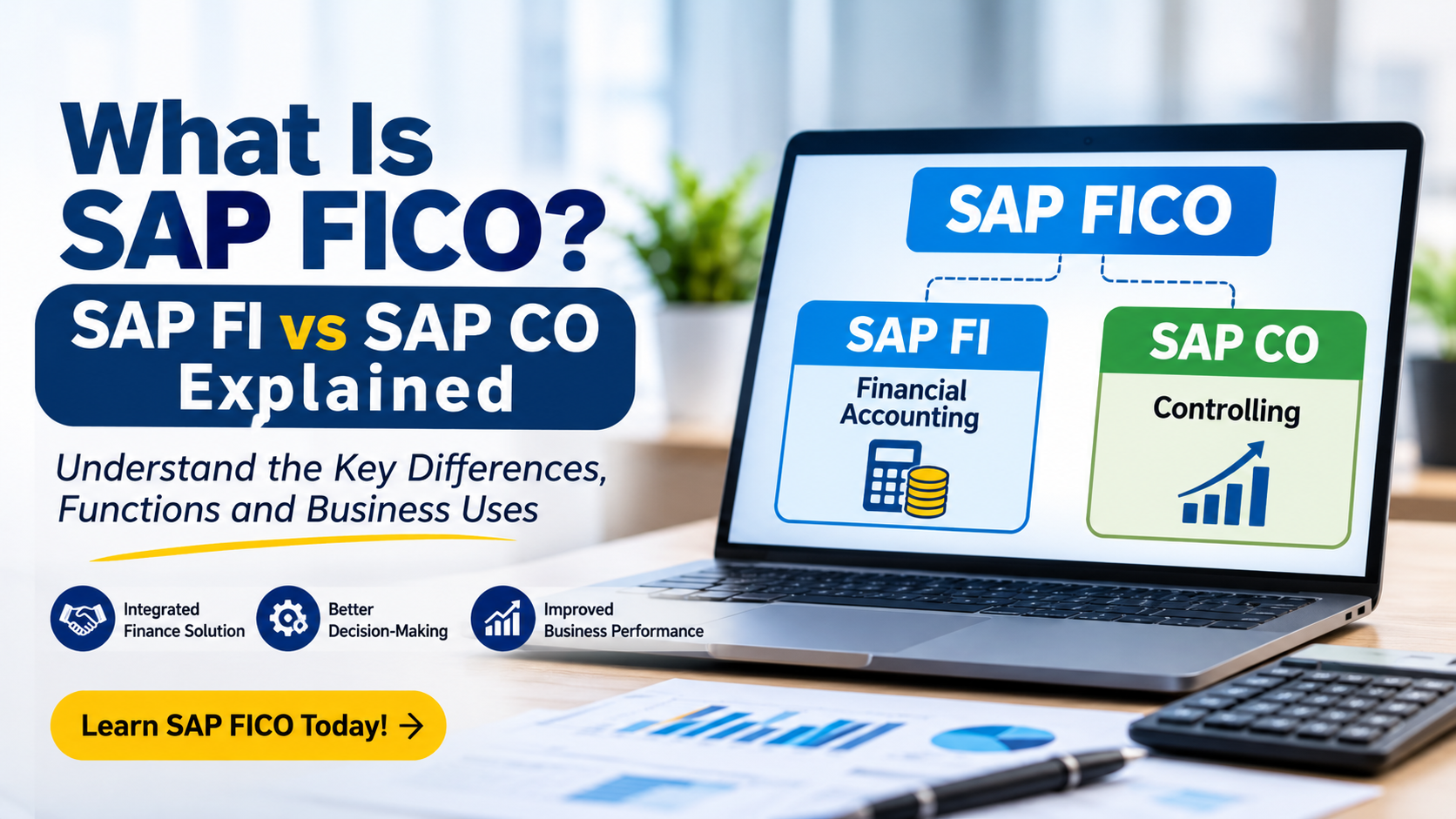
SAP FICO refers to two components of SAP, namely Financial Accounting (FI) and Controlling (CO), and it is widely used in SAP ERP systems.
SAP FICO assists organizations with recording, controlling and monitoring their finance and accounting activities, which results in receiving more accurate financial reports.
SAP FICO consists of two major components:
By integrating FI and CO components, organizations can create financial records and analyze the impact of operational activities on their financial performance.
SAP FI is the financial accounting solution that allows companies to manage their financial transactions and report them accurately. The solution also meets external accounting requirements through business transaction records.
The General Ledger Accounting process entails recording financial transactions that take place in various accounts. It assists in the preparation of statements of finance like balance sheets as well as profit-loss statements.
Accounts Payable oversees financial transactions linked to suppliers such as vendor invoices, outgoing payments, and due obligations.
Accounts Receivable deals with transactions related to customers like customer invoices, receipts, and dues.
Asset accounting aids in managing the lifecycle of fixed assets from acquisition to disposal of assets.
Bank accounting helps businesses manage bank account statements and reconciliation procedures.
SAP FI acts as a source of financial information through accounting reports and financial statements, enabling businesses to track their financial status.
SAP CO is the name of the SAP module that is utilized for management accounting and used by companies to track internal costs, evaluate business expenditures, and determine profitability.
SAP CO differs from SAP FI as it concerns internal financial accounting, while SAP FI deals with external financial accounting.
The primary features of SAP CO include:
Cost Centre accounting provides the ability to monitor expenses incurred within various departments in an organization.
Internal Order Accounting is used to analyze the expenses that relate to a certain project or business operation.
Product costing will help organizations to calculate the costs of production, such as material costs, labor costs, and overheads.
Profit Centre Accounting can be used by organizations to analyze the financial performance of particular divisions and areas of responsibility.
Profitability analysis helps businesses assess the financial performance of particular products, customers, markets, and business sectors.
SAP CO helps with the cost allocation between all the cost centers and other objects of internal financial accounting.
Although SAP FI and SAP CO are closely connected, they serve different financial management purposes. Understanding the SAP FI and CO difference helps professionals identify how each component contributes to business operations.
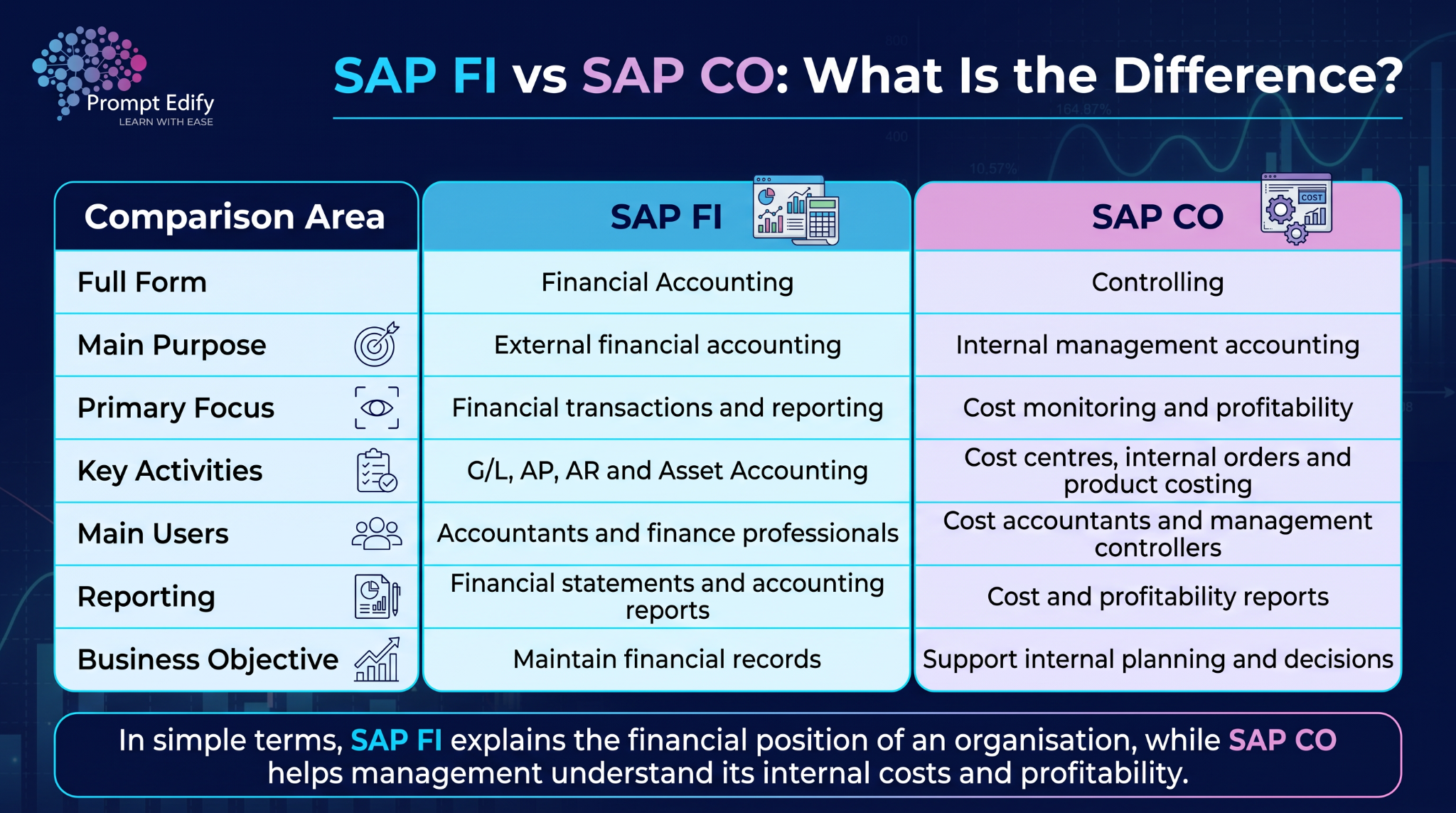
SAP FI and SAP CO join together greatly in integrating external financial accounting along with managerial accounting.
Taking an instance of a manufacturing company that procures raw materials from a vendor, the vendor bill is entered via SAP FI, resulting in processing of the transaction in the pertinent ledgers. Therefore, if the expenditure goes to a cost object, like a cost center or a cost order, this valuable data will also pave the way for cost monitoring in SAP CO.
The advantages of this process include those below:
For evaluating financial and managerial data in SAP S/4HANA Finance, the Universal Journal has been developed to help with this process.
The functionality of SAP FICO can be found in SAP S/4HANA Finance, which provides both the integrated financial accounting and controlling processes.
Reasonable SAP S/4HANA Finance basics would include the following:
By using all the above capabilities, organizations can deal with their financial operations accurately in the integrated ERP environment.
SAP FICO is appropriate for those who want to specialize in financial accounting, management accounting, and enterprise financial systems. The programme may suit:
Basic familiarity with accounting and financial procedures can make it easier to learn SAP FICO.
SAP FI and SAP CO, which are key elements of enterprise financial systems, should be the first important step in your learning process.
Prompt Edify offers advanced solutions in SAP training and consulting. The company focuses on providing services to clients that will allow them to learn how to work with SAP systems and how to conduct business processes using SAP.
The company’s learning programme in SAP finance focuses on key principles and theories of SAP FI and SAP CO. The courses offered by Prompt Edify are structured in a way that makes it easier for a person with no experience in SAP finance to learn such concepts as financial accounting, controlling, cost management, and reporting.
Whatever stage of your SAP studies you are at, learning SAP FI and SAP CO will be a good starting point in the area of SAP financial management.
By Team Prompt Edify
Have any enquiry? Call us
+(27) 740294414
(+91) 99932-86938
wecare@promptedify.com


Prompt Edify Africa (PTY) Limited
2nd Floor, Rivonia VillageCnr Mutual Road and Rivonia Boulevard Rivonia Village, 2191
Johannesburg , South Africa
Contact : +27740294414
Prompt Edify East Africa Limited
KN 78 ST, Kagarama, Kigali, Kigali, Nyarugenge, Umujyi wa Kigali, Rwanda
Contact : +250 727 845 771
Prompt Edify Private Limited
4th Floor #15, City Vista Tower, Fountain Road,
Kharadi, Pune(MH), India.
PIN- 411014
Contact : (+91) 99932 86938



Contact Us Today!
+27740294414 | (+91) 99932 86938 | +250 727 845 771
contact@promptedify.com | wecare@promptedify.com
🌐 https://promptedify.co.za/