
Understand SAP FI basics, including general ledger, accounts payable, accounts receivable, asset accounting, and financial reporting within SAP S/4HANA Finance for teams.
Financial accounting is significant in assisting organizations in regulating their financial processes, as well as in keeping records and knowing their financial standing. There is a demand for dependable technologies through which records of income, payments, expenses, and other transactions are saved when formal documentation is conducted for users and other people.
SAP solutions bring functions of financial management to customers through applications allowing organizations to conduct the operations of accounting in line with the business environment. The main subject to mention is the SAP FI module, which is responsible for the recording, processing, and reporting of financial operations.
For those who just started working in SAP finance, it is important to comprehend what SAP Financial Accounting is, how the SAP FI module functions and what is included in its functions in order to learn enterprise financial management properly.
SAP Financial Accounting is a tool for managing the accounting of an organization's upper-level management. It enables an organization to record all financial transactions, keep accounting records, and prepare financial statements.
The SAP FI module assists organizations in keeping a record of their financial activities in an organized manner. It supports processes such as general ledger accounting, accounts payable, accounts receivable, asset accounting, and financial reporting.
For instance, if a business receives an invoice from a supplier, it is captured in SAP FI. Upon receipt of a customer payment, the system updates the accounting records for that customer. These transactions therefore impact the related financials kept by the organization.
In simple terms, SAP Financial Accounting helps businesses understand where the money comes from, where it goes, and how the financial position has changed with time.
The SAP FI module comprises several functional areas, and each one of them deals with different accounting operations. Each of these functional areas is crucial for keeping accurate accounting records and handling business transactions.
This area is considered to be the most important part of financial accounting. Financial operations are recorded in relevant G/L accounts, which is necessary for forming the financial statements.
Main operations: maintaining G/L accounts, posting accounting documents, working with ledgers, and analyzing the financial balances.
Accounts Payable is responsible for the financial procedures involving suppliers and vendors. Accounts Payable records invoices from suppliers, tracks amounts owed, and makes outgoing payments.
For instance, when a company buys goods or services from a supplier, the corresponding invoice is registered in Accounts Payable.
Accounts Receivable deals with finances related to customers. Invoice processing, payments made, unpaid balance tracking, and customer account management are the functions performed by Accounts Receivable.
This function aims to keep track of the amounts payable by customers.
Asset Accounting enables the control of an organization's fixed assets in the course of their life cycle. It includes a range of processes, such as acquisition, depreciation, transfer, and disposal of the asset, plus asset reporting.
Through this process, companies can keep track of their assets, including buildings, machinery, equipment, and cars.
Besides other functions, Bank accounting allows handling of financial transactions connected with banks and helps conduct activities related to bank statement processing, checking the account balance, and performing bank reconciliation procedures.
These processes assist financial teams in matching banking data against the accounting data used by the organization.
Financial reporting employs the use of accounting data for generating reports that allow companies to assess their financial condition and financial performance.
Examples of such financial reports are balance sheets, profit-and-loss statements and others.
In SAP Financial Accounting, the system handles the recording of business transactions and the updating of accounting information.
As an example, we can look at a situation wherein a company buys raw materials from a supplier. Each time the invoice from a supplier is entered into the SAP FI system, the financial transaction is recorded, and the supplier and general ledger accounts are updated.
This process of entering a payment from a supplier is repeated when the company pays off the supplier.
A similar process takes place when a company sells goods and receives payment from the customer. In this case, an invoice is issued by the company and the payment from the customer is recorded.
In general, SAP FI automates all these processes and has many benefits for a company.
SAP Financial Accounting is another significant component of SAP S/4HANA Finance. SAP S/4HANA utilizes a new approach to financial data, allowing for more direct integration between financial and management accounting.
A major concept here is the Universal Journal that brings together different types of accounts and controlling information into a single structure called ACDOCA.
This structure facilitates producing integrated financial reports and enables cutting down the reconciliation needs of certain accounting elements.
The Universal Journal approach is also adopted in SAP S/4HANA Finance for managing both customer and supplier information using the Business Partner approach. It allows for centralizing information for business partners and all their roles.
For the SAP FI specialists, it is necessary to learn about the Universal Journal, Business Partner approach, and integration with SAP Controlling when transitioning from classic SAP ERP to SAP S/4HANA.
SAP FI and SAP CO are two important areas of SAP financial management, but they serve different purposes.
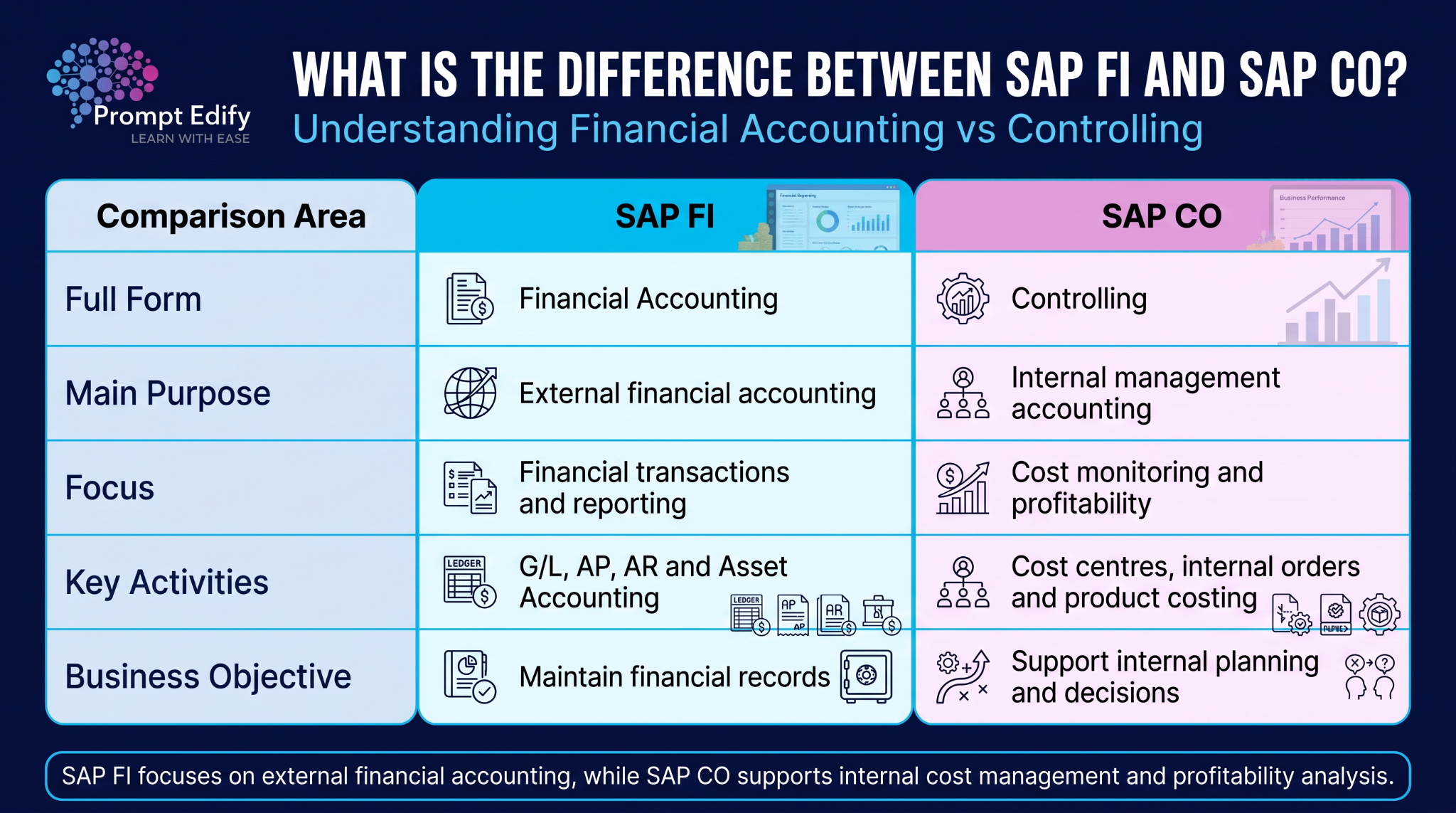
In simple terms, SAP FI focuses on recording and reporting financial transactions, while SAP CO helps organisations analyse internal costs and business performance. Both areas work together to provide a broader understanding of an organisation's financial activities.
SAP Financial Accounting is designed for those interested in accounting, finance, and the enterprise resource planning system.
The individuals who can benefit from using the SAP FI module are:
The knowledge of accounting concepts, financial transactions, and business processes opens the way for beginners to successfully study SAP FI.
Prompt Edify has SAP training & consulting skills with vast experience in empowering individuals and firms with knowledge of SAP products. The training sessions and SAP FI courses include topics related to Financial Accounting, Controlling & SAP S/4HANA Finance.
Starting with SAP learning or enhancing your skills in financial accounting, SAP FI modules can help you grasp the basics of financial management.
By Team Prompt Edify
Have any enquiry? Call us
+(27) 740294414
(+91) 99932-86938
wecare@promptedify.com


Prompt Edify Africa (PTY) Limited
2nd Floor, Rivonia VillageCnr Mutual Road and Rivonia Boulevard Rivonia Village, 2191
Johannesburg , South Africa
Contact : +27740294414
Prompt Edify East Africa Limited
KN 78 ST, Kagarama, Kigali, Kigali, Nyarugenge, Umujyi wa Kigali, Rwanda
Contact : +250 727 845 771
Prompt Edify Private Limited
4th Floor #15, City Vista Tower, Fountain Road,
Kharadi, Pune(MH), India.
PIN- 411014
Contact : (+91) 99932 86938



Contact Us Today!
+27740294414 | (+91) 99932 86938 | +250 727 845 771
contact@promptedify.com | wecare@promptedify.com
🌐 https://promptedify.co.za/