
Explore SAP GRC, its four core solution areas, business uses and benefits, and how organisations manage governance, risk and compliance effectively in business.
In today's world, organisations need to do more than run their business every day. They also need to comply with regulations, safeguard and restrict access to sensitive data, identify issues that could impact their business and implement controls. Doing all of this can become challenging across multiple departments and locations, or when a business has multiple enterprise systems.
This is where Governance, Risk and Compliance (GRC) is relevant. SAP offers a set of GRC solutions that enable organisations to put controls in place, manage compliance obligations and monitor risk in their business processes.
What is SAP GRC? And how does SAP GRC solution support business to manage governance, risk and compliance (GRC)? Know the meaning of SAP GRC, its primary solution areas, use cases and business benefits.
SAP GRC is an abbreviation of SAP Governance, Risk and Compliance. It is a collection of SAP products that organisations use to properly align business with risk, internal policies and regulatory requirements.
SAP GRC provides an integrated approach to governance, risk management and compliance instead of isolated functions. It enables organizations to put control measures in place, observe process compliance, manage user access and maintain relevant information for audits and compliance reports.
For instance, an organisation might want to restrict access to SAP transactions to those that staff require for their roles. It might need to oversee financial transactions, detect potential fraud and show that controls are in place and operating effectively. SAP GRC solutions provide the foundation to do this with workflows, risk management and monitoring.
SAP GRC is not an SAP module. It is a set of multiple related solutions that span different enterprise governance, risk management, and compliance areas, as well as access governance and security.
There are three concepts of SAP GRC you need to understand.
Governance is the framework of rules, functions and policies by which a company or other organisation is directed, administered or controlled. Governance sets out who makes decisions, how decisions are made, who is accountable and how business is monitored.
An example of a control activity is the establishment of approval requirements for supplier payments, purchases and other financial transactions. This allows employees to know what they are required to do and how they should perform their work.
Risk management is the process of identifying, evaluating, and monitoring the risks and events that could potentially impact the achievement of a business goal. Risks are financial, operational, strategic, regulatory, or technology-related.
The organisation may also face risks to system unauthorised access; system unauthorised postings; fraud; business process failure or broken linkages. Risk management ensures that the organisation has visibility of the extent of the risk and puts in place appropriate controls.
Compliance means that your company adheres to the laws, regulations, standards of the industry, as well as internal company policies.
For instance, companies might need to retain financial records, protect data, and prove that the way they conduct business satisfies applicable regulatory standards. Compliance practices allow businesses to record the controls they have in place and provide evidence to auditors.
The three pillars work together as a framework for strengthening business accountability and risk management.
SAP GRC offers various solutions and functionalities to meet your requirements. The SAP GRC portfolio belongs to one of the four SAP GRC core domains.
Business risk and compliance solutions support organisations in learning about risks associated with their business, establishing controls and tracking and monitoring activities.
They are capable of providing analysis for risk assessments, control testing, issue management and compliance reporting. These functionalities enable businesses to identify the nature of the risk and determine if the risk controls put in place are effective.
Identity and access governance deals with controlling who can access business applications and what actions they have been given permission to perform.
SAP Access Control is one such solution in this segment. It enables the functionality of access risk analysis, access request management, business role management and emergency access management.
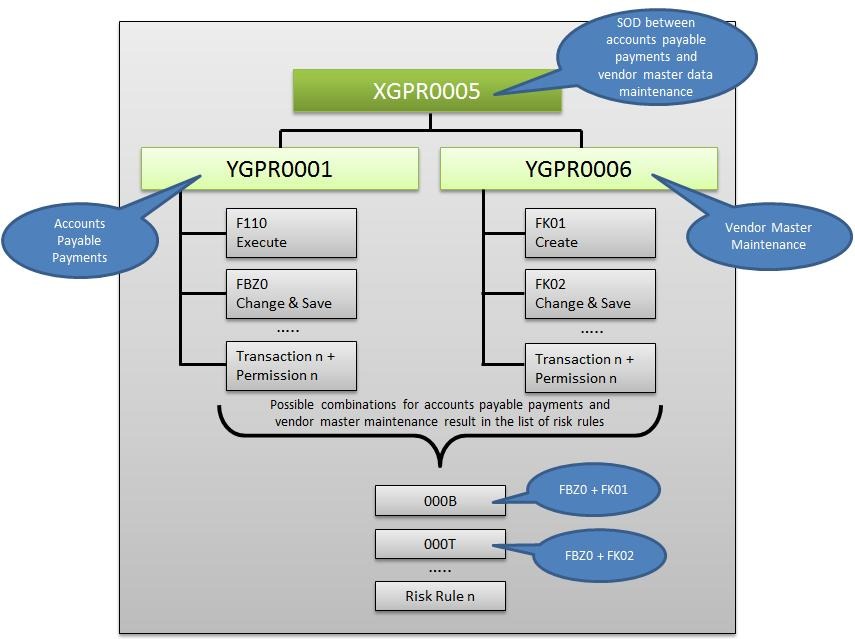
A critical concept is Segregation of Duties (SoD), which is when related responsibilities are separated to ensure that no single individual has conflicting duties and responsibilities that could enable fraud or erroneous acts.
For instance, an employee who registers a vendor in the system should not be granted the right to approve payments to this vendor.
This section covers the preservation of business applications, sensitive information, and technology environments.
SAP security and data protection offers solutions that assist companies in discovering threats, observing potentially malicious activity, and controlling access to business-critical data.
This feature is relevant to all types of organizations that rely on enterprise applications to process financial, operational and customer data.
International trade administration aids companies in handling compliance issues related to international trade.
Businesses engaged in international purchasing, selling, or shipping may have a requirement to screen business partners and check restricted-party lists. They may also have export control obligations.
SAP solutions within this scope can support screening and trade compliance processes so that businesses can uncover potential problems prior to completing related transactions.
SAP GRC can help with various activities of a business depending on the needs of the organisation and the solutions it uses.
For instance, when an employee moves to a new department, their system access permissions may no longer be suitable. An access governance process enables the organisation to evaluate the employee's current access and to put a plan in place for the change.
Likewise, in the case of an internal control failure, the organisation will be able to record the problem, identify who is responsible for rectifying it, and monitor the progress of the action to remedy the situation.
GRC applications, when used properly, will ensure the following operational benefits.
All of this, however, is dependent on the organisation's implementation approach, controls design, system setup, and continuous monitoring of the controls. SAP GRC does not automatically result in regulatory compliance, nor does it eliminate all business risks.
SAP GRC solutions can run integrated with SAP S/4HANA and other business applications (subject to GRC solution and deployment).
For instance, access governance features can be used to determine user permissions in supported SAP environments, and risk and compliance features can support monitoring across business processes.
Nevertheless, SAP GRC shall not be treated as a standard block, and portions of it available shall be coupled in any SAP S/4HANA deployment. The extent of elements, integration prerequisites, and licensing arrangements relies on the SAP product prior chosen.
Organisations need to assess their business needs as well as their SAP environment before jumping into a discussion as to what solutions are suitable.
SAP GRC applies to enterprise risk management, internal controls, auditing, compliance, and SAP system security professionals.
SAP GRC Overview Gain insights into how organisations address access risk, capture controls, and assist with compliance activities in SAP.
SAP GRC enables companies to embed the governance, risk, and compliance programs into a more structured framework. SAP's solution areas include enterprise risk and compliance, identity and access governance, cybersecurity and data protection, as well as international trade management.
Having knowledge of how these two areas interact helps businesses to achieve greater transparency, build controls and manage compliance responsibilities more effectively. Training in SAP GRC is valuable for those who manage enterprise applications that keep an organisation accountable and safe.
Prompt Edify offers SAP training and corporate learning programmes to help upskill professionals to learn various SAP functional and technical modules. To know about the SAP GRC concepts and related training courses, get in touch with our team now!
By Team Prompt Edify
Have any enquiry? Call us
+(27) 740294414
(+91) 99932-86938
wecare@promptedify.com

Prompt Edify Africa (PTY) Limited
2nd Floor, Rivonia VillageCnr Mutual Road and Rivonia Boulevard Rivonia Village, 2191
Johannesburg , South Africa
Contact : +27740294414
Prompt Edify East Africa Limited
KN 78 ST, Kagarama, Kigali, Kigali, Nyarugenge, Umujyi wa Kigali, Rwanda
Contact : +250 727 845 771
Prompt Edify Private Limited
4th Floor #15, City Vista Tower, Fountain Road,
Kharadi, Pune(MH), India.
PIN- 411014
Contact : (+91) 99932 86938



Contact Us Today!
+27740294414 | (+91) 99932 86938 | +250 727 845 771
contact@promptedify.com | wecare@promptedify.com
🌐 https://promptedify.co.za/