
Explore SAP Group Reporting features, data collection, currency translation, intercompany eliminations and consolidation for accurate group financial reporting.
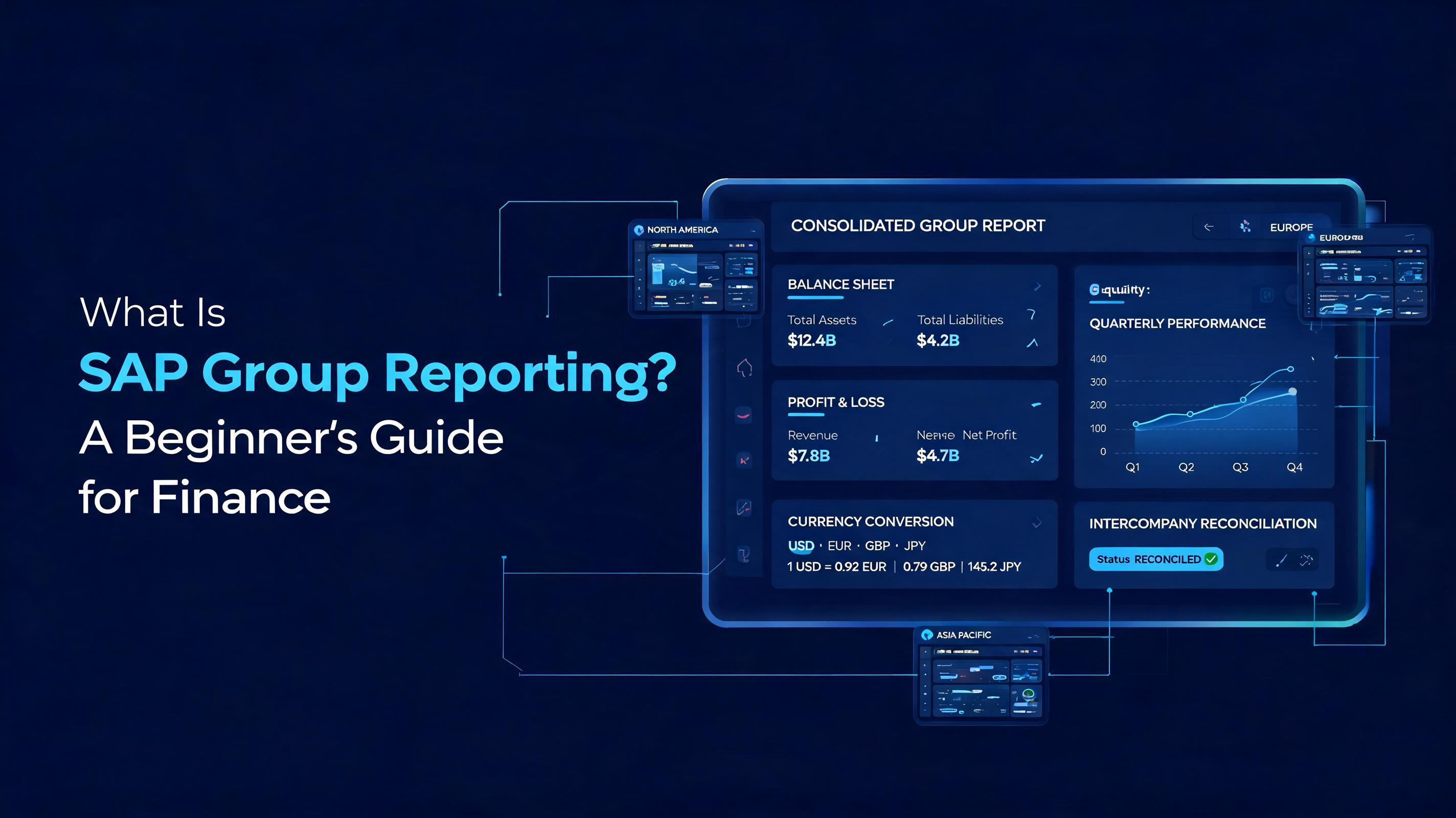
Financial data from different companies, subsidiaries, or divisions of a company might be difficult to collate for large companies. Each division or company will have its own financial accounts, with different reporting processes, or even different currencies. Due to the fact that all this data is converted into financial statements for the entire company, it is important to do an effective consolidation.
It is where SAP Group Reporting has a contribution to. It will be allowing the organizations to consolidate their financial statements and even prepare financial statements from that consolidated financial data.
SAP Group Reporting is the SAP S/4HANA consolidation module that allows you to consolidate the financial statements of your different subsidiaries and business units into one set of consolidated group financial statements.
With the module, organizations can build, view, and publish their group consolidated financial statements. Rather than executing a separate consolidation run apart from any other financial process, an organization has the ability to execute the run on its financial statements using SAP S/4HANA Finance for Group Reporting.
For example, a multinational company has subsidiaries in South Africa, India and the UK. The company creates financial statements for each of its subsidiaries. SAP Group Reporting can assist in aggregating the financial records of these subsidiaries so they can analyze their overall financial position.
If an organisation has multiple legal entities, the process of preparing consolidated financial statements is more than just consolidating numbers. You also need to take into account currency translation, accounting variations, reporting differences and intercompany transactions.
SAP Group Reporting provides a consolidated environment that helps solve these issues.
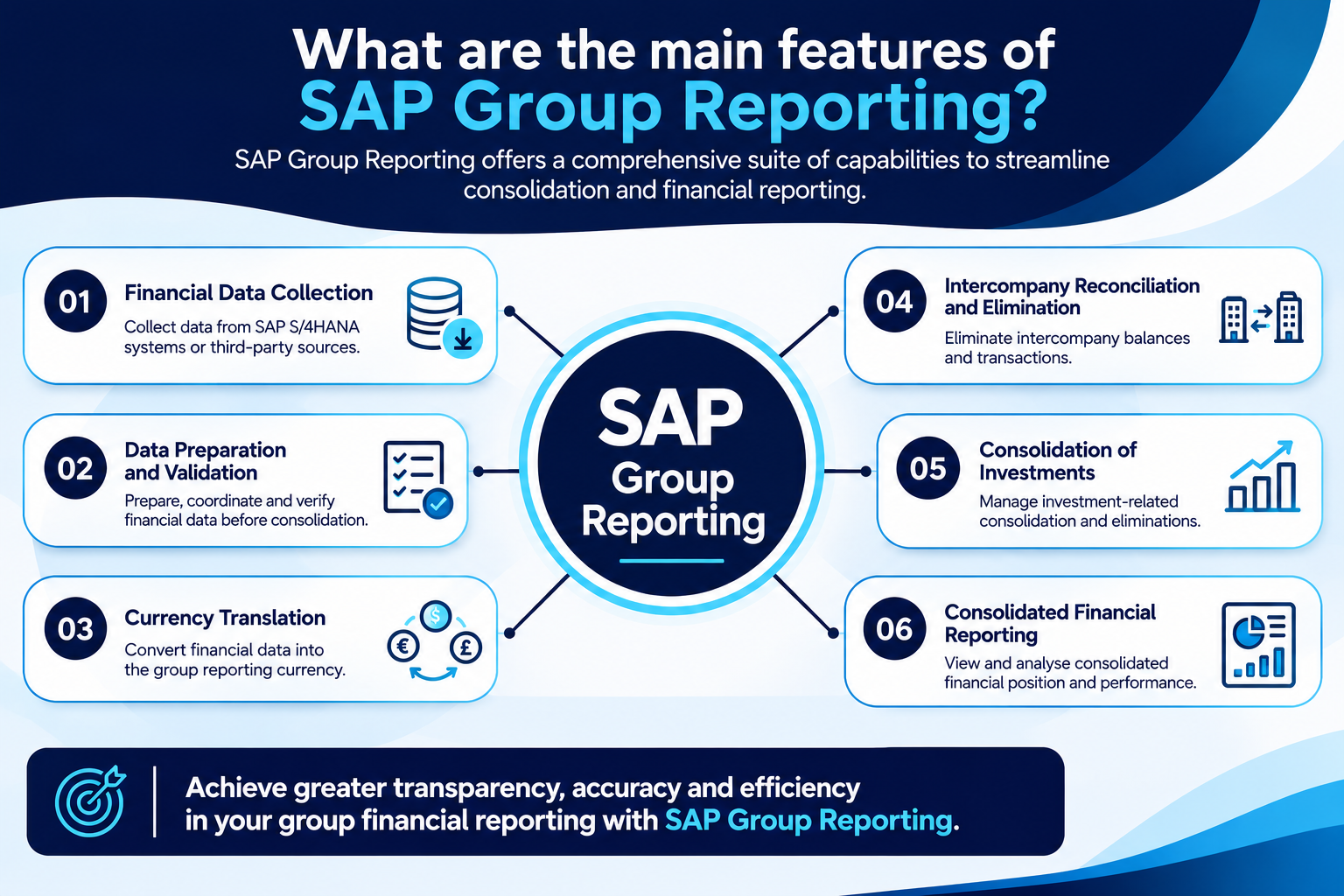
SAP Group Reporting offers the following capabilities.
When preparing the data, you might want to collect data from other third-party systems, such as SAP S/4HANA systems or third-party sources. Data Collection in SAP Group Reporting can be used to collect data from non-SAP S/4HANA systems.
Prior to taking it to consolidated statements, some financial data needs to be prepared and verified. This can include coordinating the reported data, making any adjustments and confirming it complies with the group's reporting standards.
In multinational organisations, they hold financial records in different local currencies, and so currency translation is used to convert the financial data into the group reporting currency.
Transactions such as the purchase and sale of goods or services, loans or other intercompany transactions can occur between companies in the same group. Any intercompany balances or transactions should be eliminated or offset where appropriate in the process of consolidating to prevent double counting.
Company code groupings with subsidiaries and ownership relations require investment-related accounting, for example, in consolidated financial statements. SAP Group Reporting has the investment-related consolidation business as well as the investment-related eliminations.
Once the consolidation is finalised, finance teams can view the consolidated financial data. Reports enable the user to analyse the group's financial position, performance and reporting results.
SAP Group Reporting process activities are used to get to a set of consolidated financial statements starting from a set of stand-alone entity records.
SAP Group Reporting and SAP FICO are related to financial management, but they serve different purposes.
SAP FICO traditionally refers to SAP Financial Accounting (FI) and Controlling (CO). These areas support financial accounting, cost management, internal reporting and other financial processes within an organisation.
SAP Group Reporting focuses on consolidating financial information from multiple entities to prepare group-level financial statements.
In simple terms, SAP FI and CO support financial and management accounting activities, while SAP Group Reporting helps bring financial results from different entities together for corporate consolidation.
SAP Group Reporting can be relevant for professionals involved in financial consolidation, corporate accounting, and group reporting activities.
It may be useful for:
A basic understanding of financial accounting, general ledger processes, and corporate closing activities can help learners understand the concepts more effectively.
SAP Group Reporting is an integral part of the SAP S/4HANA Finance environment. It links group financial consolidation to operational financial data and enables group reporting.
By combining it with SAP Analytics Cloud, organisations can leverage SAP Group Reporting to view an amalgamated set of financial data on a report or dashboard. SAP Group Reporting Data Collection enables organisations to collect financial data from sources other than SAP S/4HANA.
For finance experts studying SAP S/4HANA Finance, group reporting helps to give you valuable insight into how financial data leaves the books of a company and helps guide corporate decision-making.
Understanding SAP Group Reporting can help finance professionals build knowledge of financial consolidation, intercompany transactions, and corporate reporting. It also provides useful context for understanding how SAP S/4HANA Finance supports financial processes across large organisations.
Prompt Edify offers SAP training and learning support for professionals who want to develop their understanding of SAP Finance and related ERP processes. Get in touch to discuss your SAP training requirements and available learning options.
By Team Prompt Edify
Have any enquiry? Call us
+(27) 740294414
(+91) 99932-86938
wecare@promptedify.com

Prompt Edify Africa (PTY) Limited
2nd Floor, Rivonia VillageCnr Mutual Road and Rivonia Boulevard Rivonia Village, 2191
Johannesburg , South Africa
Contact : +27740294414
Prompt Edify East Africa Limited
KN 78 ST, Kagarama, Kigali, Kigali, Nyarugenge, Umujyi wa Kigali, Rwanda
Contact : +250 727 845 771
Prompt Edify Private Limited
4th Floor #15, City Vista Tower, Fountain Road,
Kharadi, Pune(MH), India.
PIN- 411014
Contact : (+91) 99932 86938



Contact Us Today!
+27740294414 | (+91) 99932 86938 | +250 727 845 771
contact@promptedify.com | wecare@promptedify.com
🌐 https://promptedify.co.za/