
Understand SAP IBP, its planning process, key capabilities and benefits, and how it connects demand, supply and inventory across the modern supply chain today.
SAP Integrated Business Planning (SAP IBP) is a cloud solution that provides an opportunity for businesses to plan, optimize and manage supply chain processes. SAP IBP unifies such planning areas as demand planning, supply planning, inventory planning and business planning in order to make better decisions.
Given the highly competitive business environment of today, businesses need to find a compromise between consumer demand, product availability, inventory and costs. Conducting each activity separately can lead to delays and excessive inventories.
And that is where SAP IBP steps in. It helps organizations cooperate, analyze information, forecast future needs and coordinate business processes.
In this blog post, we are going to explore the following topics: What is SAP IBP, its components, how the process of Integrated Business Planning takes place, and why SAP IBP should be implemented in supply chain management.
SAP IBP abbreviation means SAP Integrated Business Planning. This is an application for cloud-based supply chain planning created by SAP that allows companies to link strategic, tactical, and operational planning processes.
The main goal of SAP IBP is the unification of various planning processes within one system. In contrast to the separate planning of demand, supply, inventory, and finances, enterprises can coordinate all these processes working with the unified business plan.
Getting the definition of SAP IBP is quite easy – it means the unification of various business planning processes for meeting the demands of customers keeping operational effectiveness and expenses control at the optimal level.
Features that SAP IBP software provides are:
Integrated Business Planning Process is a strategic and systematic way of integrating various departments and activities in the process of making a business plan.
The integrated business planning process helps the organization to align the work of various departments such as sales department, operations department, finance department, procurement department, and supply chain in order to meet common business objectives.
Typically the process includes the following stages:
SAP IBP helps in conducting this process via the integrated planning environment.
The following are some key capabilities contained within the Integrated Business Planning framework which collectively contribute towards improved supply chain performance.
1. Demand Planning
Forecasting
Demand planning involves making an estimate of future customer demands. SAP IBP makes use of historic data, forecasting statistics and demand insights for better forecasts.
2. Supply Planning
Resource Management
Supply planning ensures adequate resource availability to fulfill the demands. It assists businesses to align production, procurement and capacity needs.
3. Inventory Optimization
Inventory Management
Inventory optimization helps in maintaining sufficient stock across the whole supply chain of the organization. This will help reduce inventory cost while still maintaining the required service levels.
4. Sales and Operations Planning (S&OP)
Business Integration
Sales and Operations Planning helps link together the sales, finance and operations plans of an organization. This makes it easier for the management to measure performance and scenarios.
5. Reaction and Supply Planning
Flexibility in Planning
It helps an organization respond to changes in supply and demand through planning during disruptions, capacity and customer demands.
SAP Supply Chain Planning is essential to ensure that the products will be available at the correct time and in the correct quantity and location.
SAP IBP integrates several planning domains of the supply chain into one solution and presents the comprehensive picture of the business processes.
Thus, for example, in case of increasing the customer demand, the demand planning group can adjust their forecast and, then, the supply planning group can assess how the increased demand will be covered, taking into account the production capabilities, material availability, and inventories.
Using SAP IBP, businesses can perform the following activities:
Also, SAP IBP provides the "what-if" simulation that allows assessing the results of changes in demand, supply, or capacities.
The reasons that lead to the usage of SAP IBP include accuracy of the plan of the company, visibility in the supply chain, and decision-making.
Some of the major benefits of using this business solution include the following:
1. Better Demand Forecasting: Enables better forecasting based on their historical data and trends.
2. Lower Costs of Inventory: Enabling them to optimize their inventory by keeping the optimum inventory level.
3. Better Collaboration: Aligning all the departments including sales, finance, procurement, and supply chain in the planning process.
4. Better Decision Making: Enables analytics as well as scenario planning for business decision making.
5. Improved Visibility into the Supply Chain: Allows organizations to monitor their planning process, spot any issues, and then respond to those issues appropriately.
Some examples where this type of technology is used include:
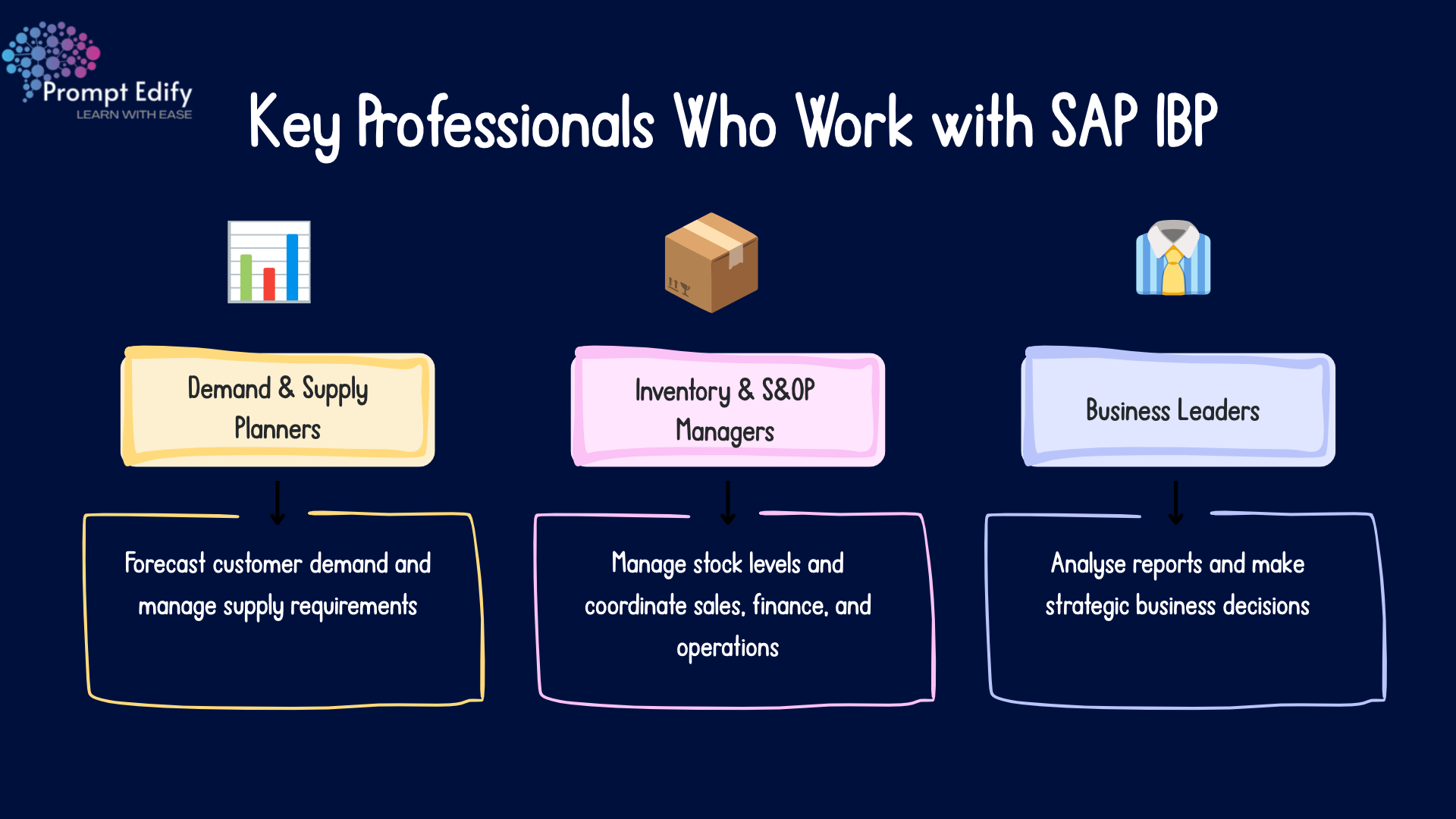
The software of SAP IBP is used by individuals who are associated with business planning, supply chain management and decision-making.
They are as follows:
All of them work in coordination using the SAP IBP software.
There’s a lot that SAP IBP can do for organisations that aim to enhance their supply chain planning processes as well as performance in the business context.
If you integrate SAP Integrated Business Planning into your business practices, you will improve your collaboration, control inventory, adapt to changing markets and make the right decision.
As supply chains get increasingly sophisticated, learning SAP IBP might be useful for those people who want to increase their expertise in supply chain management.
Would you like to get training in SAP IBP and start your career in supply chain planning? Get in touch with Prompt Edify!
By Team Prompt Edify
Have any enquiry? Call us
+(27) 740294414
(+91) 99932-86938
wecare@promptedify.com


Prompt Edify Africa (PTY) Limited
2nd Floor, Rivonia VillageCnr Mutual Road and Rivonia Boulevard Rivonia Village, 2191
Johannesburg , South Africa
Contact : +27740294414
Prompt Edify East Africa Limited
KN 78 ST, Kagarama, Kigali, Kigali, Nyarugenge, Umujyi wa Kigali, Rwanda
Contact : +250 727 845 771
Prompt Edify Private Limited
4th Floor #15, City Vista Tower, Fountain Road,
Kharadi, Pune(MH), India.
PIN- 411014
Contact : (+91) 99932 86938



Contact Us Today!
+27740294414 | (+91) 99932 86938 | +250 727 845 771
contact@promptedify.com | wecare@promptedify.com
🌐 https://promptedify.co.za/