
Understand how SAP Integrated Product Development connects product data, engineering teams and business processes to support efficient product development.

Product development does not only consist of its appearance design or choosing the material that will be used for manufacturing. Businesses have to coordinate the product requirements, engineering information, specifications, changes in design and communication within their teams. In case when all the above-mentioned elements are spread among different systems, it might cause problems such as delays, inconsistent information about the product and difficulties in coordination of development processes.
Here comes the importance of SAP IPD or SAP Integrated Product Development. It represents a cloud-based solution, through which businesses are able to integrate their product information, engineering processes and people involved in product development.
SAP Integrated Product Development is a cloud PLM software solution which allows companies to plan, organize, and control all the actions related to the product development. It is based on SAP Business Technology Platform (SAP BTP) which enables linking product data, engineering processes and people within a single digital ecosystem.
SAP IPD solution facilitates the product development life cycle from the identification of an initial idea and requirements formulation to the product structure building and the transfer of product information into production.
This solution can be used by discrete manufacturing as well as process industries. Employees will have access to product specifications, engineering structures, documents, and other valuable information with increased visibility.
This software allows replacing the fragmented approach to product development with a more integrated one.
The traditional process of product development includes the collaboration of several departments using various applications and information resources. Engineering departments may use one design software, while other departments such as purchasing, production, and quality may have other information.
The issues that may arise include:
Using the SAP Integrated Product Development will integrate all necessary information and participants in one system.
SAP Integrated Product Development features facilitate various activities associated with definition, development, delivery, and management of products.
Some key capabilities include:
Availability of particular capabilities is dependent on SAP licensing and solution configuration.
Another key aspect of SAP IPD is the capacity of integrating engineering data with the business process.
For instance, an engineering department that is working on the design of a new industrial machine can use an external CAD system to develop product designs. With the help of product data integration, the engineering data can be imported into SAP IPD.
From there, the department can integrate the data with product structures, specifications and documentation.
Procurement department will get information on components while manufacturing department will have the necessary product information. External suppliers can also engage in collaborative processes.
In this way, collaborative product development becomes possible as different parties will be able to participate in the development process through shared information and not disconnected communications.
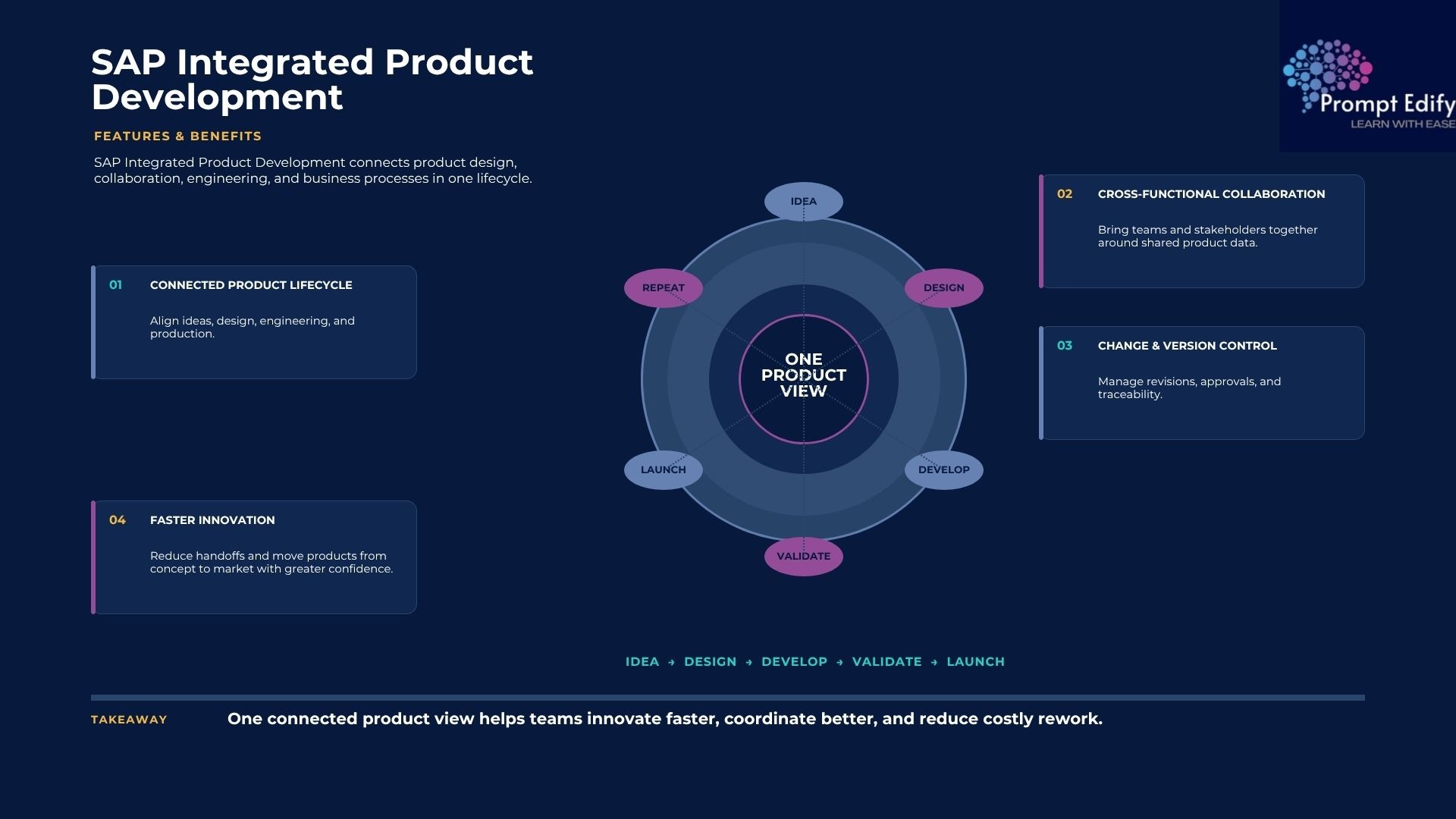
It is common practice for traditional product development process to rely on different applications and manual information exchange along with different departments' records. It might become a problem to ensure consistency throughout the product development process.
SAP IPD brings a new level of integration using cloud collaboration, centralised product information, and integration with enterprise applications.
For instance, instead of exchanging various versions of documents via emails, people can collaborate on workspaces where product information is reviewed. In addition, the integration of engineering data with enterprise product structure eliminates unnecessary manual input of data.
The goal is not only to change the particular engineering applications but to facilitate the exchange of product information.
The SAP IPD solutions can be utilized in various industries and product development environments.
Some of the typical applications are:
Some of the business advantages are quick product development, information consistency, collaboration, traceability of products and reduction in manual effort.
By integrating the development processes with enterprise process, the businesses will also gain an advantage in improvement in product information flow from engineering to manufacturing process.
SAP Integrated Product Development can be helpful to the following specialists who are working in such industries as product engineering and design, manufacturing and product lifecycle management.
Besides other specialists, SAP IPD will be beneficial for the following:
Using SAP IPD, specialists get acquainted with the basics of cloud-based product development and collaboration.
The SAP Integrated Product Development gives companies a connected platform to manage their product data and collaborate for product development activities. The features of SAP IPD offer the advantage of enhanced consistency of data, development processes and coordination between the internal and external parties involved in development.
With more organizations relying on cloud-based product development solutions, learning about SAP IPD may prove advantageous for individuals looking to learn about modern-day PLM systems.
Learn product development through Prompt Edify. Learn about SAP Integrated Product Development through SAP IPD Training to know about its features, product data management processes and collaborative development. Contact Prompt Edify to learn about SAP training.
By Team Prompt Edify
Have any enquiry? Call us
+(27) 740294414
(+91) 99932-86938
wecare@promptedify.com


Prompt Edify Africa (PTY) Limited
2nd Floor, Rivonia VillageCnr Mutual Road and Rivonia Boulevard Rivonia Village, 2191
Johannesburg , South Africa
Contact : +27740294414
Prompt Edify East Africa Limited
KN 78 ST, Kagarama, Kigali, Kigali, Nyarugenge, Umujyi wa Kigali, Rwanda
Contact : +250 727 845 771
Prompt Edify Private Limited
4th Floor #15, City Vista Tower, Fountain Road,
Kharadi, Pune(MH), India.
PIN- 411014
Contact : (+91) 99932 86938



Contact Us Today!
+27740294414 | (+91) 99932 86938 | +250 727 845 771
contact@promptedify.com | wecare@promptedify.com
🌐 https://promptedify.co.za/