
Understand SAP Manufacturing Integration, its key concepts, ERP connections, shop-floor data exchange, and how integrated systems improve production operations.
Various software systems are used by manufacturing companies for managing production, inventory, materials, quality, and business processes. In cases when these systems operate independently, there may be problems related to information exchange. This situation can result in delays, errors in information exchange, and poor communication between departments.
SAP Manufacturing Integration is a solution allowing to integrate business applications and manufacturing/shop floor systems. Information exchange between different systems becomes possible in this way.
What exactly is meant by manufacturing integration? What is its significance? How does SAP help in manufacturing integration? We will try to define some basic concepts of manufacturing integration in clear language.
SAP Manufacturing Integration is defined as the linking of SAP applications with manufacturing systems and machines and production applications.
This facilitates the ability for companies to communicate among their enterprise systems and the activities carried out on the shop floor. An instance of this may involve the creation of a production order from the SAP ERP application which is then communicated to the manufacturing execution system (MES).
After production, the production details like the production quantity and materials used are then communicated back to the enterprise system.
The manufacturing sector has multiple activities that occur simultaneously. Such activities include planning of production processes, handling materials, machinery operation, quality control, and inventory updating.
Where such activities are executed using different systems, there is a likelihood that employees will be required to enter data multiple times.
However, this challenge is minimized with manufacturing systems integration since applications can share information.
Among them are the following:
Thanks to interconnected systems, companies can better control their manufacturing operations.
ERP system integration integrates business processes with manufacturing processes. ERP systems store crucial business data such as production order, material, stock, and procurement.
Manufacturing processes make use of this business data to carry out manufacturing operations.
For instance, once an order is placed by a client, a plan is created in SAP ERP which can be further transferred to the shop-floor system. Manufacturing operations are carried out using this plan. Later, information regarding production is passed on to the ERP system.
The types of information shared include:
This assists in keeping the information in business and manufacturing integrated.
SAP S/4HANA is an ERP system which supports various business processes such as manufacturing.
It enables the management of production planning, inventory, procurement, finance and other business processes.
In a manufacturing environment, SAP S/4HANA can interface with production systems and shop floor systems to communicate key data.
For instance, production orders and materials can be transferred from SAP S/4HANA to manufacturing systems. The confirmations of production and consumption data can be communicated back.
Knowing how SAP S/4HANA is integrated is crucial for helping the learners understand how contemporary business systems enable connected manufacturing operations.
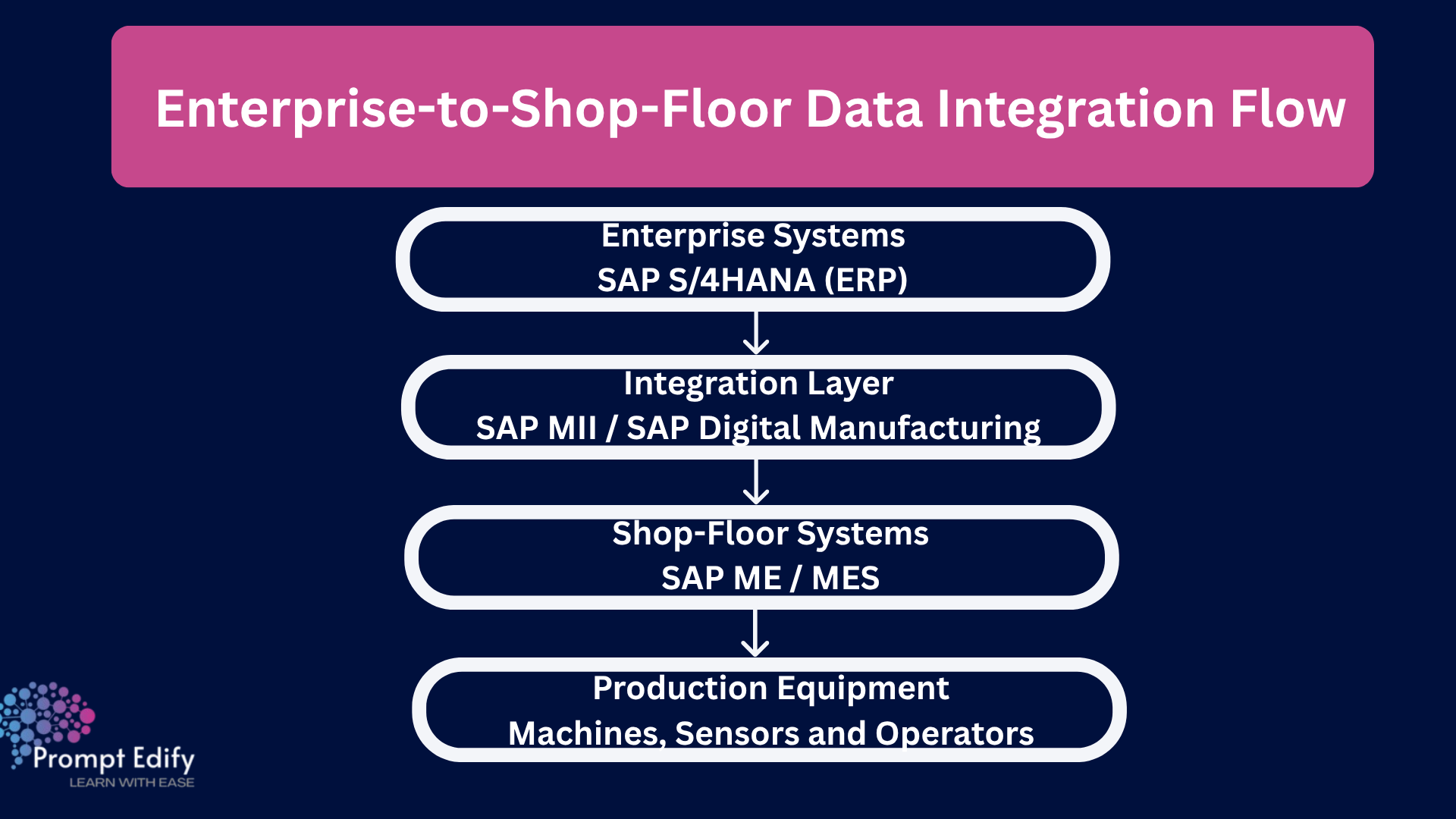
One of the key reasons why SAP Manufacturing Integration exists is to facilitate the exchange of information between enterprise and shop-floor systems.
The enterprise system takes care of business-level transactions, while the shop-floor system focuses on manufacturing processes.
Information is vital for both sides in order to be able to execute their manufacturing processes.
The data exchange process will include the following steps:
Step 1: Production Planning
Production planning is carried out in the enterprise system, where production plans, material requirements, and resource needs are managed.
Step 2: Data Transfer
Data that is needed for production is transferred to the manufacturing system.
Step 3: Production Execution
Manufacturing operations are executed using the provided data.
Step 4: Data Collection
Data on quantities of productions, machines, materials used, and quality is collected by the manufacturing system.
Step 5: Data Update
Data collected will be provided back to the enterprise system to update inventories, report productions, and track orders.
The process aids firms to develop an interaction between production activities and business operations.
Manufacturing data integration refers to the collection and sharing of information from multiple manufacturing systems in one integrated environment.
There is lots of information generated by manufacturing firms using machinery, production applications, sensors, and business software.
With information being integrated, it becomes easier for a team to know what happens in production activities.
Some examples of manufacturing data are:
Integration is a vital element in most of the stages of manufacturing.
Integration is done to link various departments and systems, hence facilitating the free flow of information across the business organization.
Areas in which integration has been used include:
As manufacturing companies implement digital technology solutions, their demand for interconnection increases. People having knowledge about SAP software and manufacturing can acquire valuable skills that will allow them to work in the digital environment of manufacturing.
SAP Manufacturing Integration Training courses will be helpful for getting to know the basics of ERP integration, manufacturing solutions, data exchange, and integration ideas.
While choosing a training course, pay attention to such areas as SAP ERP integration, SAP S/4HANA integration, MES connectivity, manufacturing data exchange, and examples of integration.
For beginners, it is advisable to start from basics of manufacturing and ERP.
Manufacturing Integration from SAP integrates applications in the enterprise to the production systems and provides an interface for the transmission of manufacturing information. Manufacturing Integration from SAP provides support for production planning, shop floor operations, inventory control, quality and reporting.
Through the integration of SAP ERP, SAP S/4HANA and manufacturing applications, information can be better shared and businesses can be better managed.
For someone who would like to understand how SAP is useful in creating connected manufacturing environments, understanding the basics of manufacturing integration can prove quite helpful.
Would you like to know more about Manufacturing Integration from SAP?
Get in touch with Prompt Edify to know more about SAP Manufacturing Integration Training.
By Team Prompt Edify
Have any enquiry? Call us
+(27) 740294414
(+91) 99932-86938
wecare@promptedify.com


Prompt Edify Africa (PTY) Limited
2nd Floor, Rivonia VillageCnr Mutual Road and Rivonia Boulevard Rivonia Village, 2191
Johannesburg , South Africa
Contact : +27740294414
Prompt Edify East Africa Limited
KN 78 ST, Kagarama, Kigali, Kigali, Nyarugenge, Umujyi wa Kigali, Rwanda
Contact : +250 727 845 771
Prompt Edify Private Limited
4th Floor #15, City Vista Tower, Fountain Road,
Kharadi, Pune(MH), India.
PIN- 411014
Contact : (+91) 99932 86938



Contact Us Today!
+27740294414 | (+91) 99932 86938 | +250 727 845 771
contact@promptedify.com | wecare@promptedify.com
🌐 https://promptedify.co.za/