
Explore SAP Omnichannel Commerce, its features, architecture, and benefits. Learn how SAP Commerce connects sales channels, customer experiences and business operations.

Consumers today want a seamless shopping experience across all types of digital and physical channels. They can first see a product on a mobile application, examine its features on a website later, run to a physical store to check if it's available, and make a purchase using another channel. Companies also require an integrated commerce environment, which makes it easier for them to connect with their target audience through the various channels.
This is how SAP Omnichannel Commerce comes into play. It allows organizations to link different sales channels, communication points, and business processes and eliminate inconsistencies for customers. With SAP Commerce technologies, businesses can handle product data, customer interactions, orders, etc.
Knowing the key features, architecture, and business advantages of SAP Omnichannel Commerce will help organizations build their connected e-commerce strategy.
SAP Omnichannel Commerce is a concept that links diverse retail and engagement methods into a unified shopping experience. Rather than treating websites, mobile applications, and brick-and-mortar stores as independent businesses, companies utilize this method of connecting to ensure their customers receive information and services in a consistent manner.
For example, one customer browses through a website and adds a product to their shopping cart, but later checks out through another channel. The experience is connected as the omnichannel commerce system shares relevant data about the product, customer, stock, and orders.
SAP Commerce Cloud empowers companies to implement omnichannel commerce by enabling product content management, catalogue management, pricing, promotions, shopping carts, checkouts, and order management functionalities.
SAP Omnichannel Commerce incorporates many functions that help meet the demands for smooth customer experiences and commerce processes.
It is crucial to keep product information consistent across various platforms. This is why SAP Commerce comprises functional modules ensuring adequate coordination of product catalogues. Such software allows a company to stay informed about product characteristics, names, images, types, and features.
This enables organizations to keep product information stable across all platforms.
In today’s online world, customers want the same information and services no matter the platform they are using. The integrated commercial environment negates the necessity for companies to worry about discrepancies in product information, prices, and promotions.
For instance, a person finding a particular product on a website must receive the same information when accessing its details through the app.
The capacity of the shopping cart and checkout functions guarantees a smoother purchasing process through online commerce channels. The commerce software from SAP provides an array of features to make cart management a reality, including adding products and promotions, removing them from the cart, and going through the checkout process.
Depending on the implementation and integration made within the business, customers become accustomed to a better purchasing experience.
Inventory and order data are important aspects of omnichannel operations. Customers want information on the site when products are available, while businesses want to have proper insight into their orders and fulfillment.
SAP Commerce allows integration with necessary software to receive insights into inventory and order management. The number of features available is determined by the specifics of the systems and integration options used in the implementation.
Customised experiences enable companies to deliver products, communications and offers that are relevant and appealing for consumers. SAP Commerce can provide functionalities like product suggestions, promotional opportunities and customised content.
These functionalities enable companies to build more relevant shopping experiences based on information about the customers, business rules and the available commerce information.
SAP Omnichannel Commerce architecture connects customer-oriented channels and commerce services with back-end enterprise systems. The goal of SAP Omnichannel Commerce architecture is to facilitate information flows between different applications and systems while permitting seamless commerce operations.
This layer contains the media via which a company communicates with its customers. These are as follows:
These media provide access to product details, shopping carts, customer accounts, and other important things necessary for purchasing a product.
Commerce platform is the one that is responsible for the key functions of commerce. SAP Commerce Cloud can help with the following activities:
As the core commerce layer, it connects several channels that customers face.
The connection layer allows for interaction among the business platform, client applications and backend systems.
APIs and connection services assist applications in exchanging data like product information, customer details, prices, stocks and orders. SAP Commerce Cloud also includes APIs applicable to the integration with outside applications and digital channels.
This layer consists of software solutions assisting in the process of business activity, including:
The combination of these systems lets companies connect commerce processes to stock levels, finances, execution of orders, and other activities.
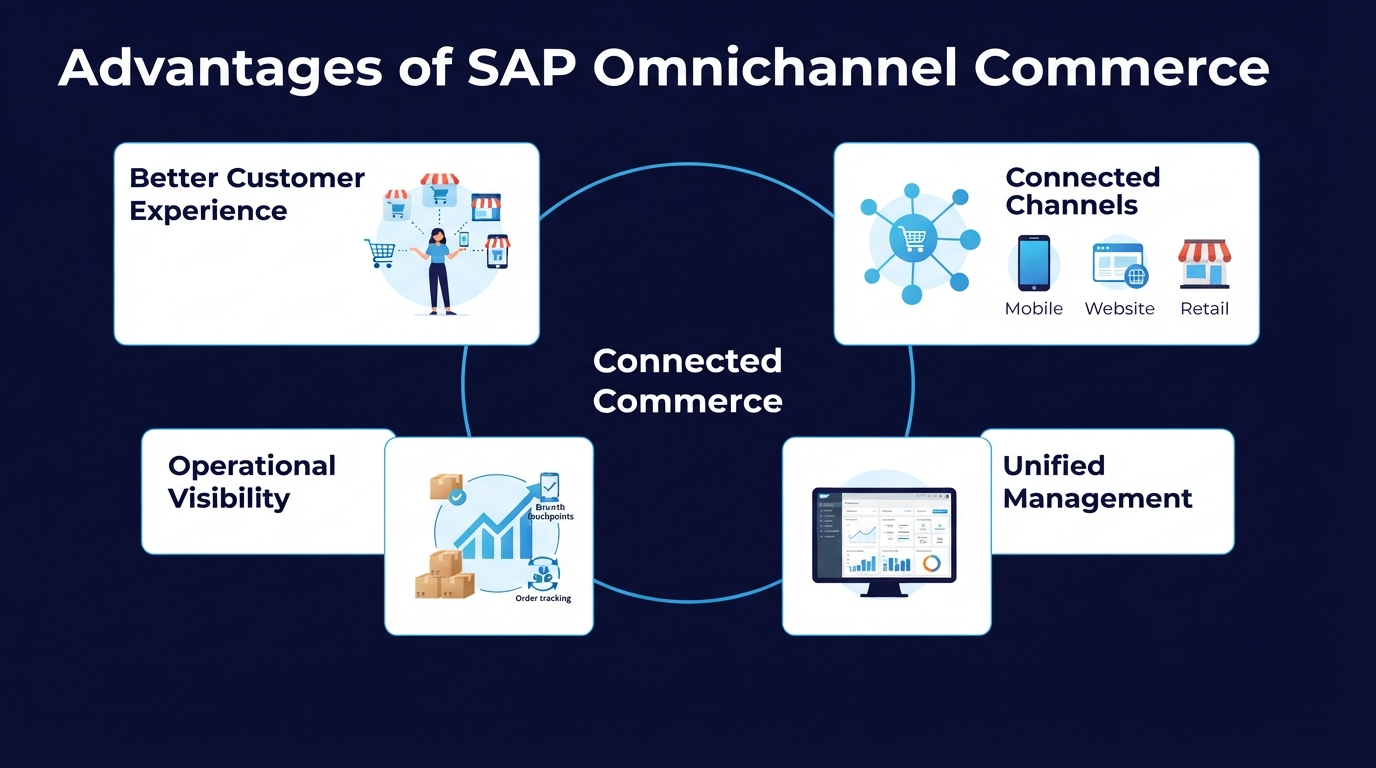
.
Adopting the omnichannel approach in commerce brings a range of advantages to businesses.
Customers are able to interact with companies through different channels, ensuring that they receive uniform information regarding the products and services they purchase.
By linking both online and offline channels, companies can minimize the gaps in information across different commerce operations and have better coordination between digital and retail processes.
A company can manage vital commerce data and processes through a single system.
Joining up inventory, order control plus enterprise systems can produce enhanced insight into commerce actions. This can lead to better-informed decisions regarding product availability, order handling and fulfillment.
Connected commerce architecture allows businesses to more easily implement additional digital interactions and alter their activities according to customer needs. The extent of the flexibility depends on the configuration of the platform.
SAP Commerce is a commerce platform that provides capabilities organisations can use to build and manage digital commerce experiences. SAP Omnichannel Commerce is the broader business approach of connecting customer touchpoints and commerce operations.
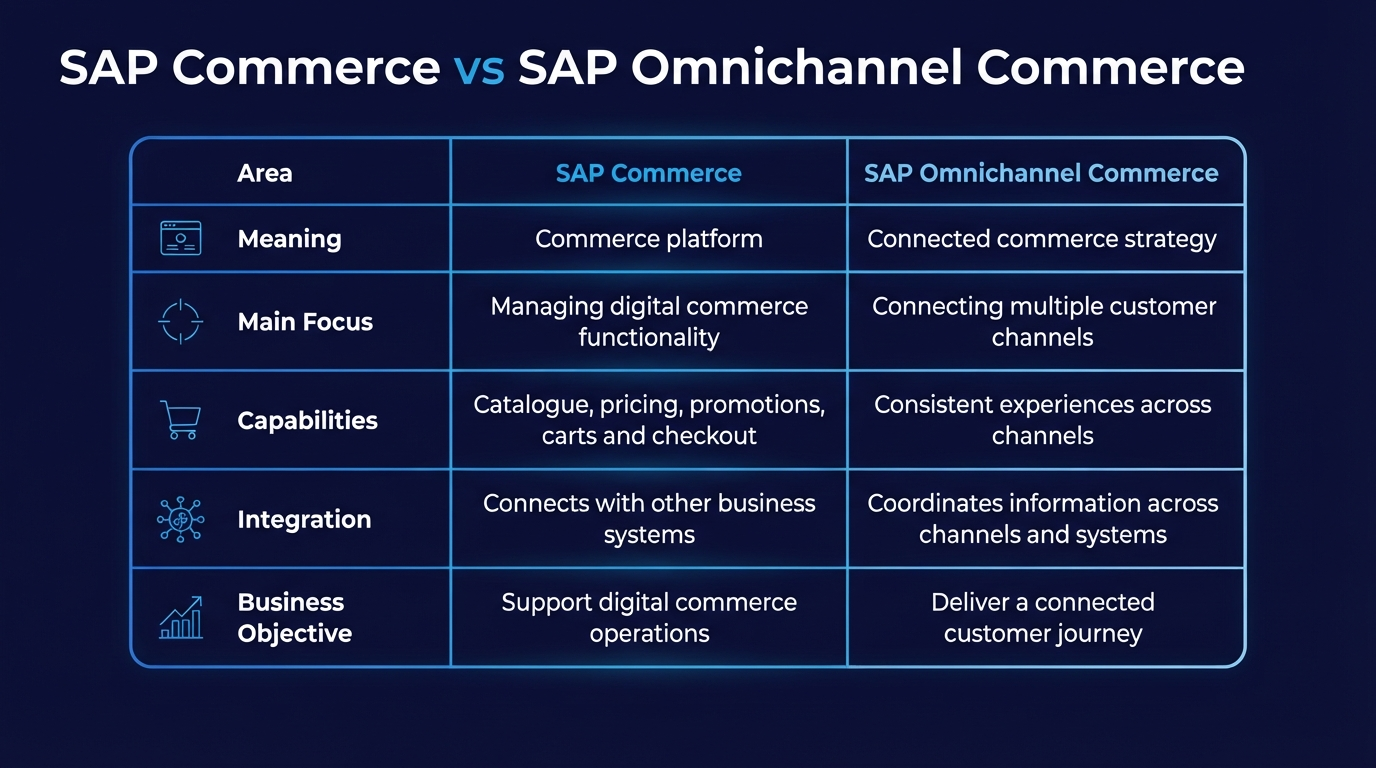
SAP Commerce can therefore serve as an important platform within an organisation's omnichannel commerce strategy.
SAP Omnichannel Commerce is essential for companies that engage in multiple channels of sales and connections with clients.
Common customers for such systems are:
The specific benefits depend on the commerce challenges and trade practices of the company.
SAP Omnichannel Commerce allows companies to make a transition from disconnected sales channels toward a more integrated approach to commerce. Connecting data such as product communication, customer activities, pricing, inventory, and purchasing helps businesses provide seamless services to their customers.
SAP Commerce has several important platform features that support this approach including catalog management, promotions, APIs, storefronts, and e-commerce operations. Understanding these functionalities and their architecture could be very helpful in realizing how integrated commerce works.
Those who want to go deeper in their knowledge of the platform will find studying SAP Commerce architecture, back office, OCC APIs, product catalog management and order management useful in landing a job in this industry.
By Team Prompt Edify
Have any enquiry? Call us
+(27) 740294414
(+91) 99932-86938
wecare@promptedify.com


Prompt Edify Africa (PTY) Limited
2nd Floor, Rivonia VillageCnr Mutual Road and Rivonia Boulevard Rivonia Village, 2191
Johannesburg , South Africa
Contact : +27740294414
Prompt Edify East Africa Limited
KN 78 ST, Kagarama, Kigali, Kigali, Nyarugenge, Umujyi wa Kigali, Rwanda
Contact : +250 727 845 771
Prompt Edify Private Limited
4th Floor #15, City Vista Tower, Fountain Road,
Kharadi, Pune(MH), India.
PIN- 411014
Contact : (+91) 99932 86938



Contact Us Today!
+27740294414 | (+91) 99932 86938 | +250 727 845 771
contact@promptedify.com | wecare@promptedify.com
🌐 https://promptedify.co.za/