
Discover SAP Omnichannel Commerce, its features, architecture, and benefits. Learn how SAP Commerce connects sales channels, customer touchpoints, and business operations.

The expectations of consumers today demand a continuous shopping experience across channels, including physical outlets, websites, mobile apps, and others. Customers can find a product in one channel like an app, compare its features in another, check its availability in a retail shop, and then make the purchase through another channel.
In order to be able to cater to these trends, businesses need an integrated commerce environment for everything to be conducted smoothly.
SAP Omnichannel Commerce is the answer to the question of how to provide this. It helps businesses connect their sales channels, customer touchpoints, and commerce operations and thus create a more seamless shopping experience.
With the help of SAP Commerce, companies are able to manage their product data, customer interactions, orders, and all other activities in commerce.
SAP Omnichannel Commerce is the methodology of connecting different customer touchpoints and shopping channels into an integrated commerce experience. Rather than treating the mobile apps, e-shops, and physical shops as standalone entities, businesses unify them for the provision of the same data and services.
Take, for example, an instance of a purchase. A customer purchases on a website, adds a product to the cart, and completes the transaction through another channel. The underlying systems share the necessary information about products, customers, inventories, and orders, which allows the business to connect everything into one cohesive experience.
SAP Commerce Cloud provides the tools for proper realization of the omnichannel methodology in retail by means of product content, catalog management, pricing, promotions, shopping cart, checkout, and overall order processing. These capabilities allow businesses to create better omnichannel e-commerce experiences for customers.
SAP Omnichannel Commerce has several features that are utilized to enable customers’ connected experience and commerce operations.
Product information must be dependable and consistent across platforms. It is the responsibility of SAP Commerce to help users carry out product catalogue management, giving companies the ability to effectively administer their products in terms of every detail, relevant imagery, categories and other features.
Product information is centrally managed, which allows companies to keep their product presentation consistent across mobile apps, websites, etc.
Customers have expectations of receiving the same information and services whether they are browsing a product online or via a mobile app.
For instance, if a product is found on the web, the customer has to have the same relevant information when visiting a website or talking to a salesman.
The shopping cart management system allows for managing the buying experience. SAP Commerce provides the tools necessary to create and manage shopping carts, add or remove products, apply promotions and complete checkout.
Depending on the business implementation and channel integration, the customer might be able to experience a more connected purchasing experience.
Inventory and Order availability information is fundamental in the omnichannel process. On the one hand, customers wish to know about product availability, and on the other hand, the business wants to have visibility of order and fulfilment processes.
SAP Commerce can interface with inventory and order management systems and other enterprise systems to obtain product availability information and connected order processes. The exact functionality varies depending on the systems in use and connections made in implementation.
Offering personalized experiences is a way for businesses to provide their customers with relevant content, products, and offers. SAP Commerce provides commerce functionalities such as promotions, personalized content, and product recommendations.
Such functions allow organizations to improve the shopping experience of buyers depending on customer information, commerce data, and business rules.
The architecture of SAP Omnichannel Commerce is designed to integrate different commerce-enabling systems, including customer touchpoints with business transactions in relation to the back-office core systems of the organization. The purpose of the architecture is to provide connectivity between different applications and systems for the purpose of enabling consistent commerce execution.
A typical architecture contains various layers, among which are the following:
This is the layer consisting of channels of communication through which the customers can connect with the business, for example:
The commerce platform is responsible for key commerce functionalities. SAP Commerce Cloud is capable of performing tasks like managing product catalogs, setting pricing strategies, carrying out promotional campaigns, overseeing the shopping cart and managing customer-oriented commerce activities.
This platform performs the role of a central commerce platform that works with many customer-oriented channels.
The integration layer provides communication between the commerce platform, customer-facing applications, and other backend systems.
In addition, by using APIs and integration services, it is possible for the applications to transfer data, such as product information, customer data, pricing data, inventory data and order information. SAP Commerce Cloud also offers its own APIs that can be used for integration with third-party applications and digital channels.
.
The enterprise applications included in this layer cover business operation activities, including:
The integration of these systems is significant for companies as this will allow them to link their commerce operations to inventory and finance systems as well as other processes essential for their operation.
The application of an omnichannel commerce model can yield numerous operational and customer experience advantages.
Customers get the chance to communicate with businesses via different channels and get uniform product and service information. It accelerates the shopping experience.
Bringing together online and offline channels allows companies to eliminate the information gaps existing between their commerce operations.
Businesses can manage their important commerce information and processes through the use of an integrated system. Centralised product catalogues, pricing and promotions can help with maintaining the consistency among the channels that need to be supported.
Integration with inventory, order management, and enterprise systems can improve the visibility of commerce processes. This will enable making better decisions regarding product availability, order processing and fulfilment.
With the help of connected commerce systems it is easier for businesses to add new digital touchpoints and to adapt their commerce activities in accordance with the changes that appear in expectations of consumers. The degree of flexibility depends on the type of configuration and approach to integration of the chosen platform.
SAP Commerce is a commerce platform that provides capabilities organisations can use to build and manage digital commerce experiences. SAP Omnichannel Commerce is the broader business approach of connecting customer touchpoints and commerce operations.
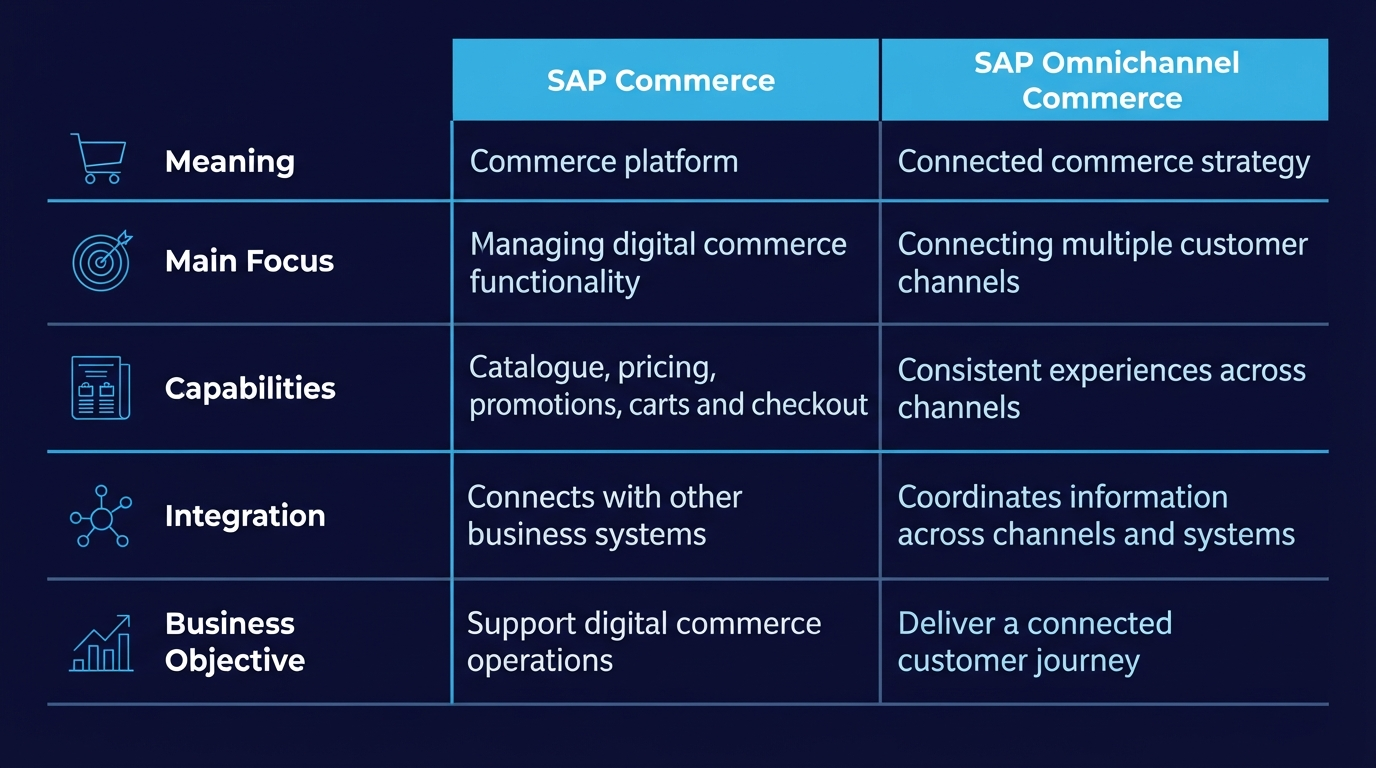
SAP Commerce can therefore serve as an important platform within an organisation's omnichannel commerce strategy.
SAP Omnichannel Commerce is helpful for a wide variety of companies and businesses that work in sales and customer engagement across many channels.
The benefits vary depending on a company’s commerce activities and requirements, existing technical solutions, and implementation.
SAP Omnichannel Commerce assists firms in transitioning from a separate sales system to a unified commerce system. Through the integration of information about goods and services, customer relationships, prices, stock, and procurement, companies can ensure uniformity in their business tasks and everyday activities.
SAP Commerce endows its users with essential elements of the platform needed for such integration, including catalogue management, promotion tools, application programming interfaces, and Backoffice. Grasping these functions and their functionality will allow sales people and IT specialists to learn more about how integrated commerce solutions can be useful for fulfilling business expectations.
If someone wishes to grasp the platform better, information about SAP Commerce architecture, Backoffice, OCC APIs, product catalogue management, and ordering will be useful.
By Team Prompt Edify
Have any enquiry? Call us
+(27) 740294414
(+91) 99932-86938
wecare@promptedify.com


Prompt Edify Africa (PTY) Limited
2nd Floor, Rivonia VillageCnr Mutual Road and Rivonia Boulevard Rivonia Village, 2191
Johannesburg , South Africa
Contact : +27740294414
Prompt Edify East Africa Limited
KN 78 ST, Kagarama, Kigali, Kigali, Nyarugenge, Umujyi wa Kigali, Rwanda
Contact : +250 727 845 771
Prompt Edify Private Limited
4th Floor #15, City Vista Tower, Fountain Road,
Kharadi, Pune(MH), India.
PIN- 411014
Contact : (+91) 99932 86938



Contact Us Today!
+27740294414 | (+91) 99932 86938 | +250 727 845 771
contact@promptedify.com | wecare@promptedify.com
🌐 https://promptedify.co.za/