
Learn what SAP PLM is, how it supports product development, manages engineering data and improves collaboration across manufacturing and other industries.
Products are involved in numerous stages before they get to the consumers. These stages include the idea for the product, design, manufacture, maintenance, and even until they are retired. The information and process have to be well managed by the organizations in every stage. Where the information regarding the product is scattered across different departments, it could lead to issues on communication, cost, and even quality.
Here enters the idea of SAP Product Lifecycle Management (PLM). This entails a systematic approach in managing the product in its life cycle.
Product lifecycle management (PLM) is an approach to managing a product starting from its conception to retirement. This involves the integration of product information, process, people and technology to make sure that all people involved have the correct information.
For instance, in a manufacturing firm where there is creation of a new machine, the design department comes up with the product information while engineers provide technical details and finally approved information is used in manufacturing. Product Lifecycle Management software helps in doing this.
SAP PLM (or SAP Product Lifecycle Management) is a suite of SAP functionalities and solutions that facilitate organisations in managing the information and processes related to products.
These include product development, engineering, design collaboration, document management and product data management. Using SAP PLM, organizations are able to integrate product information with other business processes to achieve consistency among engineering, procurement, manufacturing, and other business processes.
For example, by making changes to a product component, the updated information can be made available to others as well. This would ensure that outdated information is not used for manufacturing products.
The use of SAP PLM would be very helpful for organizations that manufacture complex products
.
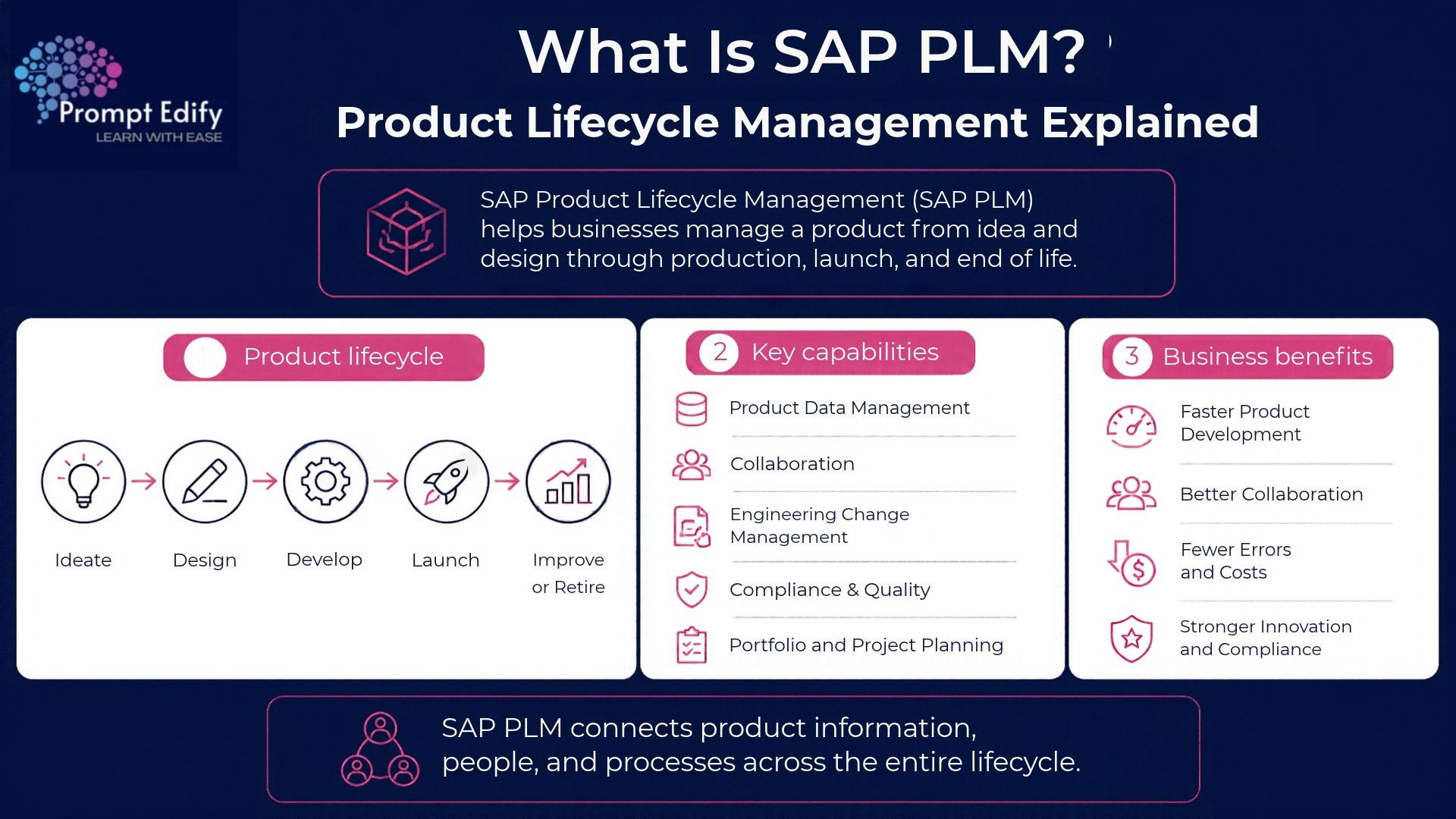
There are several different stages in the lifecycle of a product. PLM enables the company to manage information and make decisions at various stages.
All products begin with the conceptualization stage. Here, the companies decide what the customer needs are, market opportunity, objectives of the product and its technical feasibility. PLM enables the company to manage the information and ideas before development.
After approval of the concept, design teams develop the design, specifications, drawings and technical data of the product. PLM manages the design information and ensures that all the concerned teams have access to the same.
During development of the product, engineers review the designs and materials and make changes wherever necessary.
After development, the product enters the phase of manufacturing. The product data that has been approved will assist in the planning of manufacturing and communication between engineers and manufacturing personnel.
The final stage after products are delivered to consumers is to provide services such as repairs, replacements, support, and maintenance. Information about the lifecycle of the product will help the service team know the configuration of the product and associated documentation.
Finally, products will be retired when they have outlived their usefulness. Businesses may need to handle replacement parts, discontinuation, and documentation related to the history of the product.
Information about products that is to be managed by different departments within an organization can become complex, especially if each department uses different applications.
SAP PLM is one solution that solves the problem with connected product information and collaboration. Some of the main support provided includes:
PLM software stands for Product Lifecycle Management software, which is an umbrella term for different types of software that help in managing the lifecycle of products from development till their end of life.
SAP PLM is nothing but SAP's solution for product lifecycle management. The strength of SAP PLM lies in its capability of linking product processes with the overall business process, based on the solutions selected and integration.
In simple terms, PLM software is just an umbrella term for software category, while SAP PLM is SAP's product lifecycle management solution.
There are different industries where companies can use SAP PLM software, including the manufacturing industry, automotive industry, engineering, consumer goods, and industrial machinery among others.
Other benefits include:
1. What is SAP PLM used for?
SAP PLM is used to manage product information, engineering, documentation and collaboration processes throughout the product lifecycle.
2. Does SAP PLM serve manufacturing companies only?
No, although manufacturing is an area where PLM has been applied extensively, PLM could also serve well engineering, automotive, consumer goods and any other industry which deals with products.
3. What is the distinction between PLM and ERP?
While PLM manages processes related to product development and its lifecycle, ERP manages broader areas like financial, procurement, inventory management and production process management.
4. Why is SAP PLM so important?
It helps businesses connect product data, improve collaboration, manage engineering changes and maintain better control over product-related processes.
Acquiring knowledge on SAP PLM may prove useful to people involved in product development, engineering and business operations in an enterprise setting. Gaining an understanding of the integration of data and processes in the product development process can contribute to establishing expertise in the field.
Prompt Edify offers professional SAP training programs to facilitate the acquisition of practical skills in SAP systems by the trainees and professionals. Gain insight into SAP PLM training.
By Team Prompt Edify
Have any enquiry? Call us
+(27) 740294414
(+91) 99932-86938
wecare@promptedify.com


Prompt Edify Africa (PTY) Limited
2nd Floor, Rivonia VillageCnr Mutual Road and Rivonia Boulevard Rivonia Village, 2191
Johannesburg , South Africa
Contact : +27740294414
Prompt Edify East Africa Limited
KN 78 ST, Kagarama, Kigali, Kigali, Nyarugenge, Umujyi wa Kigali, Rwanda
Contact : +250 727 845 771
Prompt Edify Private Limited
4th Floor #15, City Vista Tower, Fountain Road,
Kharadi, Pune(MH), India.
PIN- 411014
Contact : (+91) 99932 86938



Contact Us Today!
+27740294414 | (+91) 99932 86938 | +250 727 845 771
contact@promptedify.com | wecare@promptedify.com
🌐 https://promptedify.co.za/