
Understand SAP Production Engineering, its key processes, master data, BOMs, routings, and work centers, and how it improves manufacturing planning and efficiency.
Engineering information in manufacturing organizations needs to be very precise to make sure that the products are manufactured based on certain standards and design specifications. Effective management of the product structures, manufacturing activities, and manufacturing resources is required to get the desired results. The SAP Production Engineering solution is used by organizations to manage this information in the SAP environment.
The understanding of its process, master data, and benefits will help organizations develop a better manufacturing environment.
Definition of SAP Production Engineering
The definition of SAP production engineering can be described as the administration of technical information and manufacturing processes involved in creating a particular material. This concept emphasizes the process of how a product can be manufactured and ensures that engineering information is available for the process.
Definition of SAP Production Engineering within Manufacturing Environment
The description of SAP production engineering in a manufacturing environment is the administration of product structures, components, manufacturing process, work centers, and methods of production.
This function works hand-in-hand with SAP production planning (PP) among others in manufacturing.
Main responsibilities:
Master data is the basis for all of SAP production engineering. Accurate engineering data provides the correct definition of manufacturing operations which can be utilized by planning and execution processes.
Main components of SAP manufacturing master data are the following.
Bill of Material is a collection of items forming an incomplete or complete product with its quantity.
For instance, when manufacturing a mechanical assembly, one will need metal pieces, fasteners, electrical components, and sub-assemblies.
All this information will be provided in the bill of material ensuring the manufacturer knows all the components that make up the product.
BOM information in SAP will be used in material requirement planning, creation of orders, and components consumption in the manufacturing process.
Routings are documents that outline the process or steps of activity involved in manufacturing the product.
The routing typically includes:
The routings help production planners determine the time of each process, schedule the manufacturing process, and determine the required resource for manufacturing.
Work centers include machinery, assembly lines, labor forces, or other resources used in manufacturing.
Work centers include critical information like capacity, scheduling formula, cost data, and standard time of operations.
As an illustration, a manufacturing plant could set up different work centers for cutting, welding, assembly, and inspection.
Work centers assist companies to plan for production capacity and resource allocation.
The production version specifies the valid manufacturing process for the creation of materials by associating a particular BOM with a routing.
The production version is dependent upon the manufacturing process, production line, or validity period and can have several production versions for a single material.
Production versions assist SAP in determining the product structure and routing that needs to be selected in production planning and order generation.
The concept of production versions becomes important in SAP S/4HANA Manufacturing.
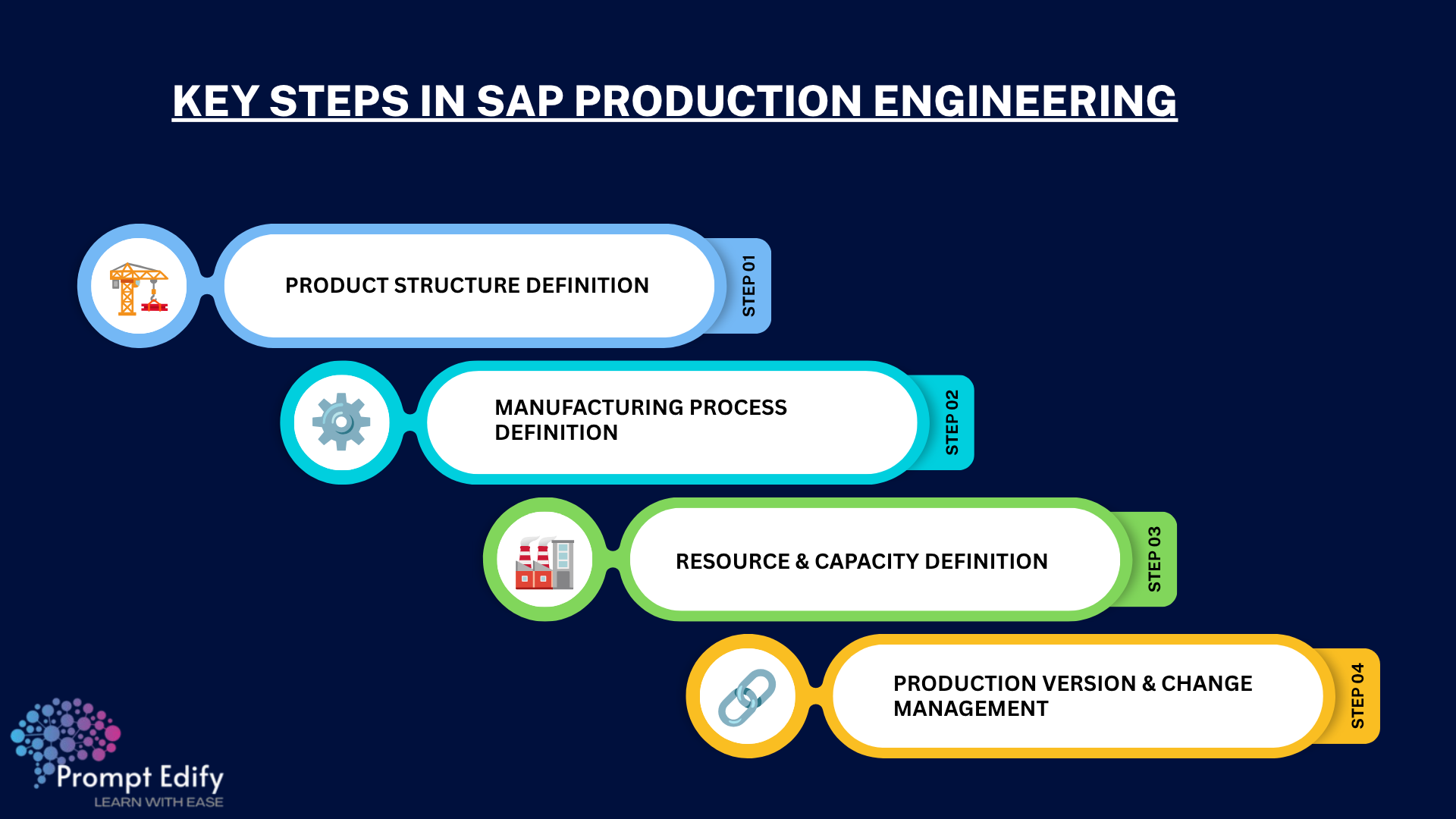
There are some related production engineering processes that convert engineering demands to manufacturing information.
Product structure definition is the first process where the structure of the product is defined using engineering specifications and BOMs. This shows the material, components, and quantity needed to produce the product.
Engineers define the manufacturing process using routings. This determines the operations, resources, and processing time to manufacture the product.
Work Centers are created to show the manufacturing resources. Their capacity and scheduling information help in the determination of the availability of the resources.
Production versions link the appropriate BOM and routing together to form an approved manufacturing process. This will ensure that the production planning is based on the right engineering data.
There may be changes in the manufacturing requirements due to improvements, redesign, or replacement of some components. The use of engineering change management will help organizations to manage these changes.
Both production engineering processes work together to ensure that manufacturing information is accurate, consistent, and available for production operations.
Manufacturing engineering is the technical basis of production planning and execution.
Production engineering refers to the way of manufacture, whereas production planning is about what to produce, when to produce, and what is needed for production.
For instance, the engineers design a bill of materials containing the necessary components and routing consisting of the manufacturing operations. The system utilizes such information in MRP calculations, planning of orders, and creation of production orders within SAP Production Planning.
When converting the planned orders to production orders, the pertinent engineering information assists in establishing the required components, manufacturing operations, and work centers.
Such an integration ensures that the production staff utilizes consistent technical and operational data.
The following are the advantages associated with the implementation of SAP Production Engineering:
SAP Production Engineering is quite vital in linking product design with manufacturing processes through management of BOMs, routings, work centers, production versions, and engineering changes to ensure that there is creation of precise manufacturing master data and consistent production process.
With SAP S/4HANA Manufacturing, linking of engineering data with manufacturing processes improves the visibility, usage of resources, and efficiency in manufacturing processes.
Wish to enhance manufacturing engineering processes in SAP solutions? Reach out to Prompt Edify for more information on how we can assist you with your manufacturing needs.
By Team Prompt Edify
Have any enquiry? Call us
+(27) 740294414
(+91) 99932-86938
wecare@promptedify.com


Prompt Edify Africa (PTY) Limited
2nd Floor, Rivonia VillageCnr Mutual Road and Rivonia Boulevard Rivonia Village, 2191
Johannesburg , South Africa
Contact : +27740294414
Prompt Edify East Africa Limited
KN 78 ST, Kagarama, Kigali, Kigali, Nyarugenge, Umujyi wa Kigali, Rwanda
Contact : +250 727 845 771
Prompt Edify Private Limited
4th Floor #15, City Vista Tower, Fountain Road,
Kharadi, Pune(MH), India.
PIN- 411014
Contact : (+91) 99932 86938



Contact Us Today!
+27740294414 | (+91) 99932 86938 | +250 727 845 771
contact@promptedify.com | wecare@promptedify.com
🌐 https://promptedify.co.za/