
Learn what SAP Project System (PS) is and explore its features, WBS, networks, project scheduling, cost tracking, business uses and SAP EPPM differences.

Complex projects need to be planned, managed, monitored and controlled in order to be successful. Businesses dealing with construction, manufacturing, engineering and infrastructure industries usually deal with projects that involve several activities, deadlines and budgeting. If such projects are managed using non-integrated systems, it will become hard to control them. That is why SAP Project System (PS) comes in handy.
If you are curious to find out what SAP Project System is, then it is worth mentioning that this is an SAP module that helps organisations to plan, execute, control and monitor projects in an integrated business environment.
SAP Project System is a project management component of the SAP ERP system that helps manage the entire process of a project, from the planning stage to settlement.
The SAP PS component is most helpful for companies involved in managing projects that require high investments and complex processes.
A company engaged in setting up a new production facility is an example where SAP PS would be useful in breaking the project down into smaller activities and budgeting the expenses.
Knowing the main SAP PS module features will provide you with a better understanding of the way in which this module assists in managing projects.
Work Breakdown Structure involves breaking down a large project into smaller, more manageable parts. Each component stands for a separate component of the project, thereby making responsibility allocation, monitoring progress and cost easy.
Thus, in case of a construction project, Work Breakdown Structure includes land preparation, foundation, structure building and finishing processes.
Networks are used by the SAP PS module for organizing activities within the project and determining the relationships between them. Activities stand for particular tasks whereas relationships show the order of these tasks.
This allows for scheduling activities, defining their dependencies and seeing the consequences of possible delays in the project.
Project scheduling makes it possible for organizations to decide on start dates, end dates, milestones and durations of activities. This helps the organization coordinate the different teams much better and make sure that the work is progressing according to the plans.
Cost planning and control is also an important component in SAP Project System. Organizations can plan their cost of projects, budgets, record actual costs incurred and compare the actual costs with the budgeted costs.
This will help to know any discrepancies in the budgets and take appropriate actions.
There could be need for manpower, equipment, material and even outsourcing of certain services in a project. SAP PS works with the appropriate SAP solutions and helps in planning and controlling all these requirements.
This module gives information about the projects and helps in evaluating the progress, cost, schedule and performance of the projects.
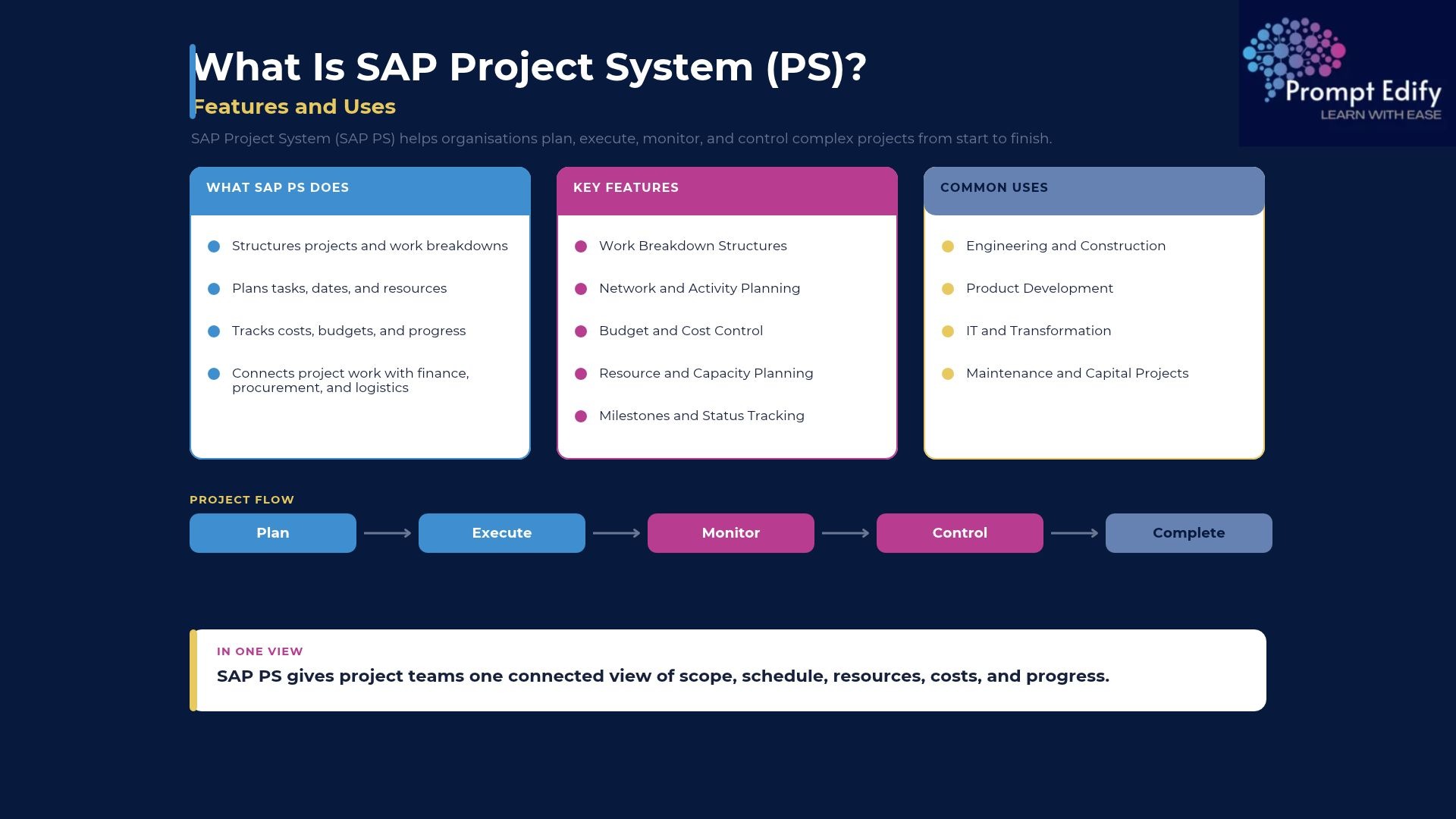
SAP project management is based on a systematic approach to project activities. Despite the fact that the procedure can vary depending on the specific business needs, it includes the following steps:
The SAP Project System is applied in different industries that demand a high level of planning, coordination, and financial management.
The typical examples of such uses include:
SAP PS and EPPM are software solutions designed for managing projects. However, the focus of both differs.
SAP PS software deals with the management of project processes and financials. It is designed to facilitate project hierarchies, activity planning, cost control, and management.
EPPM software, on the contrary, possesses a set of features for the management of portfolios and investments into projects. It ensures that the investments into the projects align with the business strategy objectives.
Thus, the difference is that while SAP PS software facilitates the management of project processes, EPPM software allows for portfolio management.
SAP PS learning will aid professionals in gaining knowledge on how the projects in enterprises are organized, planned and controlled from a financial perspective. This course will be especially beneficial for project coordinators, project managers, SAP functional consultants, finance professionals and people working in engineering/manufacturing industries.
An SAP PS training curriculum should involve WBS planning, network planning, activity planning, project budgeting, cost monitoring, reporting and integration with other SAP modules.
Exercises on the system could add value in giving insights into project management in practical situations.
It is helpful to have an insight into SAP Project System if one wants to gain experience in the area of project planning and management in enterprises. It helps to have an insight into the capabilities of the software module as well as its applications in businesses.
Industry-oriented SAP training by Prompt Edify will be a great way to gain relevant functional knowledge.
Contact Prompt Edify now and get acquainted with our SAP training programs.
By Team Prompt Edify
Have any enquiry? Call us
+(27) 740294414
(+91) 99932-86938
wecare@promptedify.com


Prompt Edify Africa (PTY) Limited
2nd Floor, Rivonia VillageCnr Mutual Road and Rivonia Boulevard Rivonia Village, 2191
Johannesburg , South Africa
Contact : +27740294414
Prompt Edify East Africa Limited
KN 78 ST, Kagarama, Kigali, Kigali, Nyarugenge, Umujyi wa Kigali, Rwanda
Contact : +250 727 845 771
Prompt Edify Private Limited
4th Floor #15, City Vista Tower, Fountain Road,
Kharadi, Pune(MH), India.
PIN- 411014
Contact : (+91) 99932 86938



Contact Us Today!
+27740294414 | (+91) 99932 86938 | +250 727 845 771
contact@promptedify.com | wecare@promptedify.com
🌐 https://promptedify.co.za/